Continuing the story of Lydia and Me https://amzn.eu/d/99yW3Qk
Today I’ve had a walk/yoga/Qigong combo: great for physical and mental health.
The Policy paper, Major conditions strategy: case for change and our strategic framework Updated 21 August 2023 (www.gov.uk), includes reference to Musculo Skeletal (MSK) Health:
What the data tells us and our existing commitments
Poor MSK health is the leading contributor to the global burden of disease, with 20 million people in the UK living with an MSK condition (see the State of musculoskeletal health). In addition, one in 8 report living with at least 2 long-term conditions, one of which is MSK related. MSK conditions are one of the leading causes of years lived with disability in the UK today, accounting for 21% of YLDs, with low back pain the top cause (see the State of musculoskeletal health). They are also one of the main reasons given for ill health inactivity, with 21% of those economically inactive reporting MSK conditions.
MSK conditions affect people across the life course and cover a range of conditions, including conditions of MSK pain such as osteoarthritis, back pain and fibromyalgia, osteoporosis and inflammatory conditions such as rheumatoid arthritis and spondyloarthritis.[footnote 48]
Prevention, early detection and treatment can enable people to live in good health, remain independent and connected to the community, reduce the pressure on health and social care services and support people with MSK conditions to thrive in work.
Reducing the risks
There are multiple risk factors that can heighten people’s susceptibility to MSK conditions. These include living in an area of high deprivation, older age, being a woman, having a mental health condition, and genetic predisposition.[footnote 49]
There are also many modifiable risk factors that include physical inactivity, living with overweight or obesity, diets deficient in vitamin D or calcium, and smoking.[footnote 48] For a high number of MSK conditions, secondary prevention will also be effective.
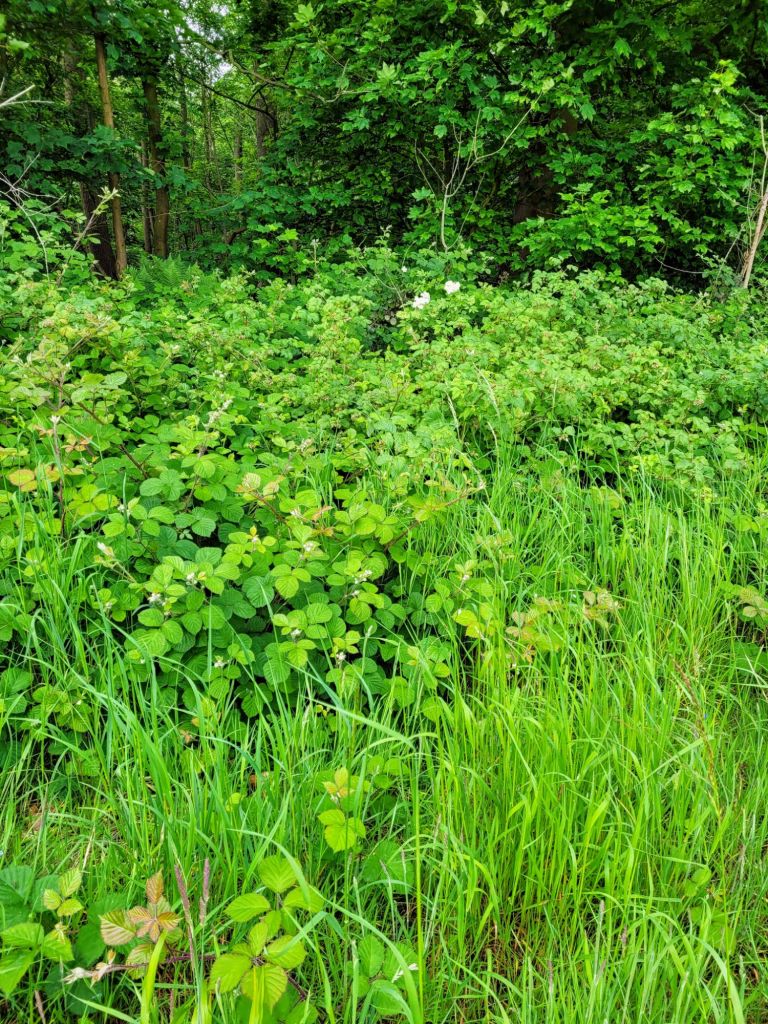
Everything around us – and underfoot – is green
I’m doing my bit in reducing the risk to myself, with my commitment to physical activity of various kinds.
The crops in the field, either side of the narrow path that leads to the woodland walk for Lydia and me, are continuing to grow. They are now up to waist height on me. That doesn’t mean they are particularly tall, because I’m not, but they are doing well and hopefully will flourish.
Lydia is a bit ‘tuggie’ this morning, so I do a few about turns. There is a moist warmth arising from the path. Everything around us – and underfoot – is green.
We’re out for over an hour, at a steady pace. I enjoy my walk in the wood. With the amount of sniffing she does, I feel confident that Lydia does too.
Returning home, we both have our breakfasts and then I rest for a while before going out to my yoga class. The class on this day lasts for one-and-a-half hours, and I feel like I’ve had a good workout by the end of it, building up muscle strength and developing flexibility.
After yoga I drive straight on to Qigong, a journey of about 20 minutes. I arrive early and sit outside on a wall for a while. It’s warm, not hot, and there is a gentle breeze.
I speak with the Qigong teacher, Sue, and we reflect on why – with all its health benefits – Qigong is still not that well known and more widely practiced. We don’t really have any answers, but I am just very glad that I do go to classes and I do get the benefits.
The current group of three Qigong lessons – of which this is the second – is concentrating on ankles and shoulder blades. We are slowly building up to a lovely movement known as ‘Cloud Hands’.
By the end of the class I feel ‘lighter’ in head and body. A lot of tension has gone. Not all of it, by any means, but a lot. I am hopeful of a good sleep tonight.

 Glad About