The predicted weather was cold, with possible snow and hail. Even so, we set off, determined to make the most of the chance to meet up outside and walk with others, following the ‘Rule of Six’.
Although it did turn out to be cold, there was no sign of snow or hail. We walked through glorious countryside in bright sunshine and completed an 8-mile circuit. Not bad considering the effects of ‘lockdown winter’ with gyms closed and the impetus to exercise at home starting to dwindle. We needed those hills, that fresh air, that blast to the senses.
With 38 years between the youngest of the group, at 27, and me, at 65, our walking speeds were variable. Our younger friends waited patiently at regular intervals for us to catch up – me and my partner plodding along at a steady 2 miles an hour. We’re not going to break any records but we’re not aiming to. What we do want to do, however, is maintain reasonable levels of fitness as we progress through our sixties and beyond.
We’ve both struggled with long-term depression but also both never given up on pushing ourselves – and now, sometimes, each other – to keep making that effort – massive though it is – to maintain an exercise regime, in one form or another.
For me it’s tended to be a bit ad hoc – I find routine difficult – although for years I did cycle to work regularly. It wasn’t a long distance but there was quite a lot of uphill on the way back. I often cursed at the end of the day when I wished – how I wished – that I’d driven there in the car. But I’m sure it’s helped me a lot and I’m glad of it now. Glad to have kept going, pushing those pedals.
Every so often I used to try jogging. I found it hard to psyche myself up, sometimes got into a bit of a ‘stride’, and even completed a 10K run once. Jogging wasn’t for me though, long term. My knees complained and I had to call it a day on that one.
There were times in my life when I simply set off from home and walked until my heels bled. Not recommended but at least it got me out and active.
In later years I did volunteering involving hard labour with a sledgehammer (and called it a holiday!). For that, I set myself training targets, carrying a backpack loaded up to 50lb in weight with books, tins of beans and bags of flour. A good friend used to come with me on some of these training walks, to make sure that I didn’t fall backwards off the hillside – with that load I would never have stopped until I landed at the bottom!
Now, I enjoy our leisure walks – sometimes with friends, sometimes just the two of us. We’re planning to do Helvellyn later this year. Must get into training again soon.
Post script 28th September 2025: never did make Helevellyn but I’m pretty sure I’m doing ‘striding edge’ in a different way. I’ll keep enjoying my walks with Lydia, every day.
After grinding to a halt last year (when I was 64), I’ve had 12 months of resting and recuperating. It’s been great to have no time pressures, be able to catch up on household jobs and generally just ‘chill’. However, I still don’t feel like giving up on my working life altogether and have just started a new job. It’s part-time and temporary – just for a few weeks – and has tested my ability to keep calm in the face of new technology (use of a smart phone is an intrinsic part of the job). With some effort I’ve been able to keep my anxiety levels within manageable parameters – breathing through the stress and repeating my ever-faithful affirmation of ‘I choose to be peaceful and calm; everything is unfolding as it should’. There have been times when I have felt anything other than peaceful and calm but I seem to be settling in. It’s tiring, but I’m doing it.
When I was going through the worst of my breakdown, one of things I hung on to, to haul myself through, was the knowledge of how hard I’d worked when I was younger – dealing with anxiety without any coping mechanisms for a long time – to develop work skills and experience. I was determined that all that hard work would not go to waste.
I do believe that if more people had more help with anxiety and associated difficulties when they were younger, it would help to avoid the devastation that having a breakdown can bring. As a society we still have a long way to go before we can consider ‘inclusion’ a reality rather than a pretend game.
Cooking with leftovers isn’t a new concept, but it’s an important one.
I’m interested in reducing waste of all kinds. Reducing food waste in my own kitchen is something that I can and like to do.
Trev and I have different views about ‘waste’ when it comes to food. When I was living on my own – which I was for some time before we met – I used to cook batches of food and either eat it for days on end until it was gone, or eat some and freeze some.
He, on the other hand, thinks that if he leaves something in a pan it’s going to ‘go to waste’ and therefore feels obliged to eat it (well, that’s his story!).
Anyway, because we both need to watch our weight, I’ve had to rethink my approach to batches and think more in portions. Apart from when I’m cooking soup.
It’s hard to overeat soup, by nature of its liquid bulk. And even if – when – we eat generous portions, the calorific value is relatively low (unless it’s laden with cheese, croutons, dumplings … but they’re another story).
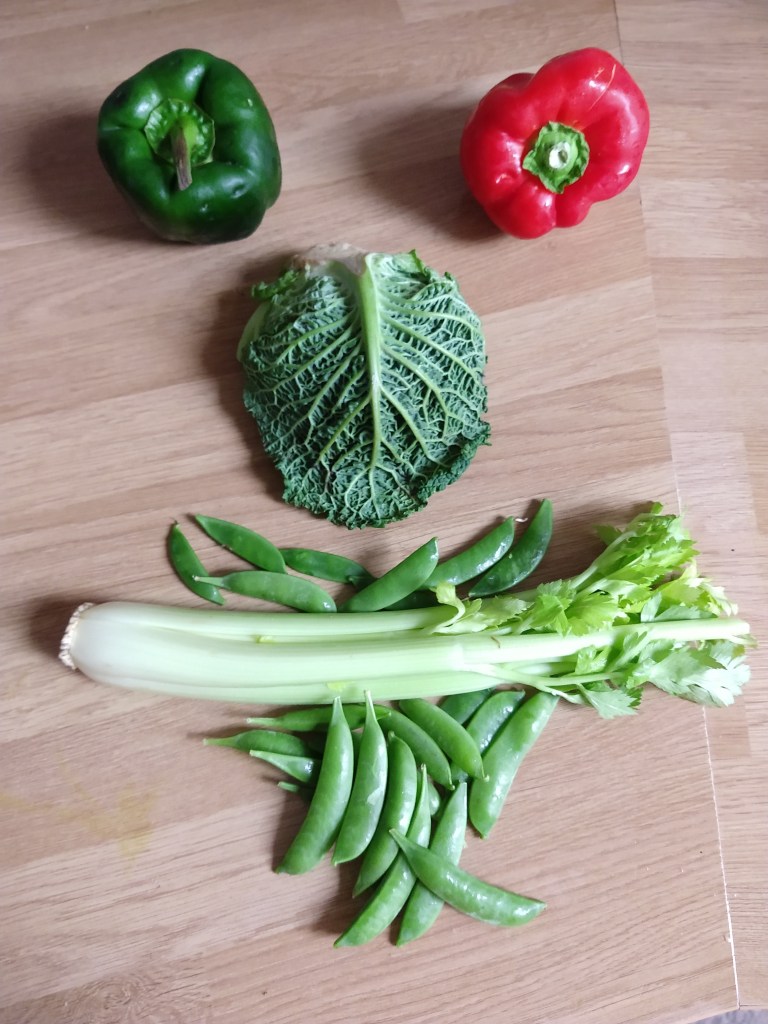
At the weekend we indulged in roast leg of lamb with a herb crust, complete with jabron potatoes, sugar snap peas and Savoy cabbage. It was a great combination (with gravy, of course), followed by magic lemon pudding (I’d been massively remiss in not having made this for over forty years) and ice cream (delish).
So, there were a few sugar snap peas and some cabbage left, plus some sticks of celery and a couple of peppers which were ‘on their way out’ but got thrown in.
Added stock, a few splashes of things here and there (my secret) and, once cooked, liquidised.
The result was healthy, ‘slurp worthy’ soup that tasted so much better than anything out of a can.
Each batch of leftover soup is unique; once it’s gone, it’s gone. But it’s great just to conjure something up from odd bits and pieces, instead of throwing them out.
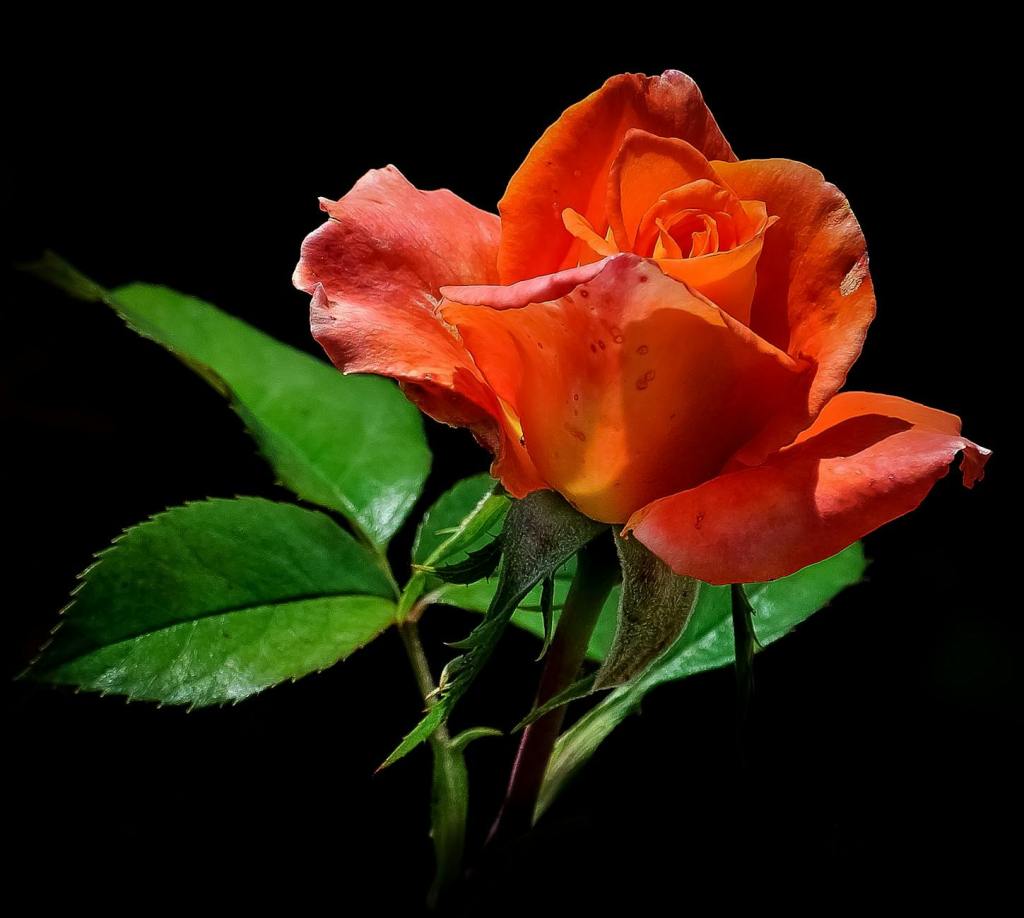
The pathways of my mind Are not defined Just like well-pruned roses They shoot and sprout In all sorts of places At paces I know nothing about
The slate chippings in my garden Are sharp and grey They lay flat and easy In the spaces that I make Not knowing why Or how long it will take
Praying to the sky Leaves turn green and fall Orange, yellow, gold Flowers unfold Well-pruned roses Always turn out best Until it’s time to weed again And then it’s time to rest
Places that I know nothing about Spaces that I make The garden of my mind is growing Like a well-pruned rose That buds and blooms Before it goes
Eventually the birds will come To sing their song In the garden of my well-pruned mind Where they belong
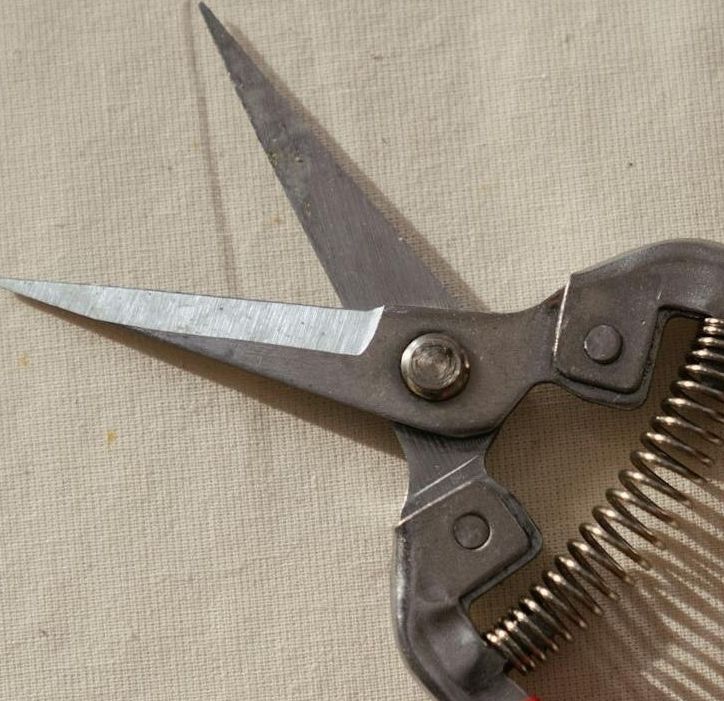
The cold, folded steel of your handles fit precisely into my palm where they belong
Thumb finds familiar catch that slips silently to one side releasing the spring opening your blades for action
You are my weapon of choice as together we cut and thrust our way to the possibility of new growth
Season after season we have fought fibrous flesh of one kind or another but today I use you for a different reason
With a delicate snip and trim and dip down each cutting goes into the dark holes I have prepared for them ready to take root if they choose
I don’t want to lose them or you, as I sometimes do in places that escape me
Then, as your dull grey surface greets me once again I know we will go on you with your blades and me with my hands to create many pots of cuttings and piles of thorns amongst the blossoms.
With no Qigong this afternoon, it’s the woodland walk for Lydia and me this morning, then yoga. Lydia often partakes in this remotely, being particularly good at ‘downward facing dog’!
The yoga teacher introduced a new exercise aid to the class: conkers. They formed a focus for our meditation and visualisation and I must say I enjoyed the experience of familiarisation with the seed of the chestnut tree. It was somehow comforting and inspiring at the same time.
As I now complete this latest 28-day cycle of writing, I reflect on how far I’ve come, not just since I started writing this blog in 28-day cycles a few months ago, but since I started my overall journey of recovery over fifty years ago, when I was still very young.
I didn’t know it at the time, but it essentially started in my teens, when I decided that I needed more than physical food in my life.
That may sound ungrateful as I know there are many people in the world who have less food than they need to survive. But my needs for nourishment were psychological, emotional and spiritual. They were very real for me and presented in the forms of social anxiety, depression, body dysmorphia and an eating disorder. That’s a lot for any teen to have to deal with and I hope that in writing about my experiences, it may help others to not have to go through the same.
It’s taken me a long time to work out what I needed to work out, to find pieces that I didn’t have reference points for. How could I know what I’d lost when I had no memory of having it in the first place?
For whatever reason – probably survival – my emotional brain closed down, and it’s taken me a lifetime to find ways of opening it up again. I’m still working on it, with Lydia’s help and a lot of help and support from a lot of other people along the way.
The most significant latest step for me is on the path presented by the Buddhist faith. It helps me to make sense of a lot of things, accept what I can’t change, and do my best to make the most of each day as it comes, recognising the value of what I have when for so long I was focused on what I didn’t have. Grief doesn’t go away, but we can grow to encompass a wider experience of life around it. That’s what I’ve been doing my best to do.
As I now take a couple of weeks break from writing a new daily blog, I’ll continue with republishing previous posts, looking back a bit before again moving on.
The paperback versions of my two latest books – ‘Rules, Rhymes, Recovery, Recipe, Random: Glad About Life’ and ‘A Woman, a Dog and a Blog: Writing into Life’ will shortly be available on Amazon, along with the Kindle and Kindle Unlimited editions:
‘Rules, Rhymes, Recovery, Random: Glad About Life’ brings together over 60 blog posts, from March 2020 through to September 2024.
It offers personal insights into the mental health recovery journey, recognising that there are no easy answers or quick fix solutions to complex problems but demonstrating that growth is possible through whatever difficulties life presents.
‘A Woman, a Dog & a Blog: Writing into Life’ presents a summary of my own backstory and that of my dog, Lydia. We had both experienced trauma before we met and, though I effectively rescued and adopted her, in many ways she has also rescued and adopted me.
We continue our journey together, day by day, step by step. Volume I of this book presents the first cycle of me writing a post a day for 28 days, at a time when the depression I had experienced most of my adult life had started to lift, only to reveal an underlying and extreme – at the time – sense of anxiety. Having lost everything that I’d worked for in the past, due to a severe breakdown in my thirties, I was absolutely petrified that history was going to repeat itself and that I would lose everything again, including Lydia. I was determined that wouldn’t happen and I drew on every aspect of resourcefulness and resilience I’d built up, and all the support mechanisms I could muster, to make sure that it didn’t. And it hasn’t.
Volume II presents the next 28 days of continuing to work with – and write about – positives in whatever way that I can. Affirmations, exercises, working with clay, working with words, walking, reflecting, resting, meditating – they’re all in there as I find my own way through and I hope it may help others find their way too.




 Glad About
You must be logged in to post a comment.