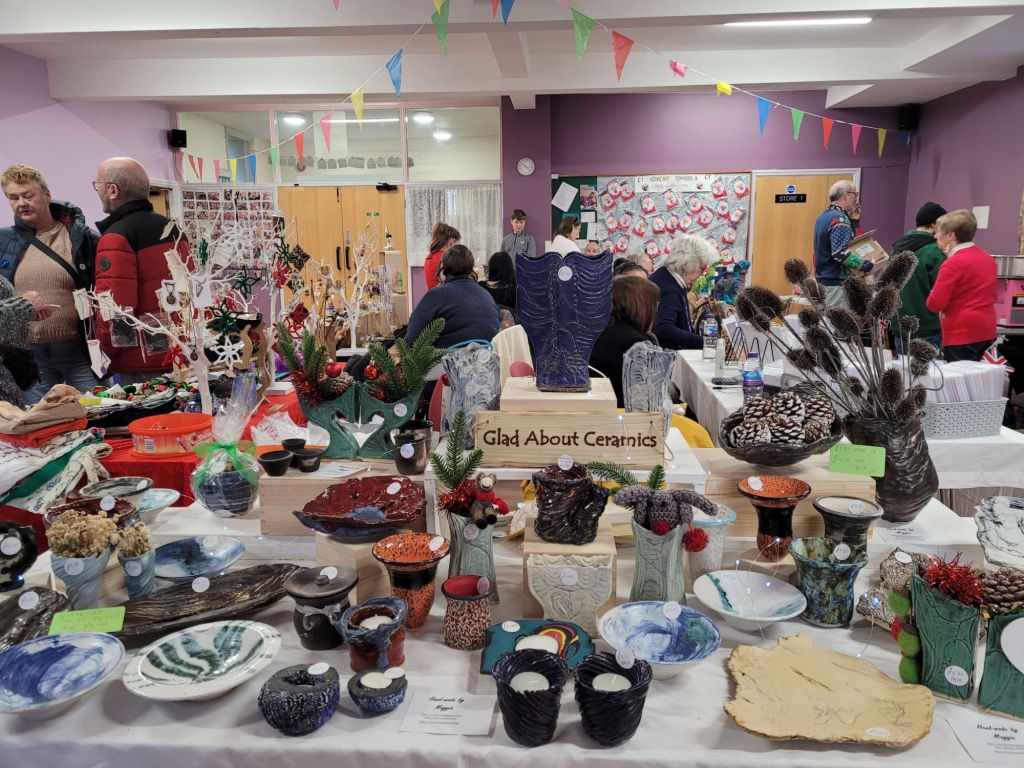
Had a good experience at the Bootham & Southowram Methodist Church Christmas Fayre, and sold enough pots to be able to pay cash for a curry tonight, delivered of course.
Enjoying a bit of telly and a few glasses of Malbec now.
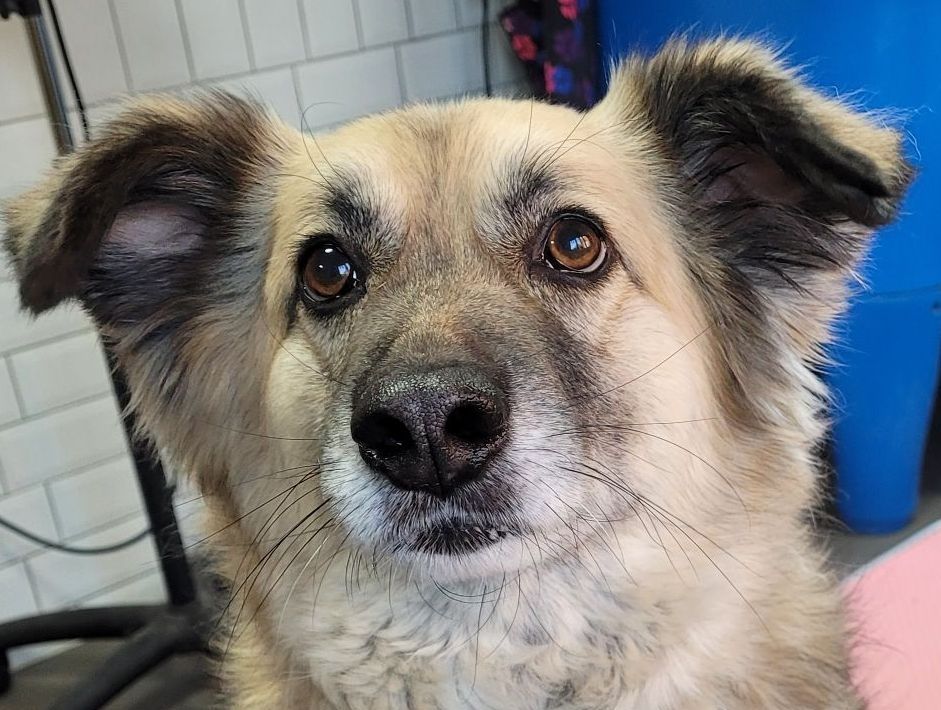
Lydia is quite relaxed. She’s had a dental stick and was eyeing up my wine but I do know where to draw the line.
Just finished watching Celebrity Traitors on demand. Don’t know what to watch next but I expect I’ll find something eventually.
Good to know that I don’t have to get up early tomorrow morning. A few more glasses of wine later . . .
Lydia jumped onto the grooming table as we arrived at our appointment this morning, without any prompting from either me or Vicky, the groomer. Each time we go she is more relaxed about the process, although I still put a muzzle on her and feed her lots of treats through it, reinforcing the positive and managing the risk at the same time.
After grooming we went for a walk and then home. For once she didn’t push her breakfast ball around until it was empty – she was still so full of treats.
This afternoon I drove to the Buddhist Centre, to do a few hours of voluntary work that I’ve offered to do.
It felt good to work in a different environment and also to not feel rushed or pressurised in any way. After being introduced to the work that needed doing, I was left to get on with it and given a few encouraging comments along the way. The work was a simple physical activity although I did need to concentrate and apply sustained effort, which I did for almost three hours before heading for home.
It’s another early start tomorrow as I’m setting up a table at the Bootham & Southowram Methodist Church Christmas Fayre. So, I’ll take Lydia out for a walk just before dawn, pack a few remaining things that I need to take into the car and head off.
Today’s been a good day and we’ll see what tomorrow brings.
It was snowing again this morning when I got up and I decided to take Lydia out straight away, in case it settled and the roads became impassable.
I put two layers of gloves on, a thermal pair underneath a fingerless pair, and my hands felt significantly less cold than they had the day before.
Lydia wore her raincoat again and we had a short walk in a field that I call ‘Quiet Field’ because I used to take her to it regularly when I needed somewhere that was fairly guaranteed to be away from the sight of other dogs.
The snow was still coming down and I was conscious of not wanting to be stuck on a hill on the way home.
I needn’t have worried as the snow stopped as we left the field and the day brightened up from there.
Lydia and I had another walk in the afternoon to make up for our shorter than usual one in the morning.
Taking on board some learning from last night’s Buddhist group meeting, I started to read again a book that I previously read some time ago: ‘How to Transform Your Life’ by Venerable Geshe Kelsang Gyatso Rinpoche.
I also made some notes, to help with recall, and it felt good to be able to read again, as I haven’t been able to for a while.
So, all in all it’s been a good Thursday, rounded off with a Chinese takeaway – delivered – for me and Trev.
I also bought some new treats for Lydia to try, doing a bit of shopping on my way to a yoga class.
Just relaxing in front of the telly now. And tomorrow is another day.
Waking this morning at around 4.20am, I get up to make a cup of tea. While waiting for the kettle to boil I snack on a few liquorice allsorts and some gummy sweets that were in the cupboard.
Back to bed, I must have dozed off for a few more hours before getting up, making another cup of tea, meditating for a short while and then deciding to take Lydia for a walk.
As I opened my eyes from the meditation, glancing towards the window I saw snow coming down.
I quickly got myself and Lydia ready to go out for a walk, in case the snow started to settle and the roads became impassable.
This morning, I insisted that Lydia had her raincoat on over her harness. She made it clear she wasn’t keen but it was so cold and the raincoat is light, and an easy fit for her. She was fine after being tempted into with a few treats.
The snow didn’t last, turning to icy rain, and it was bitterly cold. Despite her thick fur and hardy nature, I think Lydia may have been glad of her extra layer. I know I was.
Even so, and despite gloves, my hands got so cold that I can still feel them tingling, even now, over eight hours later. Still, we had a decent walk, got home and warmed up.
Later I started to get organised for a craft fair that I’m taking some of my pots to on Saturday: Boothtown & Southowram Methodist Church Christmas Fayre, near Halifax.
It will be an early start but I’ve got it planned out so that I’ll take Lydia out early and, with the car pre-packed, set off in good time to get there in good time to be able to set up my table ready for the 11am start.
Some pot pourri that I’d ordered arrived today so I made up a couple of my bowls with some clear wrap and bows: one to donate to the church raffle and one to display and hopefully sell.
I’ve got a little bit more preparation to do before Saturday, but its mostly sorted and planned now so I can start to relax into this evening, with Trev making tea and then I’m going out to a meeting of the Buddhist group.
The theme is still ‘concentration’. I do think I am starting to be able to concentrate more. I’m hoping that more sleep as well as more meditation will help.
It wasn’t an uneventful walk for me and Lydia this morning as we saw several dogs and a horse from a distance, all with owners – or, in the case of the horse, with its rider.
I thought at one point the horse and rider were going to be heading our way, which would have meant me seeking a quick diversion from their path, down into a ditch, then up and out the other side. Thankfully, they turned in a different direction, perhaps after having heard Lydia’s initial reaction of barking on sight of them.
Lydia still struggles on sight of dogs as well as horses and I still struggle to find a way of reassuring her. She gets the principle of not reacting but just finds it hard to put it into practice. I think this is something that many or most of us struggle with, one way or another.
Putting Buddhism into practice was a key theme of the weekend course I’ve just been on. So, I’ll just keep doing what I can, reflecting and hopefully learning.
As it’s Tuesday I went to visit my friend who used to live in the village but now lives in a care home. As usual, she greeted me with a warm smile, leading me to feel very welcome.
Coming home, I do a few things that I need to do in the kitchen, give Lydia her tea, then start preparing ours.
I’ve made up a sauce based on a pasta dish that I enjoyed when I visited Rome quite a few years ago. I remember it had mushrooms, ground pistachios and, I think, bacon. I’ve also included garlic and onion.
I used a food processor to chop the mushrooms up very very finely so that they are almost ground like the pistachios. I’ve seasoned with lots of freshly ground black pepper, a good splash of Worcestershire sauce, some soy sauce and half a stock cube.
It’s tasty and I’m hungry so time, I think, to start boiling some water for the pasta.
I don’t think we have enough spaghetti so I’ll use fusilli which should also help to absorb the sauce and flavour.
It seems fitting to start this latest cycle of writing on a Mental Health Monday. So, it was a walk with Lydia this morning, yoga and Qigong this afternoon.
Over the last couple of weeks, I’ve been busy with work on the house, doing some decorating, and I’m now starting on a phase of going round, room by room, clearing, cleaning, sorting.
Just as well then, that I’ve given myself a recharge boost with a weekend at the Buddhist Centre, with teachings and meditation sessions included as part of the course. I’ve also arranged to volunteer at the Centre one afternoon a week, which is an opportunity to put some skills and experience to good use, learn new things and meet new people.
For now, then, I’ve got a good complement of different activities and interests during the week, without being too structured or rigid and with plenty of time to rest or do other things as they arise. I know I’ll want and need to review what I do at some point in the future as I look for new challenges and further growth, but I’ve got what I hope is a reasonable balance for the time being.
I continue to reflect on how fortunate I am to have my health, fitness and circumstances to be able to do what I do.
Thankfully, also, Lydia is fit and healthy too.
We’ll keep walking and working together and I’ll keep writing. They’re all good things to do.
I’ve had two unexpected and early Christmas presents this year. One came in a box and the other was unwrapped; both are brilliant.
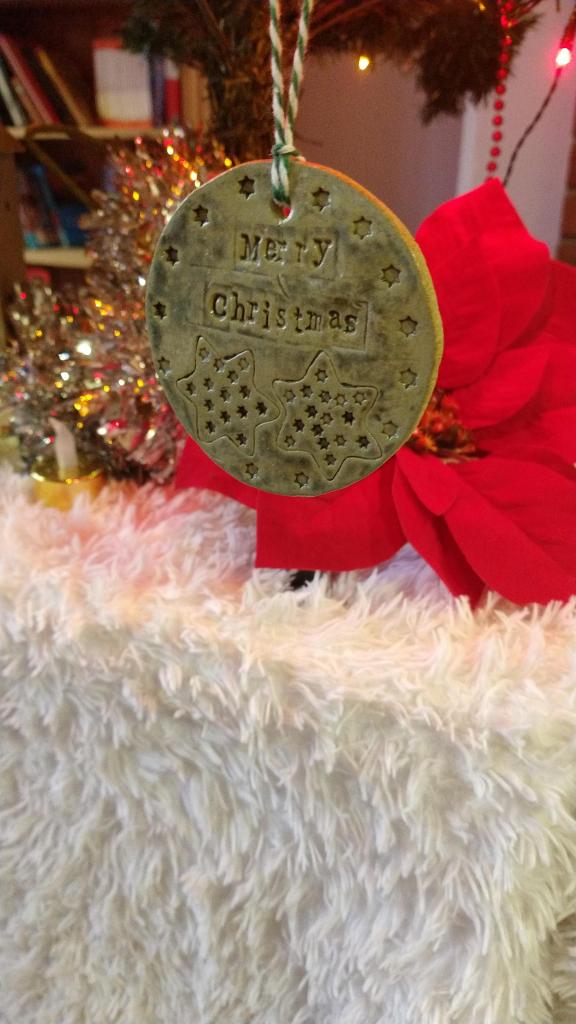
After a session at the ceramics studio which enables me to make and fire my own work – http://www.thepotterman.co.uk – I was putting my coat on to go home, and found a small cardboard box in my pocket. When I opened it up there was a handmade and personalised Christmas tree ornament, made by a fellow potter, Jenny. What a wonderful surprise; I felt I’d already had Christmas with that gift alone.
Then came another one…
After taking my partner’s daughter and three children home after a party at our house, I started taking one of the child seats out of the car. The four-year-old – who’d declared on the journey that he was tired – unbidden walked round towards me and took hold of one side of the car seat to help me carry it into the house. He didn’t say anything, he just spontaneously did it to help me. I was so moved by this; what a sweetheart – literally, a very sweet heart.
The other day I went through a box full of pieces that I’ve written in the past, and picked out seven items: poems, essays, ramblings. These are the titles:
Stirring abroad, without … within …
Bicycle pumps & bananas
Memories of a difficult day
Memories of a distinctly different day to the one I had yesterday
Surfing the Turf
Ms. Carriage
Written on the train to London some time in May
I also picked out a couple of pieces that I hadn’t written: one about learning and the other about ‘Being Human’.
I think the most important thing that I’ve learned about being human is to be able to accept that I get things wrong because I’m human, and for no other reason.
In any case, ‘right’ and ‘wrong’ in my experience aren’t always clearly defined, particularly since our lives are always unfolding, never fixed or final. We have expectations based on concepts of ‘normal’ but when we can drop those then all sorts of other possibilities arise.
There was a time when I thought that if I could do nothing else other than make sure that my cat – Bertie – had a good life, then that was enough. Who’s to say that it wasn’t?
I might publish ‘Bicycle pumps & bananas’ eventually but, for now, here’s …
Surfing the Turf
I’d like to roll myself In earth-warmed turf Like a bug in a rug Snug Safe from harm
The grass would tickle My nose and toes The worms would squirm Warm and Alive
I’d have to put an elastic band Around the roll of turf To stop it unfolding Unfurling Exposing Me
But if it did I’d need to find A sleeping bag To ease my mind
And then I would If I could Sit by the river Forever watching In awe and wonder At the world Flowing By
Breaking big rocks into smaller rocks: the hard-core approach to mental health recovery was the title of an article I wrote in 2013. It was published in a journal by the Royal College of Psychiatrists:
I was surprised, though, that there was no follow up from that. Nobody from the world of psychiatry or related fields sought to make further enquiry about the approach I was taking to rehabilitate myself back into a relatively healthy state of mind.
I think maybe it was because what I was doing seemed quite bizarre: undertaking hard physical labour involving a large sledgehammer and a lot of rocks. And yet the improvements I found in my mental well-being were significant and lasted for several weeks after I returned to my day job, based in an office.
While I don’t believe that all aspects of my complex mental health needs would have been resolved by continuing to do rigorous physical endeavour all day, every day, the experience certainly had a part to play in my overall recovery.
And the principle of breaking things down into smaller chunks is one that I work with every day.





 Glad About
You must be logged in to post a comment.