I took Lydia to the boarding kennels again this morning, for a three-night stay. It’s the first time she’s been back so soon after her last stay, but this weekend Trev and I are going camping.
We took Lydia camping not long after we first got her, and she was very anxious about it all. She did very well on the whole, sleeping between us in the tent, and I put up windbreaker screens so that she had some space just outside where she couldn’t see other dogs. We also camped as far away from other people as possible. Even so, I had to take her out in the car for her to do her ‘poopie’ and overall it wasn’t the best experience for any of us. So, this weekend, she’s back with her friends at the kennels and we’re meeting up with friends in a field.
I thought my camping days were over, not feeling inspired or enthused as I used to feel at the prospect of sleeping in a tent. However, we received an invitation from friends to join them and others for a gathering this weekend, and it should be a good one.
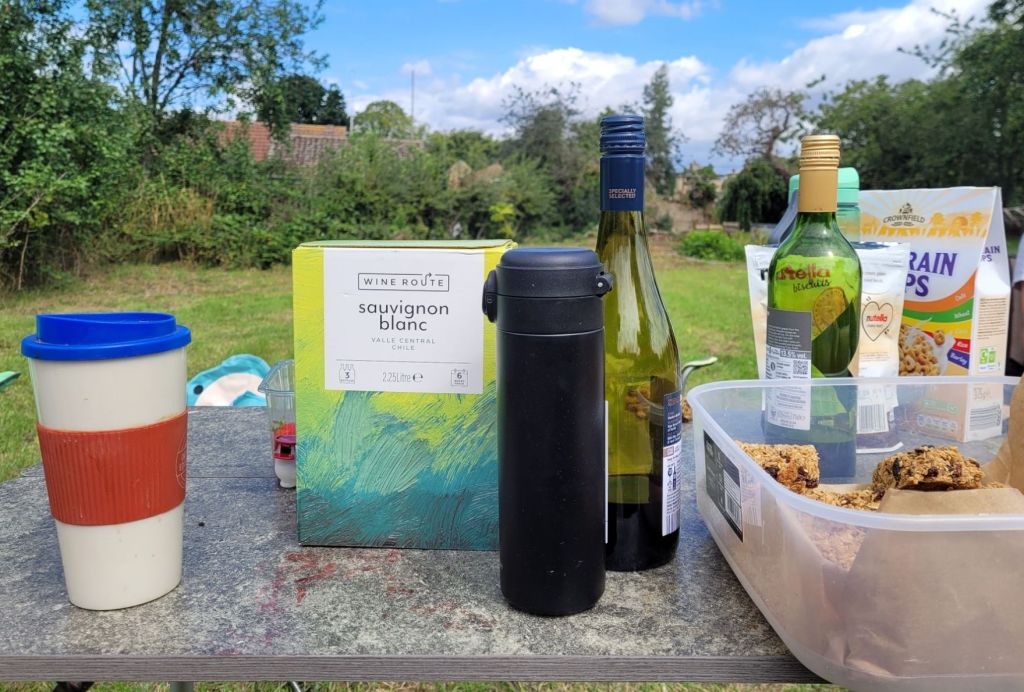
We’ve got plenty of essential supplies: wine, beer, whisky and gin. We’re all chipping in for a barbecue on Saturday night and our remit was to bring sauces. So, I bought ketchup, brown, salad cream, mayo, various types of barbecue sauce, some relish and some hot. I hope I’ve catered for all tastes.
I’m pretty sure there’s going to be a campfire, singing and hopefully lots of laughing. I think it’s going to be a very good weekend.
It helps me to recognise that the anxiety I have about being tired – and fear of never not being tired ever again – is a delusional thought.
I can then accept being tired for the time being and reduce the impact of my negative thoughts by thinking about something else.
Lydia and I have a dog field session booked for 9.30am so after a slow cup of tea (I don’t do quick these days) I get her ready to go out.
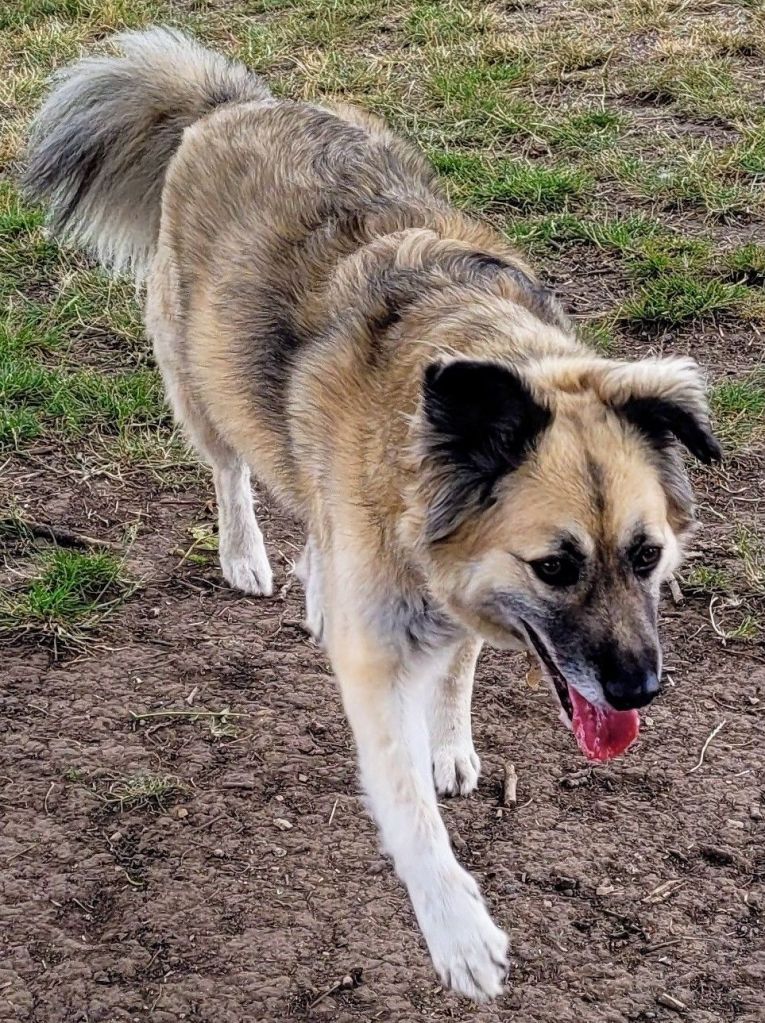
She is such a good girl when I call her to put on her harness and she then sits at the back door without me even having to ask her, waiting patiently until I give her the “OK”.
It’s great to see her bounding around the field as soon as I’ve taken off her harness and lead. She is so excited to catch up on all the smells and she does what she wants to do while I do some knee exercises.
I’ve realised this week that my knees are much improved in flexibility and I want to keep them that way. It’s so easy to become complacent and forget to do my exercises, but I need my knees!
Lydia gets some cardio-vascular exercise when she chases vans that pass on the track that runs along the other side of the fence, and follows my suggestion to have a drink of water after her exertions. We do a bit of “heel” reinforcement work and she’s very enthusiastic about taking the treats from my hand.
There is a moment, in the field, when the warmth of the sun combined with the gentle breeze feel absolutely perfectly balanced. It is a beautiful day.
Back home, Lydia has her breakfast and I have mine: coffee – made by my partner, Trev – and fruity, nutty flapjacks – made by me.
Later I do some garden tidying. Lydia helps me as she often does when I’m working in the garden, and digs away, covering the area I’ve just brushed clean with fresh soil – how kind of her!
Waking up this morning I reflect – as I often do – on how fortunate I am to have access to the Buddhist teachings that I have access to.
We’re on a short break from the mid-week classes that I usually go to, but my mind turns to two of the mantras that I have been learning from most recently. One is in the form of an acronym: RARE.
Recognise
Accept
Reduce
Eliminate
‘Recognise’ is to recognise a negative thought as delusional.
‘Accept’ is to accept the situation in which the thought is arising.
‘Reduce’ is to reduce the impact of the delusional thought.
‘Eliminate’ is to eliminate the delusional thought.
In my experience it can be extremely difficult to identify a thought as delusional because our thought patterns are often so ingrained that we don’t even notice them when they do arise. However, I’ve recently found that if I start to feel anxious, this alerts me to potential negative/delusional thoughts that are giving rise to the anxiety. I can then turn my attention to my breath, engage in a short meditation and find that the anxiety starts to abate.
I’ll continue to do what I can to recognise, accept, reduce and eliminate my delusional thoughts.
Most of us associate ‘www’ with ‘world wide web’ but an alternative presented in a Buddhist teaching recently is: ‘welcome wholeheartedly whatever’.
The nun who gave the teaching presented an example of a monk who lives at the Centre who has significant paralysis, is unable to walk and experiences constant pain. Apparently, he affirms the ‘welcome wholeheartedly whatever’ mantra and I’ve found this immensely humbling and inspirational.
I don’t know how things might unfold in my life – none of us do – but if I keep meditating, keep my focus on positives and aim to eliminate old habits where negative thinking takes hold, then I’ll be better prepared to welcome whatever does lie ahead with an open heart.
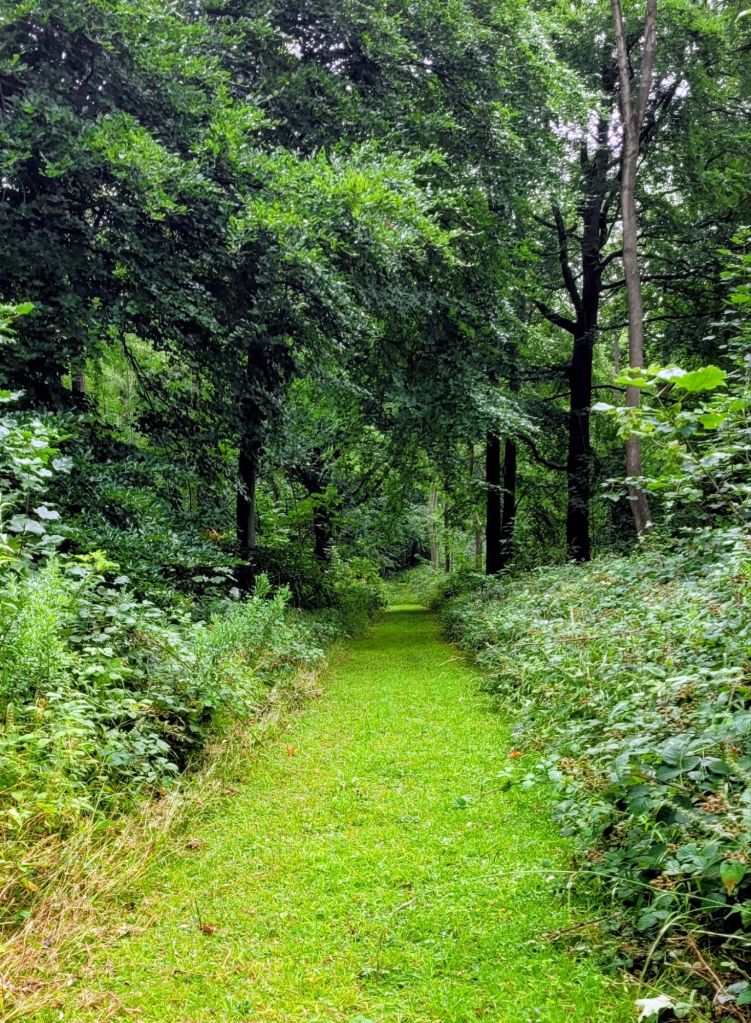
After taking Lydia on our woodland walk this morning, I visited a friend in the village this afternoon.
We met through a befriending service and it feels like one of the best things I’ve done since I retired from doing paid work a few years ago.
The service sets clear parameters, which means that I visit once a week for two hours a week. This has been good for me as I’ve had a lot going on in my life and I tend to try and do too much.
The friend who I visit has dementia. She forgets things, struggles to concentrate and has lost a lot of confidence. She has also lost through death the people who have been dearest to her in her life. I’m not a counsellor, nor a carer, but I do try to reassure her and rebuild her confidence.
We usually have a few laughs when we’re together; she’s got a great sense of humour and a very kind heart. It was lovely today to see her little cat cuddling up to her. It was like the cat wanted her to know how much she loves her. That was how I saw it, anyway, and I told her so.
Coming home, and having not had any lunch, I ate a large bowl of salad greens that another friend has given me, freshly grown by her. With some ‘French’ dressing – made from grain mustard, Italian olive oil, balsamic vinegar and a sprinkle of brown sugar – they tasted delicious. A healthy snack to top-off a lovely afternoon. Even better – my partner is making us humous for tea.
Lydia is lying quietly by the open back door – she’s been outside again most of the day. She’s not in any hurry for her tea and neither am I. We can relax and enjoy some ‘Maggie and Lydi time’ too.
These were words spoken to me this morning when I picked Lydia up from the kennels where she’d been staying over the weekend.
I’ve always thought this myself, because she is.
We had a good walk together, before I took her home, and she’s enjoyed much of the day outside in the yard, in what is warm and rather windy weather.
After a two-week break I resumed my usual ‘Mental Health Monday’ activities this afternoon: yoga followed by Qigong.
So, I’ve had two-and-a-half hours of concentrated activity for health and wellbeing with the added benefit – for brief periods – of being a tiger, a dog, a cat, a tree, a warrior and a dragon.
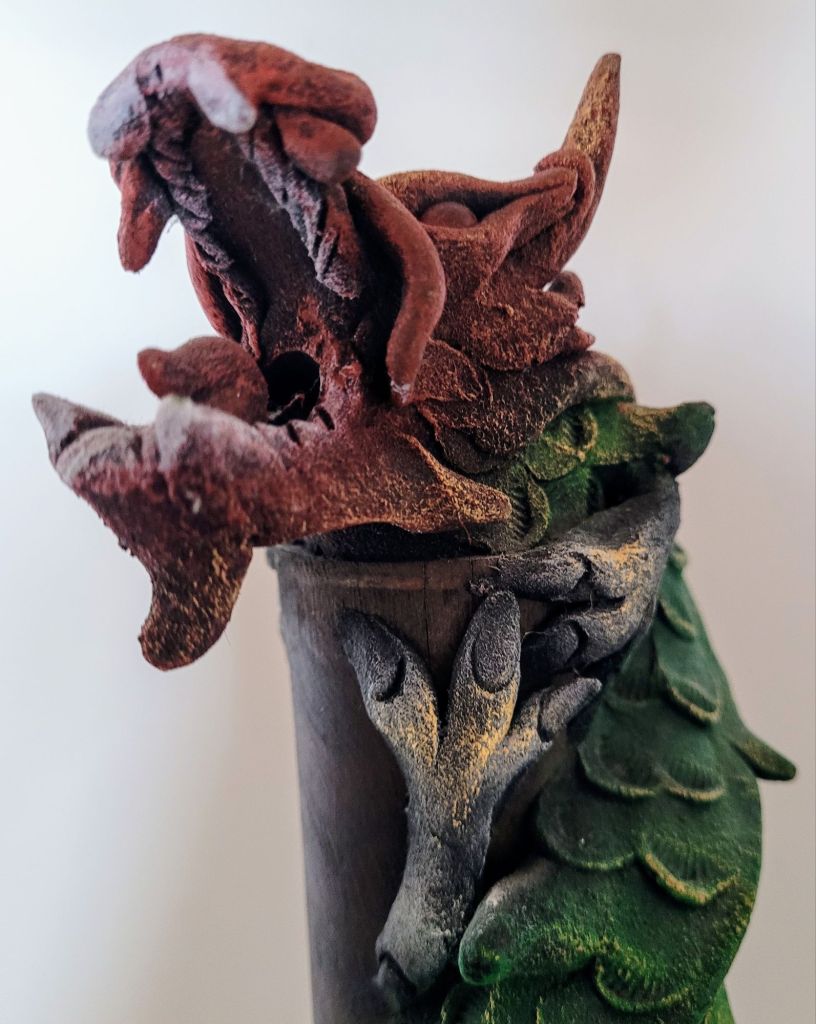
I don’t feel a need to compare and say which of these I’ve preferred being, but I did like the dragon movements.
I can now relax into a mellow evening knowing that I have given important attention to my musculoskeletal system as well as my mind and spirit. I think my girl with the beautiful soul is quite relaxed too; still in the back yard; still enjoying the warm and windy weather.
After a long day at the Show, I’m enjoying a large g&t and reflecting on the list from yesterday’s post. My focus is on ‘Let ourselves be held’.
I’m not sure if this means emotionally, psychologically, spiritually or physically. Probably any or all four or a combination.
I’m not good at letting myself be held, and neither is Lydia.
She now lets me give her massages (the “rub-a-dub-dub” massages I’ve referred to in previous posts) but she still doesn’t let me fully ‘hold’ her when we’re out walking, in terms of believing that I will keep her safe. She’s been too badly traumatised in the past.
I’ve had to be so self-reliant for much of my life that I will always fall back on myself too. I don’t think that’s necessarily a bad thing, but historically I’ve tended to look out for others, while at the same time my own needs weren’t being met. That’s not because I’m a selfless saint, but it is because I really don’t want anyone to have to go through what I’ve been through in my life if there is anything I can do to help them not to. I just don’t like that level of waste.
Looking again at the list, I’m drawn to ‘nourish our senses’.
My senses feel jaded, as if nothing is fresh and invigorating any more. This is where Lydia comes in to help, as I do find our walks together on a morning have a stimulating effect on my senses, even if it’s still at a low level of intensity.
I’m certainly much more open to ‘imperfection’ than I used to be. I can still be a bit obsessive about details, but more able to let things go.
I can only ‘do one thing at a time’ these days, and very slowly, so I’m doing OK there.
I’m not always great at being able to ‘ask for help’ although at least I know now that help can be sought out. In the first half of my life, I had no idea that such a thing might be available, never mind what form it could take.
‘Expressing emotions’ is complicated, I find. I’ll keep trying to work that one out.
I do ‘create daily rituals and routines’ although I tend to need to be flexible on timings and interpret this very broadly.
It may be a while yet before Lydia and I are both as relaxed as we need to be, but we’re working – and resting – on it.
The fact that my partner has just made a delicious meal while I’ve been resting helps enormously.
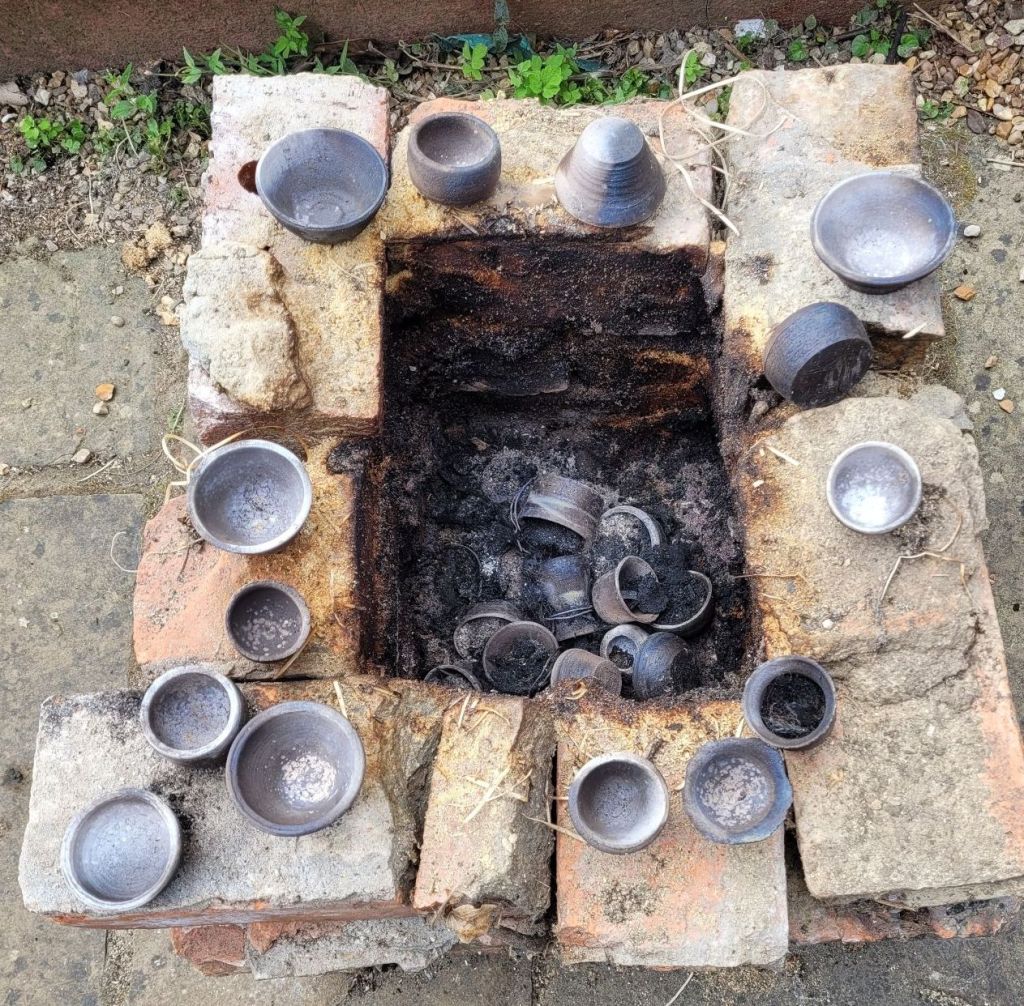
The sawdust firing went well. All the pots now carry various shades of smoky grey. They are not fully vitrified but significantly less porous than when they were in the ‘bisque’ or ‘biscuit’ state. I’m not sure what temperature the sawdust kiln reaches and will have to do some tests in future firings to find out.
None of the results are what I would call ‘spectacular’; they are more subtle, although I will continue to experiment with different materials and I think the copper wire has a lot of potential for creating interest effects around the outside of pots.
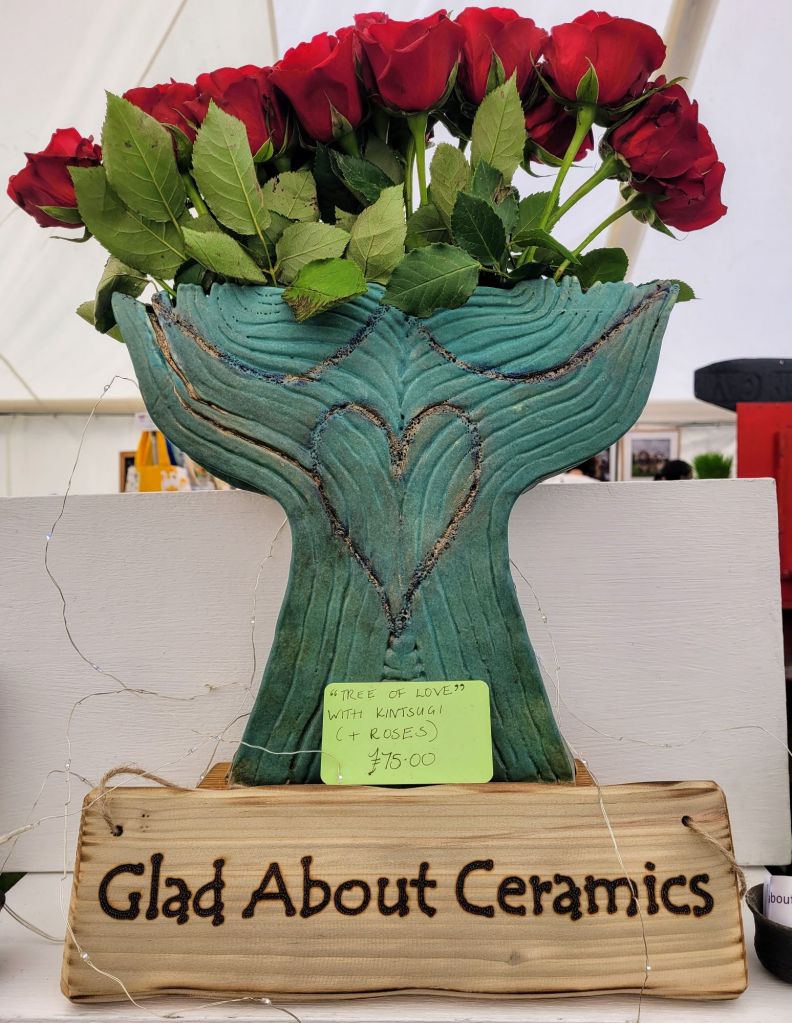
All my pieces for the Show[1] are now packed in the car.
It’s an early start in the morning, so an early night for me.
I keep thinking that I can hear Lydia moving about the house but of course she is in kennels this weekend.
My partner is out with a friend so I have the house to myself.
A friend from the Buddhist group I belong to circulated a list of ways that we can help our nervous systems to rest and recuperate. I’ll use this list to help me with the work I’m doing with my own dysregulated nervous system as well as Lydia’s:
Slow down
Allow imperfection
Do one thing at a time
Sense our breath and our body
Create daily rituals and rhythms
Offer ourselves compassion
Lengthen our exhales
Express our emotions
Honour our needs
Nourish our senses
Ask for help
Let ourselves be held
[source: Nicola Jane Hobbs, c/o Jilly]
[1] Aldborough & Boroughbridge Show, Newby Hall, Yorkshire, UK
I set fire to my sawdust kiln this morning, having repositioned it away from the passionflower vine that is spreading from the back trellis.
Lydia has gone into kennels for three nights, so she won’t be adversely affected by the smoke from the kiln and I don’t have to worry about her getting too close to the hot bricks. I’ll pick her up on Monday morning after the Aldborough & Boroughbridge Show on Sunday.
The kiln contains the 28 small pots that I threw on the wheel a few months ago.
I’ve experimented by wrapping some of them with copper wire and placing banana skin, wire wool, rice grains, and wood veneer inside in various combinations. I’ve also popped in a bit of Lydia’s fur that I’ve kept from grooming sessions. It will be interesting to see the different effects that these added materials make.
I’ll be using the pots as my version of a business card for the Show. Inside I’ll place curled up slips of paper with my Instagram address and my blog address printed on them. That way I hope to promote my work in words as well as in clay.
I like the idea of having pots to give away. I’ve done it before and found that people are very surprised and pleased to be able to take away a pot that they haven’t had to pay for, however small.
I haven’t got much more preparation left to do now, but like to work at my own pace, with no pressure.
All I have to do now, as far as the firing is concerned, is wait until tomorrow morning, by which time there should be no more smoke emerging from the kiln and the bricks should be cool enough to touch.
I get very impatient when I have a kiln firing on the go. Can’t wait to see the results, although – of course – that’s exactly what I have to do!
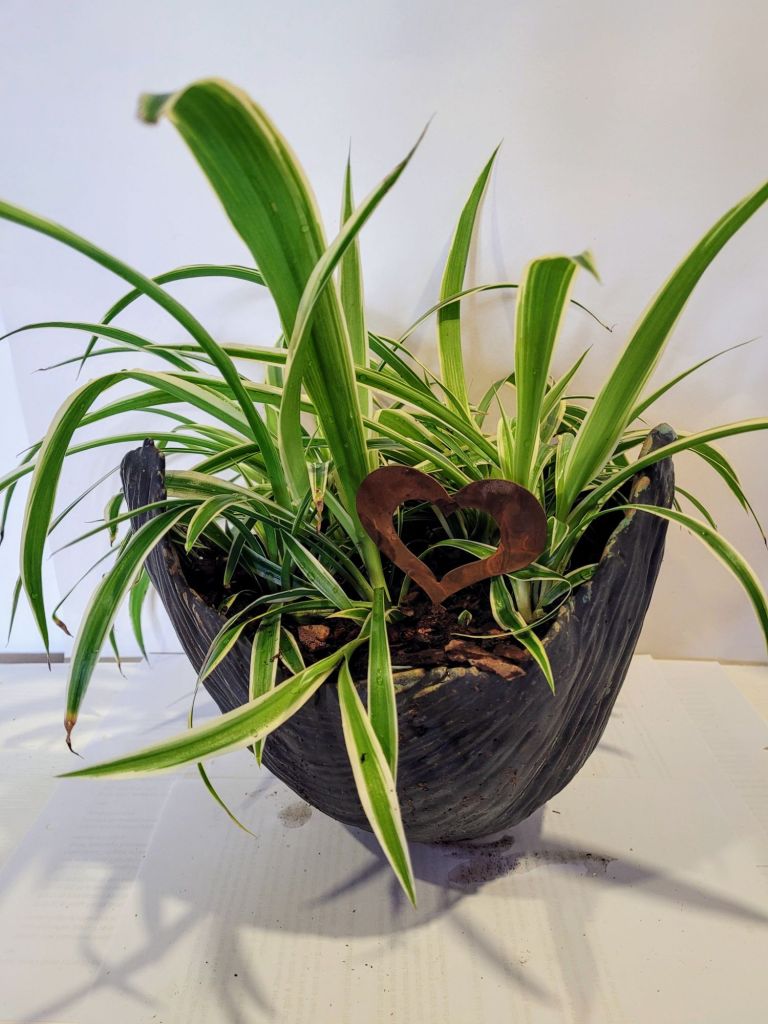
Spider plants that my “supreme unchanging friend” Maxine grew for me
There were big farm machines harvesting crops in the fields by the side of the road where Lydia and I walked this morning. She’s quite used to farm trucks now and was generally quite settled as they passed.
I’m feeling generally quite settled, although I do have a dentist appointment today. I’ll just concentrate on my breathing and I’m sure it will be fine.
I’m continuing to steadily prepare for the Aldborough & Boroughbridge Show on Sunday.
As featured in yesterday’s post, I’ve planted up some of my pots, with plants that I bought, such as ivy and a heart-shaped vine, but mostly using spider plants that my friend Maxine propagated for me. Everyone should have a friend like Maxine, not just because she propagated spider plants for me – and also gave me some pepper, tomato and cucumber plants that she’s grown from seed – but because she’s been there for me at every turn through some very dark and difficult times. She’s the “supreme unchanging friend” that the Buddhist teachings talk about.
Last night’s class was the fourth on the theme of ‘Cool to be Kind’. We looked at the “mirror of dharma”, reflecting on how easy it is to see the faults of others but how Buddhist teachings (dharma) can help us to cherish others instead.
The reference book for last night’s teachings was, ‘The New Eight Steps to Happiness – The Buddhist Way of Loving Kindness’ by the Venerable Geshe Kelsang Gyatso[1].
I have a copy of this book and when I picked it up this morning, found a bookmark at page 149. This is the start of a chapter, ‘Accepting Defeat and Offering the Victory’, with the verse:
When others out of jealousy or anger Harm me or insult me, May I take defeat upon myself And offer them the victory.
This is something I’ve been working on doing, particularly over the last 18 months. I haven’t and don’t find it easy, and in fact I find it psychologically and emotionally draining. But it somehow feels like the right thing to do. It offers a way forward for me, even though I don’t know where that way forward is leading.
However, I do have good friends to share my journey with me; and a Show to go to on Sunday.
[1] Founder and spiritual director of the New Kadampa Tradition – International Kadampa Buddhist Union



 Glad About
You must be logged in to post a comment.