Perfectly placed on a shelf, they appear to have arrived where they were always meant to be, the pebble, the picture and the plant. Which is odd really because pebbles are meant for beaches and pictures for art galleries or walls; plants can be anywhere that nature calls.
I’ve no idea where the plant came from apart from the supermarket where I picked it up. Or did it pick up me, with its green and white simplicity?
The plant is now closely proximal to the pebble and the picture, in a ceramic pot.
Don’t judge a book by its cover don’t even begin to think that you know what lies underneath when every belief that is written in time comes and goes
Don’t judge a book by its cover for the pages are those that can lie and deceive the wisdom of years may appear as true fears and the rest will come in as you weave
Don’t judge a book by its cover when the story has not yet begun Yet the time is right now and in some way, somehow what needs to be said will be done
Don’t judge a book by its cover it’s only a matter of time and again tattered and torn may be weary and worn but it’s all the same in the end
Don’t judge a book by its cover don’t even begin to think that you know for it’s all in a muddle and inside the middle is a tale that is waiting to grow so it will
Grey island you spin and swirl around me (or is it the sea?) as I sit and wait for my thick-headed brain to clear which it does almost, but elusively and all too briefly teasingly still tense tension immense
Four seagulls soar one sits probably shits (or is that on the wing?)
Thrift, rock, heather purple, black, yellow, mauve green, grey, white weather wild mild quite
Walking, talking, inwardly I sit (still) and wait for my thick-headed brain to clear and allow me to feel the joy of the sea and the splendour of the trees and everything around me
So, I sit (on a rock) and wait for my thick-headed brain to clear and know that someday soon it will be free hopefully
1998
A quarter of a century after I started my self-directed journey of recovery from a complete personal breakdown, it would be easy to think at this stage that I never will get that sense of mental clarity that I have been seeking.
I hoped by now that I could have been sailing instead of struggling to find the energy to get through each day in a remotely positive way.
There are significant differences though, between then – when I started out – and now – when I’ve arrived at a particularly low-down point, wondering how on earth I’m going to summon up the motivation and momentum to start going ‘up’ or ‘forward’ again.
The most significant difference for me is that now I’m in a loving relationship. My partner and I care for and about each other in ways that make us both feel good. He suffers from depression too, so we often alternate in terms of who most needs support from the other at any one time. We’ve both had almost catastrophic life experiences to contend with in the past, both just come through by the skin of our teeth, both had to learn to trust again – often the most difficult thing of all, including trusting ourselves as well as each other. And we’re both now thankful that we’ve found each other. ‘Together Forever’ is our motto. We want to make the most of the time that we have – both now in our 60s – and that, in itself, is a motivator. At the same time, I’m still feeling profoundly exhausted and know that I need to do some more work on myself to pull out of this and finally put the traumas of the past behind me.
I know that it’s important to sometimes push myself and at other times do nothing. Doing nothing is hard as it brings with it the fear that it will become a permanent state and that I will vegetate from doing nothing to being nothing. At my age, fear of dementia also comes in to the mix. But in the depths of depression, doing anything at all feels like just too much, so where do I start?
I keep coming back to affirmations. Affirmations, some gentle regular exercise, healthy eating, not too much alcohol. All sensible things.
The affirmations I’ve identified for myself at this time are for depression and hearing problems. While I don’t really have hearing problems as such – other than age-related deterioration – I do have problems with ‘itchy ears’ and I have also had problems in the past with being heard.
I set about learning and practising active listening skills when I trained as a volunteer bereavement counsellor – it must have been about 20 years ago now. I’ve found those skills invaluable in different jobs and roles that I’ve held, although more latterly I’ve found it increasingly hard to concentrate. Active listening, by definition, means giving another person full attention. I think my body and brain have been telling me to give myself full attention for a change; had I ‘listened’ to what they were telling me earlier, I might not have arrived at the state I’m at now, although by the nature of cycles, they do have to go full turn.
Anyway, the affirmations that I’ve found, to say to myself when I can and when I need to, are:
“I move beyond other people’s fear and limitations. I create my own life.”
When I say each of these, at the very low ebb that I’m at now, I get a sense of uplift in my spirit, even if my body and brain are running well behind. I hold on to the belief that they will catch up though. Eventually.
Oh, and of course writing – something, anything – can be therapeutic as well. I’m going to keep writing, and affirming. And washing up, and doing a bit of gardening …
These are the lives that we limit to live These are the cries that we’re frightened to give These are the days that we count on our clocks How soon will it be before it all stops?
Turning the corner, the familiar fields andshelters come into view.
Open outlook, clear and calm; this is the place where past harms are healed.
Friends, old and new, graze on at steady pace. It’s never too late for needs to be met just a turn of fate.
The familiar fields and shelters will come into view again next year. The way ahead may not always be calm and clear, but we can always come back to this place, this sanctuary, and marvel at the donkeys, stroke the pony’s mane. It’s always different every year and every year, just wonderfully the same.
It’s around a year ago today that my friend, Rosemary, passed away. She was 49.
I wrote the above piece after we had been to visit an animal sanctuary in Norfolk. Rosemary had introduced me to the animal sanctuary because she had adopted a Shetland pony who lives there, Sampson.
I suggested we go and visit which we did, and revisited a few times more, before it got to the point where it was too much for Rosemary. She found it too tiring, she said, which it was. It was too tiring because she smoked heavily and was an alcoholic.
Rosemary had been diagnosed with schizophrenia in her early 20s. While she never opened up much about her past or about anything emotional at all really – I was told in no uncertain terms to ‘leave it’ if I prompted her in any way – she did tell me once that the psychiatrist who diagnosed her told her that she would never work again.
That may well have been the case in the conventional sense of what constitutes ‘work’ in our society, but if it was unlikely that she would ever do regular paid work again, that prognosis could have been presented differently, to give Rosemary a sense of hope of having a fulfilling life, even if not the life that she would have been hoping for as a young woman in her 20s at that time.
In recent times there has been a lot of talk about mental health and a lot of awareness raising in the media, but when it fundamentally comes down to it, has anything significantly changed to ensure that people who have diagnoses of extreme forms of mental illness can find some way of identifying themselves with a meaningful role, a sense of positive purpose, in the world? I’m not convinced that it has.
Some people are fortunate to be partners, wives, husbands, mothers, fathers, which can help to offset the stigma and isolation that accompanies their condition, but many – like Rosemary – do not.
Rosemary was not an easy person to get on with. She pushed people away, more often than not, and did make lifestyle choices – however hard and judgmental that sounds – that led to her limiting her own life in many ways. But I have often wondered how different it would have been if, when given that diagnosis of schizophrenia all those years ago, she had been told about all the things that she could keep doing – and all the support that she would get in the process – to help her feel good about herself and her life, whatever form or path that took.
Having extra support at a critical time can make all the difference between us, on the one hand finding our own strength and resolve to come through with a sense of purpose and, on the other hand, wavering and floundering and – at best – just not drowning.
At times Rosemary pushed my patience to the limits and then some (and she knew it!), but I could only try and imagine what difficulties she went through every day. Somehow, through that diagnosis, and prognosis, and the position it placed her in, in the world, all her intelligence, her good memory, her dark sense of humour, her creativity, her kindness to animals and sense of fair play got devalued, not least by her.
Thank you for the friendship that we shared Rosemary. For the times we spent at nature reserves and animal sanctuaries, the concerts we went to and the smile that you used to greet me with.
Once, upon a green and white day, I walked, with shades of blue and grey above, and occasional muted pools of golden light along the way.
Cold and still, it was as, wrapped in thoughts and clothes, I lumbered on, taking weary steps in heavy boots, glad to be out but ill at ease and with no easy motion.
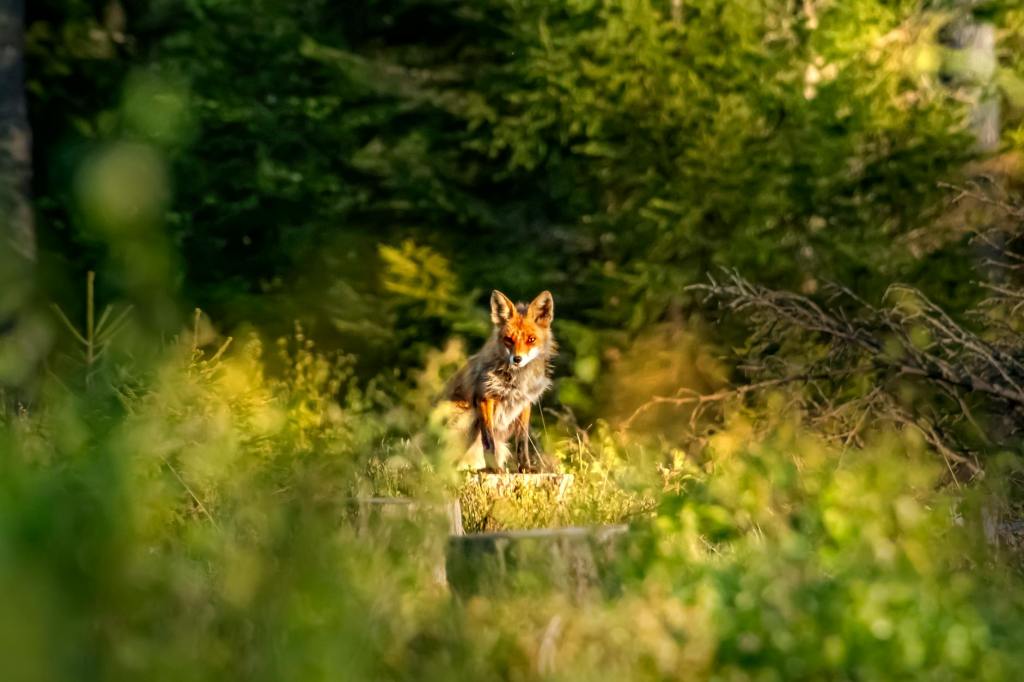
Then, suddenly, up ahead, a quick quiet movement of life and limbs, and fur of warm brown red.
A dog, I thought, at first – but no – a fox!
I stopped and stared, and thrilled at each tight turn.
Alert though not aware of me, she moved, close enough to see the splash of white upon her breast; no cunning vixen, she, with body, mind and spirit in perfect poise and purposeful grace beside the still and silent trees.
Doing what she needed to do. Being what she needed to be.
But then I moved and she was gone.
So I carried on through the green and white day with shades of blue and grey, moving easier now but missing her and wishing, that our eyes had met, that I hadn’t seemed a threat.
For in her hungry hunt for food she had nourished me, and warmed my heart while her cold search went on.
Alone, both, and alive.
She free, and I a few steps closer now, to being me.
“I choose to be peaceful and calm. Everything is unfolding as it should.”
Affirmations can be hard to take on faith at the best of times. At times like this – and especially with an affirmation like this – it can be even harder.
On my daily walk with my partner, in the beautiful spring sunshine and along the peaceful country lanes around where we are lucky enough to live, I’ve stopped and said this affirmation out loud, and it has helped; helped me to remind myself that I can choose to respond to any given situation in a calm and peaceful way, providing I have control of my emotions and my mind. It might be hard, but not impossible. It is something that I can keep working towards being able to do, even if I can’t do it now.
I first started to use this affirmation a few months ago, when I was struggling with some very difficult work situations and high levels of associated anxiety.
I discovered it in a slightly different form at http://thinkup.me/affirm and my thanks go to the author of that article. (5 Recommended Positive Affirmations for Anxiety by Yvonne Williams Casaus, 26 December 2017)
After struggling with anxiety and depression for many years, I keep thinking that I’ve beaten them, only to be hit again by another wave.
The difference, though, between when I first started my personal battle with depression – in my teens – and now – in my 60s – is that I now have a well-stocked resource bank of strategies to fall back on.
Even so, the nature of the disease- and it is a dis-ease – is such that it can be hard to fall back on what we know works when we are at our lowest ebb. I also find that I no longer have the reserves of fighting energy that I used to have, but if I can at least find an affirmation that resonates with me – even on a leap of faith – then I am doing something positive to pull myself through.
The first time I came across affirmations was when I was going through a breakdown in my late thirties.
Suddenly reaching out – desperately, as I knew I was in danger of drowning and was definitely not waving – I found that there were sources of help and support around that I had never even heard about before or could imagine being available.
Counselling was one of these, meditation another, and I also came across a book called You Can Heal Your Life by Louise Hay (1984).
In that book, as I recall, I identified an affirmation that reflected the exact opposite of how I was feeling:
“I am the love and beauty of life in full expression.”
At the time, I was feeling like the worst wretch that ever crawled the planet. But I knew I had to do something to turn my life around and so I took on board the affirmation and kept saying it to myself again and again and again. And it worked. Not on its own, not without me doing all sort of other things at the same time and ever since, but it helped to cure my warts (literally) and set me on the path to keep working and trying, never giving up.
This brings me to some more poetry, and Poetry Rule No. 28, Stand your ground when you need to; move when you don’t.
Sometimes
Sometimes it isn’t as bad as you think it’s going to be it isn’t even worse as you hesitate with anticipation and brace yourself to curse
Sometimes you’re presently surprised more than you thought you could be when you’re met with some small kindness unexpectedly
At times like these it’s good to be wrong in fact I would go so far as to say it’s a blessing that’s been missing for a long time so, no messing seriously
Sometimes are better than no times never wouldn’t you agree?
I’ve recently been fortunate to have taken part in a group poetry project.
Group experiences have been central to my mental health recovery for many years.
Some group experiences have an uplifting, energising and inspiring effect; others lead to alienation, isolation and degradation.
The poetry group experience that I’ve recently had was a good one, thanks largely to the enthusiasm and encouragement of the group leader https://mariafrankland.co.uk/.
In case you don’t want to buy the book, or perhaps as a taster (I’m one of 12 poets in the completed work), here are my poems from the collection:
Now
Now at the Pinnacle 14-and-a-half per cent proof point of my existence I’ve reached the Nottage Hill sub-station of my life I haven’t got a Sauvignon Blanc’s clue about what to do next other than to ‘méthode-champenoise’ my way through and hope that if the cork crumbles the bottle won’t be blue and the sieve will be fine so that just for now I can at least drink the wine
I can dance
I can dance without moving my feet at all I don’t have to do the foxtrot or quickstep my way to any ball I can cry without moving my lips I can laugh without making a sound all I have to do is know that the earth is flat, it isn’t round The dance is mine to make up from the music of the wind a sense of something swirling in and around my mind I don’t need a choreographer an audience or loud applause I just need to dance in my own way and then I’ll dance some more I can dance without moving my feet at all on and on and on and on it is my dance my life my call
Here’s to Wealth!
Cheers my dear to the love that you bring into my life and though I never want to be your wife I want to share with you all the good things that life brings
I love it when you sing as I know it comes from within your soul and as we learn together to love each other something magical unfolds
The trees without leaves that you hung around my neck and from my ears help to take away all my fears of things undone of words unsaid the sadness of never nurturing a child upon my breast
Where once was hope and then despair becomes a sense of stillness in the air and from that place of breathing and of wings comes freedom to wonder and wander into the rich realms of being together feeding the birds with the wealth of our love
Instant Coffee
Heading for instant gratification no time to waste or spare I take my mug into the kitchen only to find a queue of people there
Halted, suddenly, empty cup in hand my thoughts spill over into the needs of others heads bowed or lifted as we together stand
I only needed coffee and soon the queue was gone my waiting time was over but for someone else it had only just begun
***
I’m also proud of the back cover copy that I wrote for the book:
A relationship break-up can be a difficult experience at any age. It isn’t always easy to see the opportunity beyond the heartache, and even less easy to find ways of putting the experience into words.
The triumphs of Maria Stephenson’s emergence into a new life as a writer and teacher are embodied in her collection of ‘Poetry for the Newly Single Forty Something’ (2017). Maria didn’t just stop at publishing her own collection though. She inspired others to explore their creative approaches to the theme, leading to this exciting anthology, which is more than the sum of its poems.
The words of each poet paint a picture of part of their own unique life story. Demonstrating diverse responses to life and writing challenges, threads of commonality emerge and unite.
What are you waiting for? Dive in, explore, share in the joy of words and wonders of life that these writers have explored and shared. These poems aren’t just about being newly single, or about being forty something, they are about being – essentially – human.
The reason for my pride is partly because I think it stands well as a piece of writing in its own right (and even being able to credit myself with that is a remarkable* achievement in its own right), and partly because of what it represents for me in terms of having come through what I’ve come through, still fighting, still writing, still reaching out.
* https://iamremarkable.withgoogle.com/ (#IamRemarkable is a Google initiative empowering women and underrepresented groups to celebrate their achievements in the workplace and beyond.)
I’ve recently read an article in the BBC’s Science Focus journal about willpower.
I’m not a scientist which is one of the reasons why I get this journal every month. I find out about all sorts of interesting things that I wouldn’t hear about otherwise, and it’s generally a really good, accessible read (although some bits go way over my head!).
In this article there was reference to willpower in relation to eating disorders and the impact that meditation and other aspects of mindfulness training can have on the power of the human will.
In my early teenage years, I had to use willpower to start to take control of my own life but eventually had to allow myself to move beyond it and enter that scary place where self-control no longer prevailed.
I still use willpower – to push myself from the point of doing nothing – which I can so easily fall into – to the point of doing something, making a start with decorating my house, for example. But as far as eating is concerned, I seem to have arrived at a much healthier state of mind, where I eat when I’m hungry and recognise the signs when I’m full. I enjoy food – a whole range of different types of food, not just the ‘cottage cheese and crispbread, endless omelettes and no chips diet’ that I lived on for many, many years.
When I concentrated on eating as little as I possibly could every day, I had little capacity to concentrate on anything else. I’m no longer limiting my life like I limited my food intake although I’m not just eating my way into the oblivion of obesity either.
Ironically, the room that I’ve started working on in the house is the dining room. I’ve found a fabulous wallpaper – ‘Mystical Forest’ – and I’m taking my time, doing a bit at a time, and can gradually feel that sense of transition from having to push myself to do it, to getting drawn in to the process of doing it, and taking pride in the way it looks. I don’t think I will gain any interior design awards, but it is a labour of love, to enhance the lovely home that me and my lovely partner are lucky enough to live in.
 Glad About
You must be logged in to post a comment.