I’ve recently read an article in the BBC’s Science Focus journal about willpower.
I’m not a scientist which is one of the reasons why I get this journal every month. I find out about all sorts of interesting things that I wouldn’t hear about otherwise, and it’s generally a really good, accessible read (although some bits go way over my head!).
In this article there was reference to willpower in relation to eating disorders and the impact that meditation and other aspects of mindfulness training can have on the power of the human will.
In my early teenage years, I had to use willpower to start to take control of my own life but eventually had to allow myself to move beyond it and enter that scary place where self-control no longer prevailed.
I still use willpower – to push myself from the point of doing nothing – which I can so easily fall into – to the point of doing something, making a start with decorating my house, for example. But as far as eating is concerned, I seem to have arrived at a much healthier state of mind, where I eat when I’m hungry and recognise the signs when I’m full. I enjoy food – a whole range of different types of food, not just the ‘cottage cheese and crispbread, endless omelettes and no chips diet’ that I lived on for many, many years.
When I concentrated on eating as little as I possibly could every day, I had little capacity to concentrate on anything else. I’m no longer limiting my life like I limited my food intake although I’m not just eating my way into the oblivion of obesity either.
Ironically, the room that I’ve started working on in the house is the dining room. I’ve found a fabulous wallpaper – ‘Mystical Forest’ – and I’m taking my time, doing a bit at a time, and can gradually feel that sense of transition from having to push myself to do it, to getting drawn in to the process of doing it, and taking pride in the way it looks. I don’t think I will gain any interior design awards, but it is a labour of love, to enhance the lovely home that me and my lovely partner are lucky enough to live in.
It’s not my real name, but ‘Glad’ is better than sad, and I’ve worked hard in my life to be Glad, not sad.
I’ve recently started decorating my house – our house. This may not seem like an amazing revelation or achievement, but it is for me. I’m 64 years old and have had a long struggle to be able to enjoy doing the everyday things that I can focus on now.
It’s taken about fifty years of unlearning and then re-learning how to be me. Poetry hasn’t been the only vehicle I’ve used for recovery and discovery, but it has been a regular companion along the way.
As a teenager – like many teenagers since and still – I developed a very negative self-image of myself, inside and out.
Out
Out, out into the world That’s where I wanted to go What I wanted to do When I was young But when I looked in the mirror All I could see Was an ugly, unattractive body Looking back at me
I went on a diet from the age of about 15 that lasted for the next 30 years or so, and affected every aspect of my life (or more accurately non-life that it had become). I didn’t think I had anything to offer as a person, didn’t know how to form relationships, and put all my energy into losing weight. At least if I was thin, that would be something. Except it led to nothing, because it wasn’t solid ground on which to build a life. It was the best I could do at the time, but I did eventually realise, after I’d had a major breakdown in my late thirties, and was trying to get myself going again in my forties, that I needed to eat, to give me energy, to be able to live. I had to finally, eventually, push through that awful sense of self-loathing that I associated with putting on weight in order to emerge as a (literally as well as generally) well-rounded person with an appetite for life.
I still have to work at it, still take anti-depressants, can’t use shop changing rooms or look at myself naked in a mirror, but on the whole this does not affect my ability to enjoy my life – with my partner – and try to make the most of every day.
I can still very easily cut myself off, go into ‘zombie’ mode, more readily associate with entropy than energy, so decorating my house – however long it takes – and writing this blog – wherever it takes me – are positive signs of engagement; action rather than inaction.
I hope my poems and other musings may resonate with anyone who has struggled to find their own identity and path through life. I know now that there are endless possibilities and I hope that the following poem (in six parts) helps to show how important it is for each of us to find our fighting spirit:
Jacket 1 It’s there, on the chair The red fleece jacket With hood and drawstring waist That I don’t want to wear Don’t want to keep
It’s warm and soft when I put it on But far too big for me Drowned in a red sea Shapeless, I feel A baggy, saggy, faceless entity
I look at the jacket On the chair In limp, loose folds of red, and seams This isn’t the jacket of my dreams
It’s theirs to wear Not mine to keep Their tears to cry Not mine to weep
It’s there, on the chair The red fleece jacket With hood and drawstring waist That I don’t want to wear Don’t want to keep So I’ve put a price on its head To let it go free To someone who wants it But when will that be?
Jacket 2 It’s there, on the chair The red fleece jacket With hood and drawstring waist That I don’t want to wear Don’t want to keep
It’s warm and soft when I put it on But far too big for me Drowned in a red sea Shapeless, I feel A baggy, saggy, faceless entity
I look at the jacket On the chair In limp, loose folds of red, and seams This isn’t the jacket of my dreams
It’s not my layer These aren’t my lies With drawstring waist And nylon ties
It’s not my jacket They’re not my dreams These aren’t my ties They’re not my seams
So I leave the jacket On the chair To go my way While they go theirs
Jacket 3 Now it hangs upon the door That red fleece jacket That I didn’t want to wear Didn’t want to keep
It’s warm and soft when I put it on And not too big for me Warmed in a red sea Shapeless no more No baggy, saggy faceless entity
I look at the jacket On the door In limp, loose folds of red, and seams It’s not the jacket of my dreams But just a layer to keep me warm From frozen looks And glares of scorn
It is my jacket With hood and waist To wear a while From place to place
Jacket 4 What next?
Jacket 5 Jacket in?
Jacket 6 No!
Gladabout.life blog posts from March 2020 to September 2024 are now available as an e-book on Amazon for Kindle:
Rules, Rhymes, Recovery, Recipe, Random: Glad About Life
As this 28-day cycle of journaling/blogging comes to a close, I reflect on how far I’ve come in being able to make the most of every day as I do, after the journey of mental health breakdown and recovery that I’ve had, for most of my so far 69 years.
I’m now going to have a short break from writing while I put together a two-volume book of the story of Lydia and me so far. While I’m doing this, I will re-post a blog from the past every day.
A full collection of my earlier blogs, from March 2020 to September 2024, is now available on Amazon for Kindle:
‘Rules’ came originally from a set of ‘self-management rules’ that I devised, largely to reflect on some of the very negative experiences I’d had of being managed by others. I later developed these Rules into ‘Poetry Rules’, relating them to poems that I wrote or had previously written.
‘Rhymes’ are my poems, even though not all my poems rhyme. I just like writing them, expressing myself through words in whatever way I choose.
‘Recovery’ pieces reflect on different approaches and factors that influence mental health and wellbeing, including barriers to recovery.
‘Recipe’ is largely focused on one dish, but it’s an important one: Leftovers Soup.
‘Random’ – well, anything that didn’t quite fit in to the other categories but wanted to include anyway.
Step by step, day by day, the story of Lydia and me continues, and I’ll continue to record it at https://gladabout.life/.
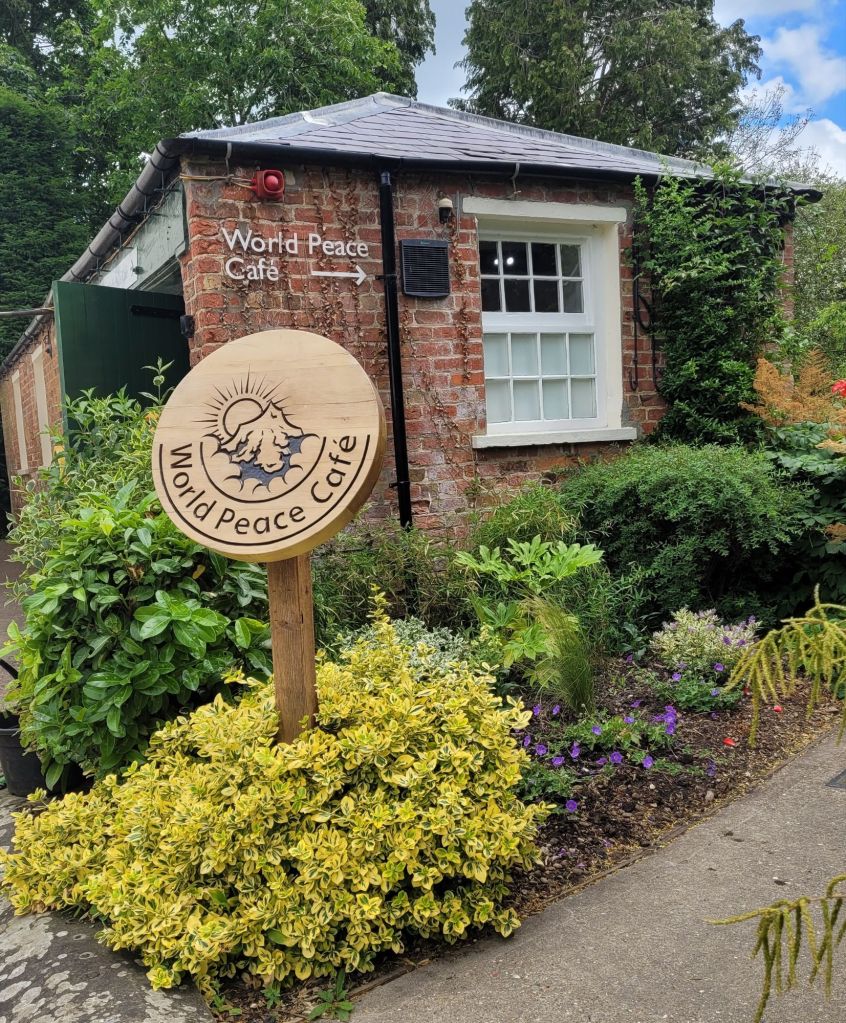
It may not be the only Peace Café in the World, but it is the only one that I know, in this part of the World. And it’s a good one.
The lunch followed a morning of Buddhist meditations and teachings, on how to overcome anger and frustration.
I’ve done a lot of work on my ‘anger issues’ over the last 3 decades but found recently that I needed to do more.
The principle presented in today’s teachings is to practise patient acceptance, with a loving heart.
There are some aspects of my life where I find this easy and joyful, such as the work I’m doing with Lydia. It does require patience, to keep repeating the same training routines and reassurances, and to keep looking for further ways to provide reassurance and help her overcome her fears.
On the other hand, having let go of most of my own anxieties now about being able to keep going on a sustained basis, I no longer feel under any self-induced pressure to achieve ‘outcomes’. We just do what we do, day by day. I love my time with Lydia, and I think Lydia enjoys her time with me too.
I got another ‘wake up’ call from her at 1.30’ish this morning.
This time she did want to go outside, which I presumed was for a toilet need.
Usually, she’ll come back in quite quickly and we settle ourselves down for some more “sleepy time” but this morning I waited a while and then went out to see where she was.
It was a warm and beautiful starry night.
I’m not great on constellations but I did recognise a clear ‘plough’ and a star that shone very brightly, which I thought may have been the North Star.
Thanks to Lydia, I had those few special moments looking up at the stars.
Sitting outside now, as I write, in the sunshine, after a mellow morning followed by a leisurely lunch, I do feel a sense of personal peace that I thought for a long time I would never be able to feel. Yesterday was grief and anger; today is peace.
I’ll still have to keep working at it: meditating; learning; relaxing; growing; writing; loving.
I’m lucky to have a lot of good things in my life and to be able to have days like I’m having today. I do wish that for others too.
I don’t claim to be a dog trainer or a mind trainer – I’m just a woman with a dog who writes a blog, and has written a book, about life, and about being glad.
Lydia woke me at about 1.30am, with a gentle nudge from her nose.
I thought she must need to go outside for a pee but as I started off downstairs, I realised she wasn’t following me. When I went back into the bedroom she was rolled over, ready for me to tickle her tummy; give her a “rub-a-dub-dub” massage that she’s growing to love. So I did.
Now, I realise I probably shouldn’t be encouraging disturbances to my sleep in this way, but then again she asked so nicely, and I do think we are approaching a breakthrough position with addressing her anxiety. So, I give her plenty of “rub-a-dub-dubs” before reintroducing her to the idea of “sleepy time”.
This afternoon, I had a good play session with my steam cleaner. It’s almost as good fun as a pressure washer and the bathroom is now clean.
After a shower – in my now clean bathroom – and an early change into pj’s, I sat outside for a while, reading.
I finished the autobiography that I’ve been reading for a couple of weeks. It ended with an account of an inquest into the death of a family member. The writer’s loss is immeasurable, as is the courage and humanity shown by him and his family. Re-engaging with life, through grief, isn’t easy, but they are doing it. Every day, they are doing it.
I don’t claim to be a dog trainer or a mind trainer – I’m just a woman with a dog who writes a blog, and has written a book, about life, and about being glad.
I don’t like a lot of fuss. I just have a wet trim, but it’s a good one.
The hairdresser is tired, almost to the point of tears. She needs a rest, a holiday.
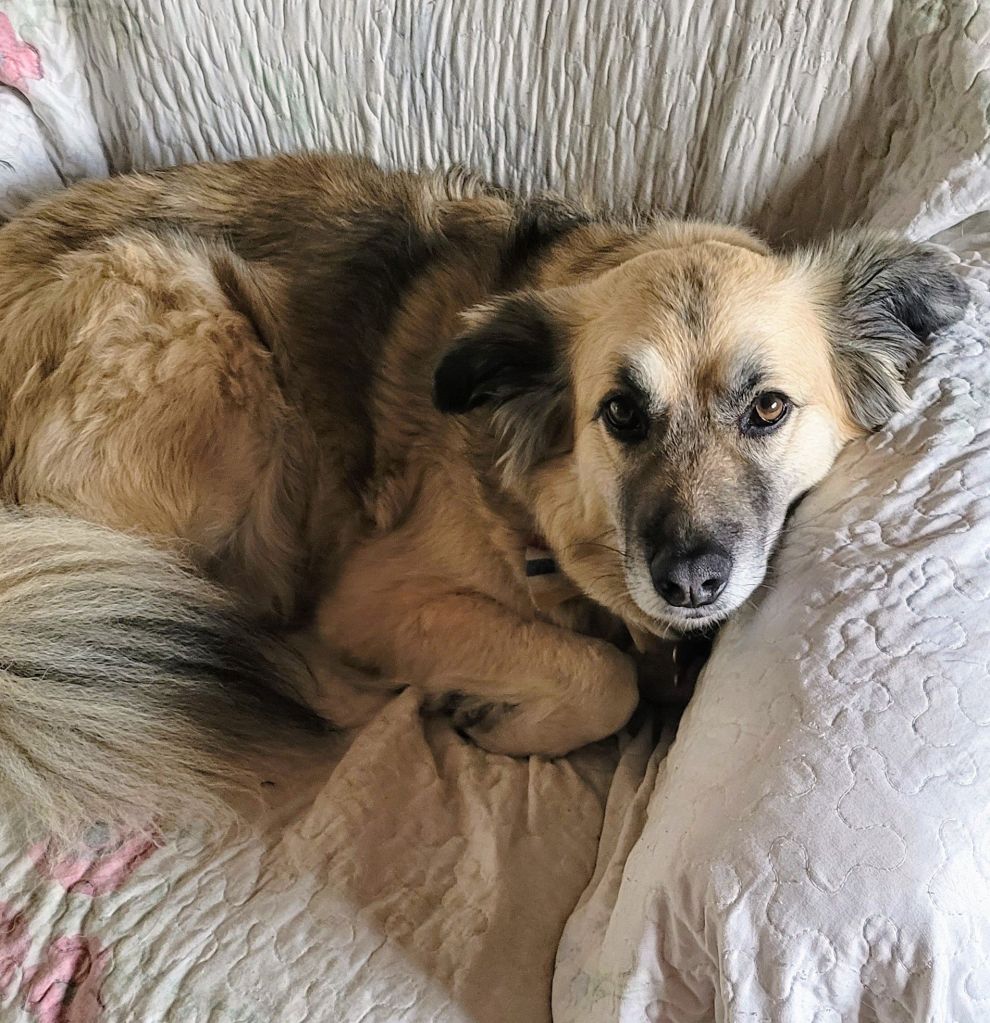
Lydia is enjoying the return of sunshine in our back yard. She’s been an absolute delight to be with today. I’ve given her lots of “rub-a-dub” massages and she’s loving them.
I’ve booked in to a half-day retreat at the Buddhist Centre on Saturday – overcoming anger and frustration. I’ve also booked to go to the Hepworth Gallery in Wakefield on Sunday where they have a Ceramics Fair. So, a good weekend lined up and an easy day tomorrow.
Oh, sleep it is a gentle thing …
My book, Train your dog; train your mind – positive reinforcement for humans and canines – is now available in paperback: https://amzn.eu/d/eQ2sWjU.
The Kindle version is currently for sale at £3.99 on a Kindle Countdown deal https://amzn.eu/d/99yW3Qk.
Lydia enjoying a yak’s milk chew yesterday evening
Continuing the story of Lydia and Me
“Oh, what a beautiful day!”
Yesterday I sat outside on a bench, with a friend. We were watching the world go by. Our part of the world, in our village. It was quiet, with just a few passing cars, people and birds.
Then my friend suddenly burst into song: “Oh, what a beautiful morning! Oh, what a beautiful day!”* And I joined in.
It was a moment I will treasure and will always remember every time I now walk past or sit on that bench.
My friend, in her eighties, suffering from dementia and grieving the loss of loved ones from her life, gave me a great gift. She transformed my day into a beautiful one, through her spontaneity and joy; the joy of her loving heart, however sad it may be.
This morning as I woke, I found messages on my phone from members of a WhatsApp group I belong to. It’s a group called ‘Sangha Meditation’. ‘Sangha’ is a Buddhist term for ‘community’ and I really value the support and sense of community that centres around the Buddhist teachings that I go to. The messages were very simple – people just checking in to see who was planning to go the evening meeting – but it was good to be included in that very simple exchange. How wonderful!
This evening’s class will be the last in a series of four, on the theme of ‘Transforming Adversity’.
I’ve had a massive amount of support from friends and therapists over the last few years of my life, when I’ve been doing my best to deal as positively as possible with a very difficult and complex set of circumstances. I’ve also been taking on board the Buddhist teachings, as presented in these weekly classes, and occasionally at weekend and day retreats.
The practice of meditation has been and continues to be a transformative process for me. I still have a long way to go to achieve the calm and peaceful mind that I aim for. However, thanks to friends – in the village and in the wider community – I do now have moments of spontaneously feeling happy.
I think Lydia has moments when she spontaneously feels happy too. We’re getting there.
My book, Train your dog; train your mind – positive reinforcement for humans and canines – is now available in paperback: https://amzn.eu/d/eQ2sWjU.
The Kindle version is currently for sale at £2.99 on a Kindle Countdown deal https://amzn.eu/d/99yW3Qk.
I don’t claim to be a dog trainer or a mind trainer – I’m just a woman with a dog who writes a blog, and has written a book, about life, and about being glad.
The newly ploughed field that we walked around this morning. It used to be covered with dandelions. I wonder what will grow there next…
Continuing the story of Lydia and Me
Wonderful weather!
I do love the sunshine and warm weather, but it’s also good to appreciate other weathers too.
This morning, walking Lydia, there was a warmish wind and a few spots of summer rain. I love summer rain, the way it brings out all the earthy scents from the ground.
We had a longer walk than we’ve been having when it’s been hot.
I continue to ask Lydia to “sit” and “wait” before she gets out of the car. I think she doesn’t understand why she needs to do this – why would she? – but she’s starting to resist less. I rub her neck and ears and talk to her while we’re waiting, and think this helps. It’s all about rushing less and being more in the moment.
She has really taken to the “sit” and “wait” routine before we leave the house now, and I give her lots of praise as well as treats. When she makes a soft, gurgly noise from the back of her throat, I think I must be doing something right. She just sounds happy.
I did what I do to reassure her when we had cars passing by on two occasions. She didn’t lunge or bark but they weren’t particularly close either.
A man with two dogs who I am familiar with walked by on the other side of a drainage dyke. I don’t think she saw the dogs because of the height of the grass growing on the banks either side, but she did see the man and started to lunge. I did what I do, and she settled. I gave her some “rub-a-dub-dub” massages and we did a few repeats of the “watch” routine before we continued on.
Earlier, before we’d set off for our walk, she barked at a window cleaner working next door. I called out “here” and she did! Progress. Step by step, day by day. Progress.
Progress for me too. I am so enjoying writing this blog and engaging with interactions around the publishing of it.
I had a good sleep again last night. It may have been aided by the cheeky little gin and tonic I had, sitting outside in the not-so-warm weather. I also read a little – an autobiography which has a very sad central theme with many aspects that are essentially and vibrantly life affirming around that. Good to be reading again, as well as writing.
Train your dog; train your mind – positive reinforcement for humans and canines – now available in paperback: https://amzn.eu/d/eQ2sWjU.
The Kindle version is currently for sale at £2.99 on a Kindle Countdown deal https://amzn.eu/d/99yW3Qk.
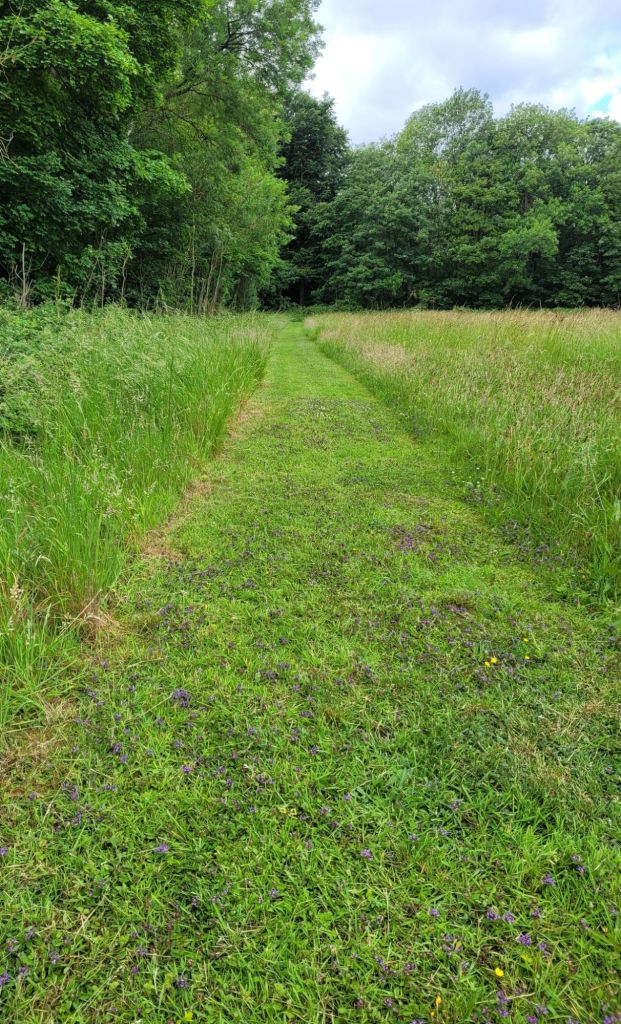
The path beside the wood: a carpet of green with purple, yellow and cream
Continuing the story of Lydia and Me
I slept!
After resting from late afternoon into the evening, I slept.
I decided to take two paracetamol tablets, eventually, to help set me off. I do this only very occasionally. I’m wary of relying on medication to help with relaxing and sleeping. They are addictive and eventually don’t work.
30 or so years ago, after I’d had a complete breakdown in all aspects of my life, I became addicted to prescription tranquilisers and sleeping tablets. Never again.
I detoxed by walking miles and miles in the hot Mediterranean sun, sweating it out. To do cold Turkey I went to hot Turkey. It worked, and after that I started finding more constructive ways to manage my mental, physical and emotional health.
It hasn’t been and still isn’t easy but I push through on positives, most of the time.
Today I’ll have another woodland walk with Lydia; then go to a yoga class for an hour and a half this afternoon. There is no Qigong today – we have a week’s break between blocks of three. I’ve already done some physio exercises for my knees, while waiting for the kettle to boil.
Yesterday’s wall of emotional exhaustion is no more.
As I enjoy spending a bit more time in bed, I listen to whatever sounds the world is bringing to me: the beep of a lorry reversing, the gentle rustle of leaves, a motorbike revving and cars passing by. They’re nothing spectacular but they are the sounds that are here for me this morning, and I like them, just as they are.
Train your dog; train your mind – positive reinforcement for humans and canines – now available in paperback: https://amzn.eu/d/eQ2sWjU.
The Kindle version is currently for sale at £1.99 on a Kindle Countdown deal https://amzn.eu/d/99yW3Qk.





 Glad About
You must be logged in to post a comment.