It was an early start for Lydia and me this morning.
I’d set the alarm for 6.15 but was awake and got up before then.
After a quick cup of tea I took Lydia out for a walk.
She is very amenable and adaptable to changes in routine. We normally have a slow start to the day and I take her out mid- to late morning. However, she took it in her stride – literally – as we walked together for about an hour before heading back for breakfast.
Leaving Lydia at home with Trev, I set off to go to a half-day course at the Buddhist Centre, about a 50-minute drive away.
It’s an easy drive and I arrived in good time for the start of the session: Finding the Hero Within.
I was relieved to find that it didn’t mean I had to be able to quickly don a cape and a vest with a big ‘S’ on it and whizz about in the sky.
The ‘hero’ or ‘heroine’ was defined as anyone who made the decision to train their mind to identify, reduce and eventually eliminate delusional thoughts. Delusional thoughts are those such as ignorance, desirous attachment and anger. These delusional thoughts lead us to believe that our happiness is dependant on external factors or other people rather than ourselves.
For me, an important aspect of the teaching this morning was the emphasis on meditation as the primary means for training the mind, and the acknowledgement that it was all about building things up, bit by bit. Making the commitment, and taking small steps towards achieving it, are the key, with the ultimate aim of building our capacity to be of benefit to others.
This brings me to self-management rule no. 26:Your brief case is an important tool. Use it well. Use it wisely. I’ve struggled with using my brief case – my life – well and wisely, largely because of the mental health complications that I developed as a child and young adult.
I’ve had to do a lot of unravelling, and that in itself has been debilitating and exhausting. Having said that, perhaps what I’ve done is the best that I could do in the circumstances that I was presented with, and now I can start to do things differently, in the circumstances I’m now in?
There is really only one answer to my question, so I’ll continue to meditate, read the dharma (teaching) books, go to classes and retreats and find whatever way that I can to be the best person I can be, for the benefit of others.
I have to confess I find it daunting – terrifying – but bit by bit, step by step, is the way.
The health benefits of exercise are well recognised.
Exercise also keeps the brain and your other vital organs healthy.
Experts believe exercise releases chemicals in your brain that make you feel good. Regular exercise can boost your self-esteem and help you concentrate, sleep and feel better.
“I get a huge buzz from my rock ’n’ roll class. Hours later, my legs ache, but I’m still smiling.”
Exercising doesn’t just mean doing sport or going to the gym. Walks in the park, gardening or housework can also keep you active.
Experts say most people should do about 30 minutes’ exercise at least five days a week.
Try to make physical activity that you enjoy a part of your day.
We all know this and are likely to have had direct experience of these benefits.
Why, then, can it still be so difficult to find the motivation to exercise?
It’s an issue that I’ve struggled with all my life, experiencing barriers associated with body image when I was younger. I knew swimming was good exercise but would only ever go to a swimming pool or wear a swimsuit on a beach if I’d starved myself to be thin enough to feel able to do that. And even then, I felt morbidly self-conscious about how I looked. It took a long time and a lot of working through masses amount of personal ‘stuff’ before I could stop worrying and start enjoying swimming. My partner and I even go wild swimming now, and it feels wonderful.
I tried jogging but always found it so hard to build myself up to a regular routine. Lacking in willpower and discipline some people might say. Struggling with severe depression, anxiety and low self-esteem was the real reason. I’ve continued to struggle ever since, but have also never given up. Now 65, I’ve been doing on-line exercise classes, including yoga and pilates during lockdown. Last summer we did some cycling around our local lanes. We still both find that it’s an effort to go out, sometimes, but give each other a push and/or moral support when we need it. Whatever it takes.
What’s the alternative? An inactive old age with all the complications that brings?
I’ve always found it difficult to go to a gym or to exercise classes after work. Just getting through a day involved such a major effort for me. So, I looked for ways to combine exercise into my daily routine. Cycling to work meant that I often turned up looking like a drowned rat, but it did help.
Even so, I continued to struggle with depression and continued to find it hard to motivate myself to exercise enough to help it lift on anything more than a temporary basis. I felt like the only way I could sustain the ‘lift’ would be to train as if I was an Olympic athlete. I have neither the physique nor the talent to be anything remotely akin to athletic and, like most people, have had to commit a significant amount of my time to earning a living and keeping up with the usual day to day domestic activities.
There were times as well when I felt that the more I exercised, the deeper my depression went, after the initial ‘buzz’ fell away.
I continued to have to do a lot of work to try and shift it, with exercise being one of a number of tools and techniques that I’ve tried and tested over the years. It has been, and continues to be, a lifetime endeavour. I think that this is in part because of the way emotions are stored in the body, a matter which has been increasingly recognised and written about including the following article by Sean Grover (2018):
For years, I’ve made a study of where people tend to store their unwanted emotions. Certainly, not all body aches or illnesses are psychosomatic. However, as I studied people’s bodily reactions to stress, recurring patterns emerged.
Healthy vs. Unhealthy Repression
Fear is the driving force behind repression, and is frequently rooted in your past. Repression is often necessary, particularly when you feel overwhelmed or experience trauma. But an overdependence on repression fuels psychosomatic symptoms and self-destructive patterns.
In his article in Psychology Today, Sean Grover goes on to identify the ‘Top 10 Tension Areas for Unwanted Feelings’ as:
1.Lower Back: Anger 2. Stomach & Intestines: Fear 3. Heart & Chest: Hurt 4. Headache: Loss of control 5. Neck/Shoulder Tension: Burdens 6. Fatigue: Resentments 7. Numbness: Trauma 8. Breathing Difficulties: Anxiety 9. Voice & Throat Problems: Oppression 10. Insomnia: Loss of self
I find this interesting and helpful, relating these areas to recent and past experiences.
I did a lot of work on repressed anger at one point, including going to a workshop where I was encouraged to take a lot of it out on a punch bag. The physicality of the release at the time was phenomenal (although I did go into a kind of ‘toxic shock’ afterwards, so I would not recommend anyone trying this approach without a very strong support network around them).
Some years later, experiencing stress at work, I searched out volunteering opportunities, finding an outlet by doing trail maintenance work where I could break big rocks into smaller rocks to make hardcore with a sledgehammer. I came back refreshed and invigorated. Although the effects did wear off after a while, I have so far – touch wood – not suffered from lower back problems.
Fatigue and resentments strike a chord with me – I’m so good at hanging on to them, no wonder I feel tired all the time!
So, while I’ve done a lot of work on myself to get to this point, and to feel largely positive about the position I’m in, there’s still a lot to do.
It’s often the enormity – or perceived enormity of the challenge – that puts us off dealing with it, which leads to repression, which leads to depression….
There are no easy answers or quick fix solutions, especially when difficulties are deep-rooted. I just keep reminding myself that it’s all about the next step. And the one after that. And the one after that. It does get easier. Miraculously – it feels to me – my steps feel a lot lighter, at the age I’m at now, than they did when I was young, all those years ago! Something must be working, somehow. Barriers can be overcome. It’s not easy, but it’s worth working at it, bit by bit.
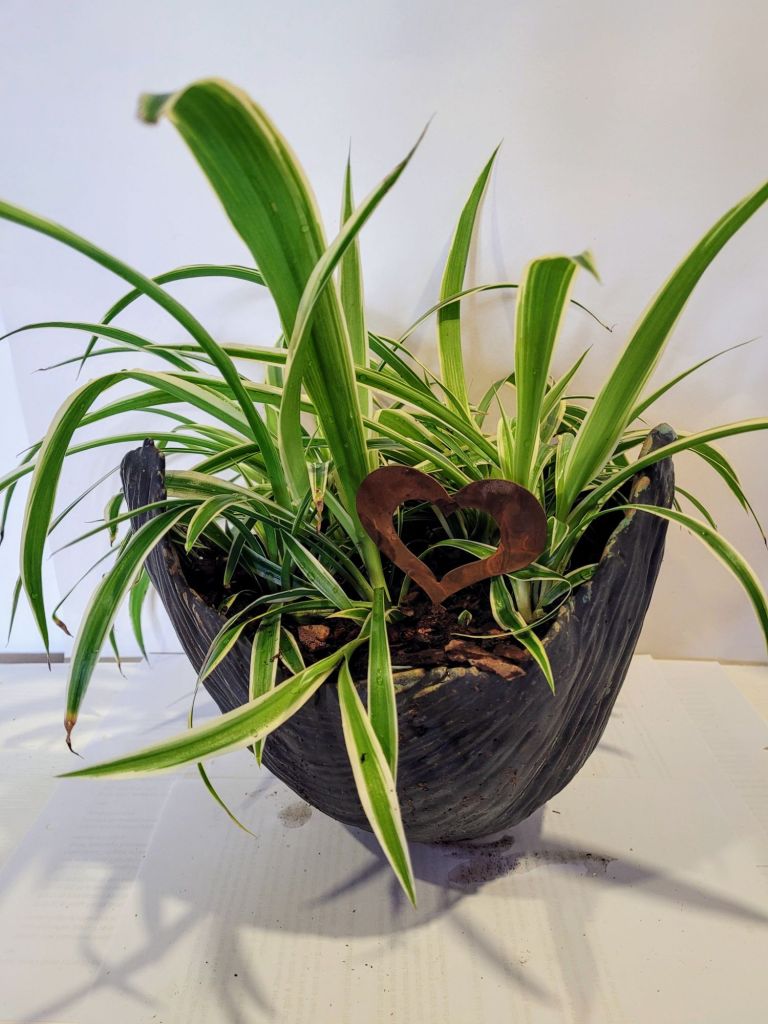
Spider plants that my “supreme unchanging friend” Maxine grew for me
There were big farm machines harvesting crops in the fields by the side of the road where Lydia and I walked this morning. She’s quite used to farm trucks now and was generally quite settled as they passed.
I’m feeling generally quite settled, although I do have a dentist appointment today. I’ll just concentrate on my breathing and I’m sure it will be fine.
I’m continuing to steadily prepare for the Aldborough & Boroughbridge Show on Sunday.
As featured in yesterday’s post, I’ve planted up some of my pots, with plants that I bought, such as ivy and a heart-shaped vine, but mostly using spider plants that my friend Maxine propagated for me. Everyone should have a friend like Maxine, not just because she propagated spider plants for me – and also gave me some pepper, tomato and cucumber plants that she’s grown from seed – but because she’s been there for me at every turn through some very dark and difficult times. She’s the “supreme unchanging friend” that the Buddhist teachings talk about.
Last night’s class was the fourth on the theme of ‘Cool to be Kind’. We looked at the “mirror of dharma”, reflecting on how easy it is to see the faults of others but how Buddhist teachings (dharma) can help us to cherish others instead.
The reference book for last night’s teachings was, ‘The New Eight Steps to Happiness – The Buddhist Way of Loving Kindness’ by the Venerable Geshe Kelsang Gyatso[1].
I have a copy of this book and when I picked it up this morning, found a bookmark at page 149. This is the start of a chapter, ‘Accepting Defeat and Offering the Victory’, with the verse:
When others out of jealousy or anger Harm me or insult me, May I take defeat upon myself And offer them the victory.
This is something I’ve been working on doing, particularly over the last 18 months. I haven’t and don’t find it easy, and in fact I find it psychologically and emotionally draining. But it somehow feels like the right thing to do. It offers a way forward for me, even though I don’t know where that way forward is leading.
However, I do have good friends to share my journey with me; and a Show to go to on Sunday.
[1] Founder and spiritual director of the New Kadampa Tradition – International Kadampa Buddhist Union
I don’t like a lot of fuss. I just have a wet trim, but it’s a good one.
The hairdresser is tired, almost to the point of tears. She needs a rest, a holiday.
Lydia is enjoying the return of sunshine in our back yard. She’s been an absolute delight to be with today. I’ve given her lots of “rub-a-dub” massages and she’s loving them.
I’ve booked in to a half-day retreat at the Buddhist Centre on Saturday – overcoming anger and frustration. I’ve also booked to go to the Hepworth Gallery in Wakefield on Sunday where they have a Ceramics Fair. So, a good weekend lined up and an easy day tomorrow.
Oh, sleep it is a gentle thing …
My book, Train your dog; train your mind – positive reinforcement for humans and canines – is now available in paperback: https://amzn.eu/d/eQ2sWjU.
The Kindle version is currently for sale at £3.99 on a Kindle Countdown deal https://amzn.eu/d/99yW3Qk.
1.Lower Back: Anger 2. Stomach & Intestines: Fear 3. Heart & Chest: Hurt 4. Headache: Loss of control 5. Neck/Shoulder Tension: Burdens 6. Fatigue: Resentments 7. Numbness: Trauma 8. Breathing Difficulties: Anxiety 9. Voice & Throat Problems: Oppression 10. Insomnia: Loss of self
I found that list helpful then, and I do now.
Historically I’ve had a long struggle with anger. I’ve done a lot to address this, as I described in my blog from 2021, and continue to do so.
I’ve recently worked through sudden surges of fear and anxiety, as described in my book, Train your dog; train your mind – positive reinforcement for humans and canineshttps://amzn.eu/d/eQ2sWjUhttps://amzn.eu/d/99yW3Qk. (also available for Kindle, see below)
I don’t have any problems with my stomach and intestines, nor breathing difficulties. I used to suffer from fatigue but don’t anymore, generally sleep well, never get headaches and am altogether faring very – and thankfully – well for my 69 years.
I could just be lucky and, in many ways, I know that I am. I am very very fortunate to have the robust and healthy body that I have. But I have also done a lot to work through negative emotions, as well as finding ways that work for me to keep my body fit and healthy.
Having established a basic pattern – incorporating Qigong, yoga and walking – into my weekly routine, I’m sticking to it.
A step at a time, a day at time. It’s amazing how it builds up until you realise that you don’t have to make quite so much effort that you used to have to make, because a lot of the inner resistance has gone.
As I write, Lydia lies sleeping on the floor in front of me. She rests and sleeps a lot but she’s approximately 10 years old. She readily jumps in and out of the car with ease, rolls around in the dog park, runs about wearing her ‘happy legs’ as I call them. She’s booked in for a routine health check at the vets next week but I’m fairly confident she has no issues with her heart or digestive system (I make sure that good stuff goes in and monitor what comes out). She continues to have fear and anger issues on sight of her triggers: other dogs, some people, moving vehicles.
We’ll keep working on our residual tension areas, together.
It probably won’t be easy, but we’ll do it, step by step, day by day.
Train your dog; train your mind – positive reinforcement for humans and canines – now available in paperback: https://amzn.eu/d/eQ2sWjU.
The Kindle version is currently for sale at £0.99 on a Kindle Countdown deal https://amzn.eu/d/99yW3Qk.
The Buddhist teaching last night was about ‘patient acceptance’, this being the opposite of anger.
I have been working on patient acceptance for some time, and also been struggling with anger.
In his book, ‘How to Transform Your Life’, the Venerable Geshe Kelsang Gyatso Rinpoche says that “We need to think about our own faults because if we are not aware of them we will not be motivated to overcome them.”
I have been motivated to overcome my fault of anger and continue to be motivated to do so; never more so in my life than I am now. Meditating helps.
The benefits of meditating in a group, for me, are significant. That doesn’t mean that I can’t and don’t benefit from meditating on my own, but there is something about a group meditation that I find has a calming effect, at a very deep level.
Today, I don’t feel angry.
It’s now early evening.
I had a lovely walk with Lydia this morning, then met up with a friend and sat outside in the sunshine, then met up with another friend and had a walk with her and her dog. I think that all adds up to a very good day. I am very lucky, to have had such a good day, today.
Lydia is lying quietly outside. It’s very peaceful here.
I received some bad news as a bolt out of the blue, and it hit hard.
It could be argued that I could have foreseen it coming, but I didn’t.
The calm, peaceful mind I’ve been cultivating was suddenly no more. I was angry.
I know anger is a negative emotion, and the teachings of Buddha tell me that it arises from self-cherishing delusions; having more regard for myself and my own needs than for those of others.
I do accept this, in principle. In practice, yesterday my anger arose and was a long time abating.
As I continue to learn how to train my mind – and my heart – anger is something that I need to and will address. I’m going for growth.
Today, on my walk with Lydia, I am still aware of anger. It feels like it is pervading my whole body.
I have concerns that Lydia will pick up on this, but she doesn’t seem to have done.
We are in a quiet spot with no immediate triggers. Lydia is calmer today than she has been on this same walk for some time.
She walks to heel with a loose lead most of the way, and I reinforce this with food rewards and praise.
It rains a little bit but neither of us minds. Then the sun comes out.
I’m going to visit friends this afternoon. It will be another good day. And this time I believe the good feeling will stay, at least for longer than it did yesterday.

 Glad About
You must be logged in to post a comment.