Doing again

First published 28 December 2021
At the turn of the Millennium, I completed a project under the Mind-Millennium Award Scheme.

My project – the Lifelines Project – involved collecting and publishing poems, pictures and self-help strategies from other people who, like me, had suffered from enduring and debilitating depression.

I had not met many of the contributors, and was amazed – honoured – that they trusted me with their personal expressions, all because of the underlying intention of reaching out in the hope of helping others.

If you, yourself, are suffering with depression, I would like to wish you well and tell you that you are not alone.”

Since then, there’s been increased awareness about mental health and how it can be improved.  While there remains much to be done in society from the ‘prevent’ and ‘promote’ perspectives, being able to – and even encouraged – to talk about mental health difficulties more openly represents a start.

In my own experience, I eventually got fed up of talking – I’ve never been much good at it anyway.  I knew that I needed to take action, to find ways of turning my life around, however difficult or painful that might be.  And I knew it would be difficult and painful, to rebuild from a below zero level when I was in my forties.

From somewhere, somehow, I found the resolve to put my head down, prioritise, and push myself through.  For a long time, I concentrated on work and on developing my internal resilience.  Just before I turned 60, I decided to take the plunge and commit to a relationship. I now have a much fuller and richer life than I have ever had before and I’m thankful for that.

Even so, life continues to be difficult and I still take antidepressants – probably always will. But I have other coping skills and strategies, and have also been able to recently retire, taking away work pressures that I could no longer deal with.

I wasn’t able to keep in touch with all the people who contributed to the Lifelines Project but they’ve always remained in my thoughts and I hope that they too have been able to find a way through; a way that works for each of them:

Sylvia

Marcia

Maggie 2

Peter

Virginia

Henzie

Maggie 3

Jonathan

Fiona

Sean

Christopher

Polly

Christine

Caz

John

Caroline

Frances

Susan

Patricia

Mary

Dave

Mark

Tony

Iain


From major to minor

Photo by Kristina Paukshtite on Pexels.com

I’ve recently come through a minor breakdown.

I make the distinction between a minor breakdown and a major breakdown on the basis of the level of functionality that I lost, and the time it has taken to return to a semblance of normal functionality (whatever that means).

When I had a major breakdown over thirty years ago, it took years to recover to the point where I could do paid work again (although I did a lot of voluntary work as part of the recovery process).

In the years leading to my major breakdown, which was effectively from my teens until my late thirties, I developed unhealthy coping strategies.

With no idea how to deal with things differently, I worked out ways of getting through that worked – to a degree – but they weren’t sustainable, and I came crashing down.

“The wound is the place where the Light enters you.” – Rumi

The main thing was – in the trauma of the breakdown experience – I didn’t give up; the survivor in me kicked in. Reaching out for and finding sources of support helped me to rebuild. I started to retrain my brain through meditation and affirmations, did hard physical work and exercise when I could, pushed myself when I felt I needed to; tried to rest and relax into feelings that had previously been buried and then surfaced like a volcano. They were so difficult to deal with.

What do I do
with all these feelings?
Do I chew them up

and spit them out
and start again?
And if I do
what then?

I’m now retired, so in a sense the pressure is off, in that I don’t have to recover enough to fulfil the demands of a job. However, in retirement it is all the more important – and can be difficult – to find reasons to be motivated; to get up in the morning; to have a sense of purpose.

After my recent breakdown, and with support from my partner, good friends, and effective medication, I was able to start drawing on these healthier coping strategies fairly quickly, because I had already built them in to my life over many years; they had become part of my ‘muscle memory’, in brain and in body.

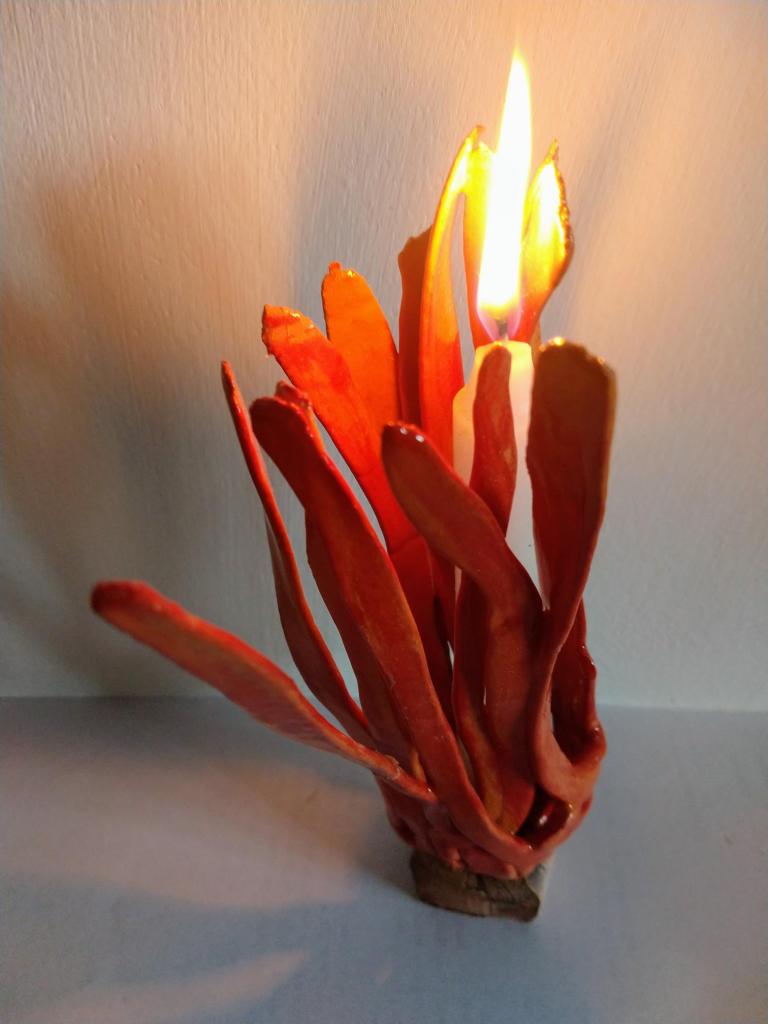
The Chinese exercise for health and well-being – Qigong – works on the whole person; walking our dog takes me into fresh air and the opportunity to appreciate the morning or evening light; making things with clay helps to take my mind away from unwelcome thoughts; Buddhist mind training helps me to just accept these thoughts as thoughts; meditation and affirmations provide the opportunity to let go of negative and introduce positive, even if it’s just for a few moments.

I haven’t yet achieved that all elusive peace of mind – my mind is still a work in progress – but I can at times feel a sense of peacefulness in the moment, and that is very welcome.