After a morning walk with Lydia and an afternoon visit to see a friend, I settle down to a relaxing evening.
Nothing much to do; nothing to prove.
I don’t know what the future holds, and have a lot of fear associated with this, but I can’t do any more, for now.
All I can do is what I’ve been doing, take each day at a time and be as positive as I can be within it; also accept that some days are better than others and sometimes it’s good just to do very little.
This morning, I said some prayers for meditation that are provided in the book, Universal Compassion, by Geshe Kelsang Gyatso Rinpoche. I’m familiar with these prayers as I’ve recited them several times at different ceremonies I’ve taken part in at Buddhist Centres over a number of years. It felt good, to refamiliarize myself with the words, that are so soothing and somehow reassuring. I don’t even feel I need to fully understand them, just say them, meditate and take it on faith that they will help me through; they are helping me through.
After each meditation at the Buddhist class that I go to in Pontefract, or the Centre that I go to in Pocklington, we are invited to listen to or participate in the chanting of ‘The Liberating Prayer’[1].
I choose to chant and I love the words of this prayer. I also often say it to myself at other times, when I wake, for example, or when I feel a sense of anxiety surging. Saying the prayer, combined with practicing some breathing meditation, takes me into a better place mentally.
[1] Composed by Venerable Geshe Kelsang Gyatso Rinpoche and recited at Kadampa Buddhist Centres throughout the world.
After yesterday’s sensation of clarity and light emerging, today brings an inner pull into heavy and dark.
Recognising this as part of a process is important. The dark thoughts are the deluded thoughts; the process of moving from dark to light takes time and effort; practice, patience and persistence.
Following an early visit with Lydia to Vicky the groomer and then a walk, after breakfast – kindly cooked for me by Trev in the form of porridge and a cup of fresh coffee – I went back to bed for a few hours. Lydia was also happy to rest.
It’s unusual for me, these days, to do this. I do generally need to go to bed early and get up late when I can, but this morning it’s fair to say that I felt a pull into dark at a deep level and decided to rest. I have enough positive activity built into my week generally to be able to give in to that inward pull occasionally, and today I needed to just be with it.
Yesterday I missed both yoga and Qigong as I had to get my car fixed. I think this may have played no small part in how I feel today. However, after a couple of hours resting, I get up, brush my hair, put on some make up, give Lydia some fuss, open the back door so that she can enjoy the fresh air, and start writing.
Writing is helping me to process, just like other things are. I’m visiting M in her care home this afternoon and we should be able to go outside into the garden as we usually do on a fine day. I enjoy reading to her; short stories from a magazine. She usually dozes off when I do, which I take as no reflection on my reading style, just a sign that she is relaxed and comfortable in my company. I hope so.
Before heading out I remember to meditate. I don’t have to sit cross-legged – thank goodness, because I couldn’t – but adopt a comfortable seated upright posture and focus on my breath. Fresh air coming through the back door helps.
The gears in my car are still not fixed so I’m taking it back to the garage again this afternoon.
I know it will get sorted, one way or another, sooner or later. I do hope it’s sooner though.
Some clarity of thought is coming through and I woke this morning with a lighter heart than I’ve had for a long time.
Even so, I revelled in being able to lie in bed until after 9am, before getting up, making tea for Trev and me, and then doing a short meditation before taking Lydia out for her walk.
Even just a five-minute meditation on a morning is making a real difference, combined with the group sessions that I take part in on a Wednesday evening and the additional occasional teachings at the centre. It’s a slow shift but a shift nonetheless. Yoga and Qigong also have strong meditative aspects to them, working at different levels.
It’s another warm September morning – we are still so blessed with the weather. I know we are blessed whatever the weather but I have enjoyed the weather this summer, moving into autumn.
While waiting in the queue at the post office I do a few exercises for my knees. They are so much better now than a few months ago and I’m not taking that for granted.
I then went on to buy a large unsliced loaf from the local bakery. Two big chunky slices with olive spread and blackcurrant jam make a delicious breakfast for me while Lydia enjoys her food from her feeding ball.
I think back to when I restricted my food intake to such an extent that I used to do an eight-hour evening shift as a waitress, full on, on my feet and rushing round all that time, before I would allow myself a slice of bread for breakfast the following morning.
Even though breakfast for me now is usually late – today around 11.30am – and I rarely have lunch, it’s not because I’m limiting myself by willpower, it’s just because I don’t want to do things any differently. I don’t want or need three meals a day plus snacks.
I’m not thin, but I’m not heavily overweight either. I have Lydia to thank for that, at least in part. Our regular walks every day give my system a much-needed boost.
As I wake this morning I reflect on a reminder from the Buddhist teachings over the last few months:
Welcome Wholeheartedly Whatever
It isn’t always easy to welcome the difficult stuff especially when it feels like there’s no end of difficult stuff to deal with.
But I find that the more I apply this principle, the more I begin to understand what it means. I’ve still got a long way to go in deepening my understanding of what it means, but I’ll keep working on it.
Today, though tired after yesterday’s intensive session at the studio, including the 50-minute drives to get there and back, I feel a sense of something having shifted in my inner landscape; not a momentous shift – marginal, but a shift nonetheless.
Sticking with a steady routine of walking Lydia daily, going to regular yoga and Qigong classes, building a short meditation practice into my morning routine, benefiting from the expert guidance and teachings from the Buddhist Centre and the weekly classes, and returning to the pottery studio for an afternoon of contemplative creativity in conducive company, are all helping to restore something in me that has needed to be restored for a very long time.
As I write, Lydia is relaxing in a corner of the room on her favourite rug. She’s had her walk and breakfast, spent a bit of time outside doing a bit of barking, and now – like me – she is ready to rest a bit.
I’ll go out later and do a bit of shopping, taking some soft plastic waste with me to go in the recycling bins that Aldi have in store. Their distribution methods do create a lot of plastic waste but at least they provide recycling facilities. Less waste would be better but we all have to start somewhere.
It’s hard to say which self-management rule applies here, although it could be rule no. 13: something to do with responsibility.
A few months ago I had high levels of anxiety which manifested in various ways.
I became highly stressed about my car, as I was having problems with the gears and I started to catastrophise about ‘worst case scenarios’, knowing the extent to which I need my car for daily walks with Lydia.
I pushed through on positives as best I could at the time, the worst-case scenario didn’t present itself and my car has been fine for a few months.
Recently, I’ve started having problems with the gears again.
In the intervening months I’ve taken a lot of time to rest and continue to practice meditation, yoga and Qigong.
I write my blog, in 28-day cycles. The process of writing is proving to be very therapeutic. I’ve written intermittently and irregularly for years but not in the same way as I do now.
My daily walks with Lydia have also been therapeutic, giving us both a good start to the day with regular exercise, fresh air and that all important connection with the natural world. In Lydia’s case a lot of her connection is through her nose; for me it is more a sense of the air around me and the ground under my feet; the slow steady movement of walking.
This time I haven’t experienced high levels of anxiety about my car problems. It’s been a minor inconvenience which Trev has helped me with by picking me up from the garage when I dropped it off this morning. It should be ready later this morning and may need a new clutch in the longer term.
Anxiety, I’m sure, arises from past experiences when we’ve needed to address a problem, and haven’t been able – for whatever reason – to find and implement a solution; where everything fell apart and we had no help in finding ways to put things back together. We’ve learnt to ‘not cope’ and to retreat instead of establishing ways of knowing what to do and how.
When I was younger, I had none of the personal resources and resilience that I have now. I wasn’t taught any coping strategies as any assertion on my part would have upset the status quo, however uneasy that status quo was (and it most certainly was uneasy, at best).
However, through experience and reflection I’ve done my best to learn and change, to take responsibility for the things that make up day-to-day life and to see and do things differently.
I still rely on a small dose of anti-depressant medication every day, but the main processes I use are the ones that are active not passive. Moving from passive to active has been the major achievement of my life. The mental effort it has taken has been enormous and sustained, which is why, at the moment, I need to rest a lot as well. Re-focusing and re-prioritising takes time and I need to continue to trust in the process, however frightening the prospect of uncertainty may seem. I’ve come a long way, just in the last few months. I’m not going back now.
It was an early start for Lydia and me this morning.
I’d set the alarm for 6.15 but was awake and got up before then.
After a quick cup of tea I took Lydia out for a walk.
She is very amenable and adaptable to changes in routine. We normally have a slow start to the day and I take her out mid- to late morning. However, she took it in her stride – literally – as we walked together for about an hour before heading back for breakfast.
Leaving Lydia at home with Trev, I set off to go to a half-day course at the Buddhist Centre, about a 50-minute drive away.
It’s an easy drive and I arrived in good time for the start of the session: Finding the Hero Within.
I was relieved to find that it didn’t mean I had to be able to quickly don a cape and a vest with a big ‘S’ on it and whizz about in the sky.
The ‘hero’ or ‘heroine’ was defined as anyone who made the decision to train their mind to identify, reduce and eventually eliminate delusional thoughts. Delusional thoughts are those such as ignorance, desirous attachment and anger. These delusional thoughts lead us to believe that our happiness is dependant on external factors or other people rather than ourselves.
For me, an important aspect of the teaching this morning was the emphasis on meditation as the primary means for training the mind, and the acknowledgement that it was all about building things up, bit by bit. Making the commitment, and taking small steps towards achieving it, are the key, with the ultimate aim of building our capacity to be of benefit to others.
This brings me to self-management rule no. 26:Your brief case is an important tool. Use it well. Use it wisely. I’ve struggled with using my brief case – my life – well and wisely, largely because of the mental health complications that I developed as a child and young adult.
I’ve had to do a lot of unravelling, and that in itself has been debilitating and exhausting. Having said that, perhaps what I’ve done is the best that I could do in the circumstances that I was presented with, and now I can start to do things differently, in the circumstances I’m now in?
There is really only one answer to my question, so I’ll continue to meditate, read the dharma (teaching) books, go to classes and retreats and find whatever way that I can to be the best person I can be, for the benefit of others.
I have to confess I find it daunting – terrifying – but bit by bit, step by step, is the way.
Lydia has been less inclined to tug on her lead so far this week, in whatever walking places we’ve been to.
It’s a slow process, unlearning ingrained responses to situations and re-learning new approaches.
I know that myself because that’s what I’ve been doing myself, for a very long time: learning to change negative thought patterns and actions to positive ones.
For Lydia, I’ve taken guidance from a behaviourist and from on-line learning, applying and repeating what I believe are sound principles and recognising that there are no quick-fix solutions.
For myself, I’ve learnt what I could from experience and taken guidance from sources that I believe are sound, including Buddhist teachings and meditation practices. Again, there are no quick-fix solutions.
It’s hard to find a balance sometimes, between accepting things as they are, and not giving up.
I have by no means given up on anything although, at the moment, I do feel tired, mentally and emotionally.
There is no Buddhist group meeting this week – due to a summer break.
I’ve twice sat down to meditate on my own today, once this morning and again this afternoon. I much prefer to meditate in a group, but the main thing is that I am doing my best to do it on my own, and when I feel tired.
My ‘old’ way would have been to do nothing because I didn’t know what to do. I do now.
Waking up this morning I reflect – as I often do – on how fortunate I am to have access to the Buddhist teachings that I have access to.
We’re on a short break from the mid-week classes that I usually go to, but my mind turns to two of the mantras that I have been learning from most recently. One is in the form of an acronym: RARE.
Recognise
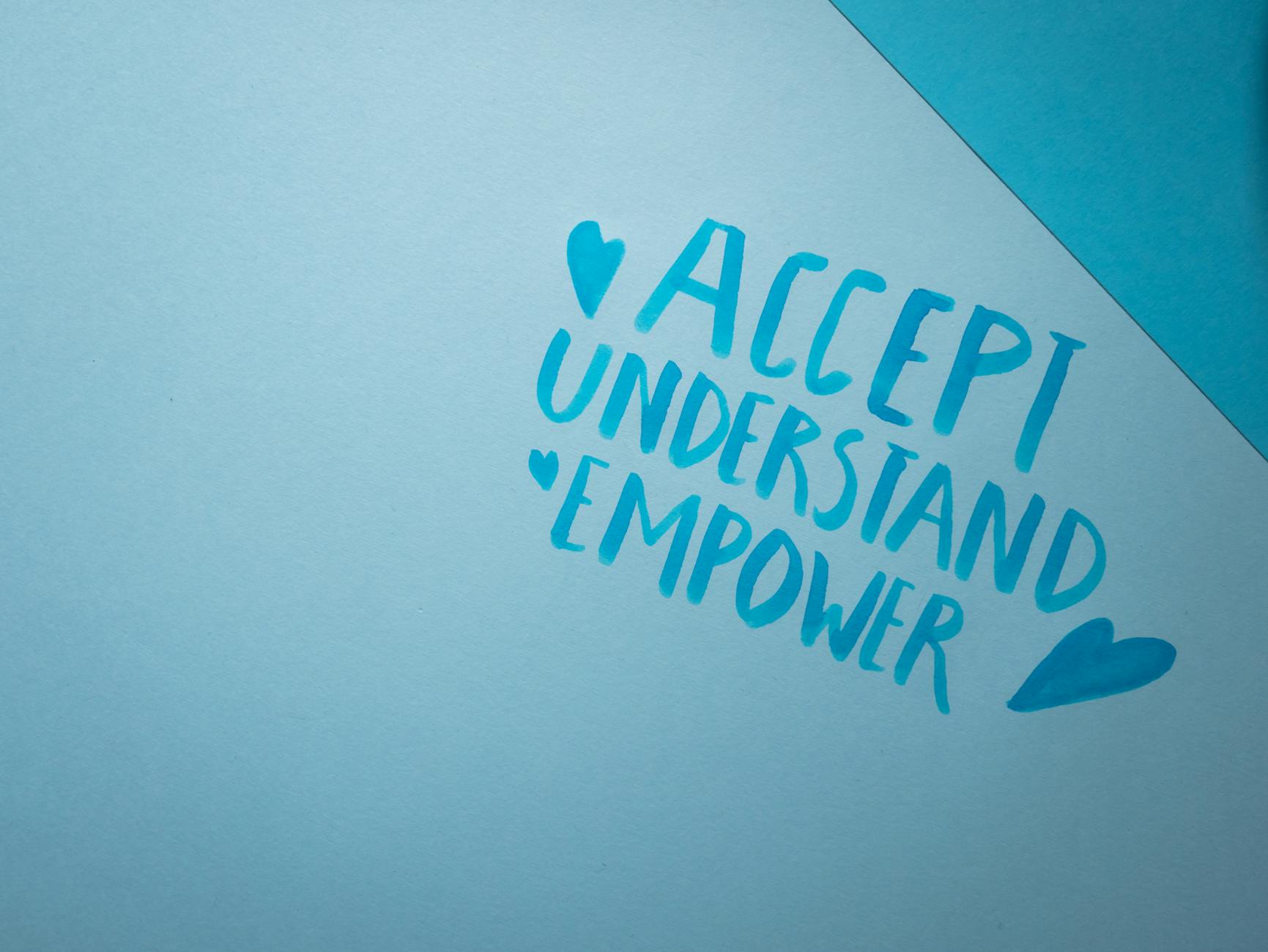
Accept
Reduce
Eliminate
‘Recognise’ is to recognise a negative thought as delusional.
‘Accept’ is to accept the situation in which the thought is arising.
‘Reduce’ is to reduce the impact of the delusional thought.
‘Eliminate’ is to eliminate the delusional thought.
In my experience it can be extremely difficult to identify a thought as delusional because our thought patterns are often so ingrained that we don’t even notice them when they do arise. However, I’ve recently found that if I start to feel anxious, this alerts me to potential negative/delusional thoughts that are giving rise to the anxiety. I can then turn my attention to my breath, engage in a short meditation and find that the anxiety starts to abate.
I’ll continue to do what I can to recognise, accept, reduce and eliminate my delusional thoughts.
Most of us associate ‘www’ with ‘world wide web’ but an alternative presented in a Buddhist teaching recently is: ‘welcome wholeheartedly whatever’.
The nun who gave the teaching presented an example of a monk who lives at the Centre who has significant paralysis, is unable to walk and experiences constant pain. Apparently, he affirms the ‘welcome wholeheartedly whatever’ mantra and I’ve found this immensely humbling and inspirational.
I don’t know how things might unfold in my life – none of us do – but if I keep meditating, keep my focus on positives and aim to eliminate old habits where negative thinking takes hold, then I’ll be better prepared to welcome whatever does lie ahead with an open heart.
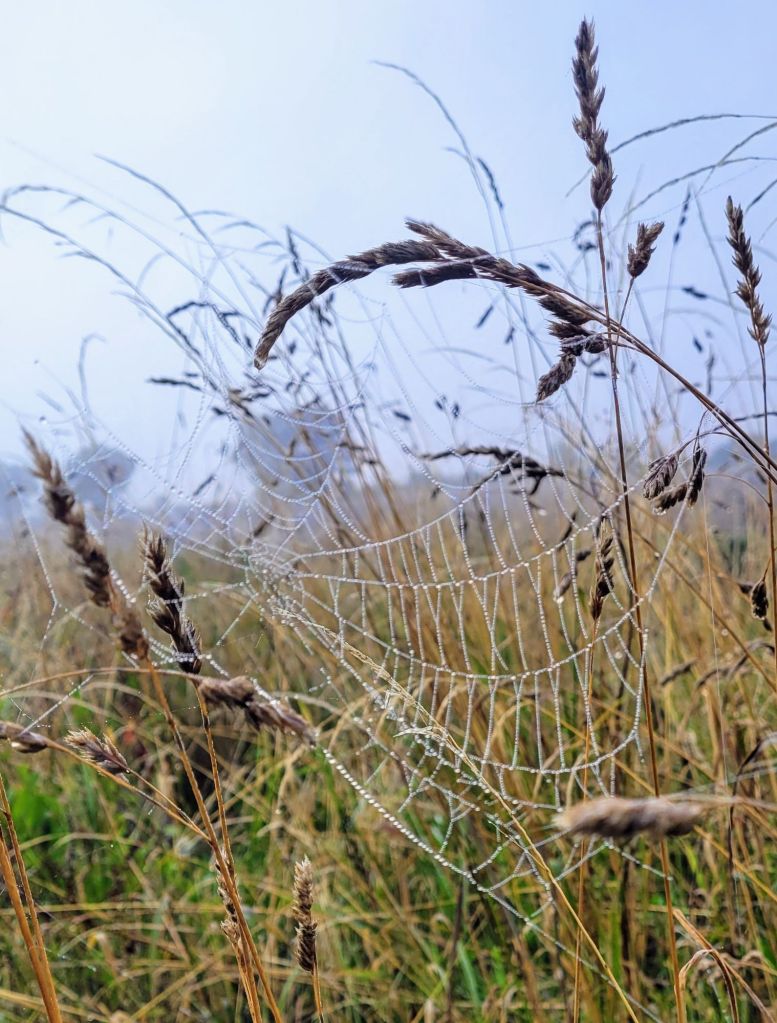
It was misty when we stepped out, and the spiders had been busy all night by the look of it. There were webs everywhere, finely woven and sparkling when the sun started to shine.
After our walk, I gave Lydia her breakfast and headed off to meet up with a friend.
We don’t meet often, this friend and I, but we settled into each other’s company quickly and easily, as only good friends can do.
Like me, she has recently suffered from anxiety, so we were able to ‘compare notes’. She’s found hypnotherapy a great help; I’ve found meditation works for me, along with affirmations.
“I choose to be peaceful and calm. Everything is unfolding as it should.”
I did a quick Google search and it seems that hypnotherapy is not usually available on the NHS, which means that it sometimes is.
I’ll stick with meditation for now, but hypnotherapy is something that I had little awareness of before and know a bit more about now.
We talked about a lot of other things too, of course, and I so enjoyed catching up with my friend. Then I had another good friend to go home to: Lydia of course!
Good friends come in all shapes, sizes and species. I don’t know where I’d be without them.




 Glad About
You must be logged in to post a comment.