We were talking about Christmas jumpers in the kitchen after the Buddhist group meeting tonight.
I don’t have a Christmas jumper as such any more, having sent the one I had to a charity shop a few years ago. I do have a festive jumper though. It is warm and soft with a kind of Nordic pattern on it and I may wear that to the meeting next week.
We meditated on the ‘Om Ah Hum’ mantra with much of the teaching devoted to deepening our understanding of that mantra, which represents the body, speech and mind of Buddha.
Home to lovely Lydia, I give her a few treats and she’s now lying down on the other side of the room, ready I think for her ‘sleepy time’.
I’m not quite ready for my ‘sleepy time’ yet this evening. I may just sit up for a while and reflect a bit more on the mantra.
At the turn of the Millennium, I completed a project under the Mind-Millennium Award Scheme.
My project – the Lifelines Project – involved collecting and publishing poems, pictures and self-help strategies from other people who, like me, had suffered from enduring and debilitating depression.
I had not met many of the contributors, and was amazed – honoured – that they trusted me with their personal expressions, all because of the underlying intention of reaching out in the hope of helping others.
If you, yourself, are suffering with depression, I would like to wish you well and tell you that you are not alone.”
Since then, there’s been increased awareness about mental health and how it can be improved. While there remains much to be done in society from the ‘prevent’ and ‘promote’ perspectives, being able to – and even encouraged – to talk about mental health difficulties more openly represents a start.
In my own experience, I eventually got fed up of talking – I’ve never been much good at it anyway. I knew that I needed to take action, to find ways of turning my life around, however difficult or painful that might be. And I knew it would be difficult and painful, to rebuild from a below zero level when I was in my forties.
From somewhere, somehow, I found the resolve to put my head down, prioritise, and push myself through. For a long time, I concentrated on work and on developing my internal resilience. Just before I turned 60, I decided to take the plunge and commit to a relationship. I now have a much fuller and richer life than I have ever had before and I’m thankful for that.
Even so, life continues to be difficult and I still take antidepressants – probably always will. But I have other coping skills and strategies, and have also been able to recently retire, taking away work pressures that I could no longer deal with.
I wasn’t able to keep in touch with all the people who contributed to the Lifelines Project but they’ve always remained in my thoughts and I hope that they too have been able to find a way through; a way that works for each of them:
I first encountered Qigong when I was exploring anything and everything that I could find that I thought might help to restore my mental health from a point of crisis to some semblance of stability. That was over 25 years ago, and I had a long and arduous journey ahead of me. Along the way I took part occasionally in Qigong classes and workshops. It wasn’t until some years later, however, when I was struggling to push through the challenges of a demanding job – in itself part of my recovery process – that I considered a more regular commitment to the practise of Qigong.
Google searches came up with limited references to Qigong being offered locally. Luckily, one of these few was an evening class at a school just a few miles from where I was living, in Leeds.
An online Medical Dictionary notes:
Qigong (pronounced “chee-gung,” also spelled chi kung) is translated from the Chinese to mean “energy cultivation” or “working with the life energy.” Qigong is an ancient Chinese system of postures, exercises, breathing techniques, and meditations. Its techniques are designed to improve and enhance the body’s qi. According to traditional Chinese philosophy, qi is the fundamental life energy responsible for health and vitality.
The Dictionary goes on to state:
Qigong may be used as a daily routine to increase overall health and well-being, as well as for disease prevention and longevity. It can be used to increase energy and reduce stress. In China, qigong is used in conjunction with other medical therapies for many chronic conditions, including asthma, allergies, AIDS, cancer, headaches, hypertension, depression, mental illness, strokes, heart disease, and obesity.
Qigong is presently being used in Hong Kong to relieve depression and improve the overall psychological and social well-being of elderly people with chronic physical illnesses.
While I can’t claim that I commit to a daily practice – not yet anyway – I have been attending these evening classes – and some day workshops at weekends too – with the same teacher ever since.
When the Covid lockdowns first started, Sue Dunham – the teacher – was quick off the mark with setting up Zoom classes. Just as in the live classes, Sue’s commitment to her own practice and to sharing her knowledge and vast experience has shone through into these Zoom sessions.
Sue doesn’t just demonstrate what to do for us to follow. She talks through and builds up each movement step by step, repeating as necessary; infinitely thorough and always engaging. Her approach is very meditative and mindful, working deep on different themes in each group of three classes. During the height of the pandemic, focusing on the lungs could not have been more appropriate, and we’ve also recently worked on the spine and the digestive system.
Though the movements are slow and steady, I find that I sleep really well after a class session, and wake in the morning with the sense that I’ve had a really good workout, even though it isn’t ‘exercise’ in the conventional sense.
According to Sue:
“Qigong is an extraordinary practice: it can bring you to question fundamental beliefs about mind and your life, bringing you to that in a supported, gentle way. I have found it to be accessible and yet challenging, it’s enigmatic but intriguing!”
One of my favourite Qigong movements is called ‘Healing Form’, and Qigong has certainly become an essential part of my own movement towards health and healing.
When I started to become aware of my body, as a teenager, it was on the basis of how it looked. The negative compulsive obsessions I developed were – I realise now – associated with complex psychological and emotional traumas that have taken me 50 years to unravel.
Fortunately for me, my body was and is healthy and, while I continued well into adulthood to control my life by controlling what I ate, my body served me well. Deep roots hold tight, though, and it was a long time – being ultimately faced with the choice of life or no life – before I was able to find the strength, coping mechanisms, and resolve, to push through and come out the other side.
Qigong has helped me to work at a deeper level with my body – my amazing body.
It hasn’t provided me with a miracle ‘cure’ but it has helped to shift my focus into health and wellbeing, which is where it should be.
I feel a lot ‘lighter’ these days, even though I’m 65 and probably weigh at least 4 stone more than I did when I was 15. At six-and-a-half stone and still feeling the need to lose weight, I was weighed down and locked in as a teenager.
Some of the grief, sadness and regret linger on, but less so day by day. I’m thankful for a lot of things and hope that I can continue to be so for many years to come. Qigong helps me to nurture my body, with all its intricate mechanisms for feeding and flow.
One of the wonderful things about this practice is that it takes me beyond what I ‘know’, what I can measure or evaluate, into that sense of wonder, about what I don’t know, with all the associated mysteries of those realms.
When I’m practising Qigong, under Sue’s infinitely patient and painstaking instruction, I feel as graceful as a dancer, and that – for me – is something of a miracle.
The Covid pandemic has shown us just how vulnerable any of us can be, at any age, but also how those vulnerability factors can increase as we get older. The more we can do ourselves to mitigate those factors, the more likely we are to be able to lead fulfilling, meaningful lives for longer. That’s my plan, anyway, and I’m sticking to it!
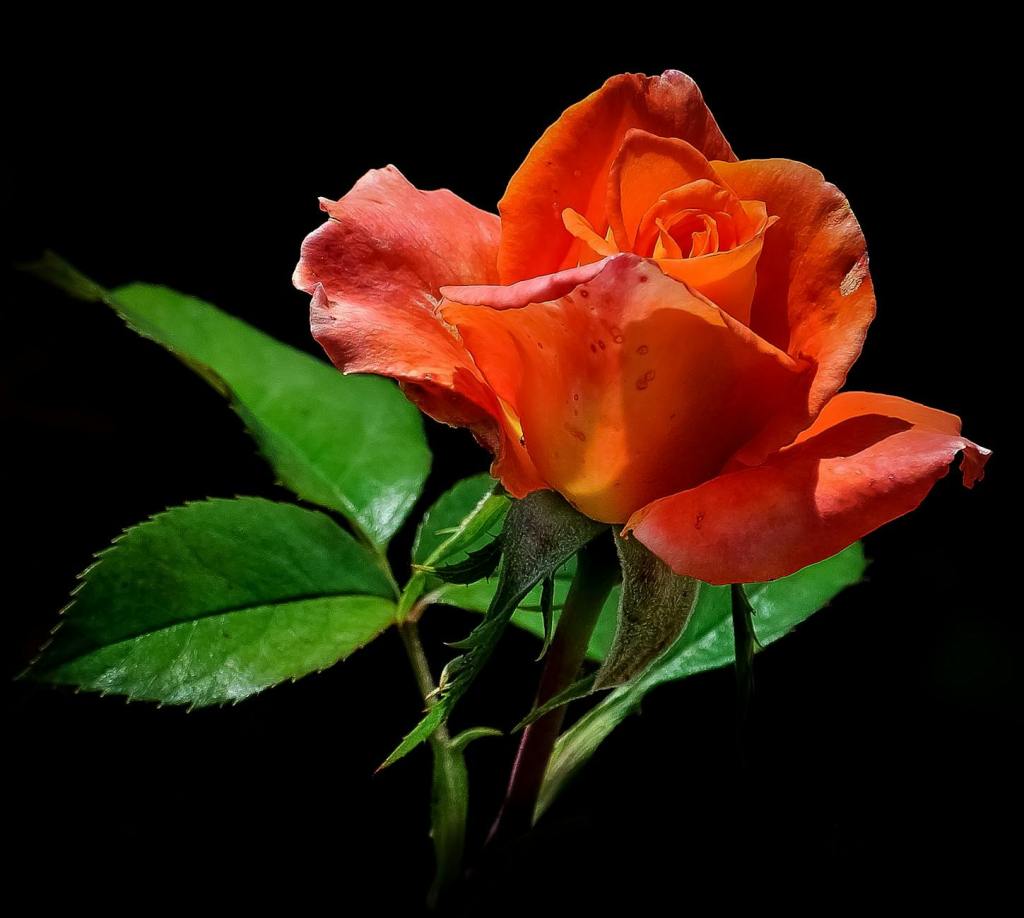
The pathways of my mind Are not defined Just like well-pruned roses They shoot and sprout In all sorts of places At paces I know nothing about
The slate chippings in my garden Are sharp and grey They lay flat and easy In the spaces that I make Not knowing why Or how long it will take
Praying to the sky Leaves turn green and fall Orange, yellow, gold Flowers unfold Well-pruned roses Always turn out best Until it’s time to weed again And then it’s time to rest
Places that I know nothing about Spaces that I make The garden of my mind is growing Like a well-pruned rose That buds and blooms Before it goes
Eventually the birds will come To sing their song In the garden of my well-pruned mind Where they belong
The woodland walk this morning was wild and windy for Lydia and me. Winter seems to have suddenly arrived and missed out Autumn. Hopefully it will revert back again, at least for a while.
It was good to have yoga and Qigong to go to this afternoon.
I’m also keeping up with my meditation practice, on a morning before taking Lydia out for her walk. I still have dips into negative thought patterns, but am learning to recognise them for what they are.
Body work, breath work, mind work. I do feel I’m continuing to make progress with my mental health, sticking with the things that work for me and repeating them in cycles that also work for me.
It was an early start for Lydia and me this morning.
I’d set the alarm for 6.15 but was awake and got up before then.
After a quick cup of tea I took Lydia out for a walk.
She is very amenable and adaptable to changes in routine. We normally have a slow start to the day and I take her out mid- to late morning. However, she took it in her stride – literally – as we walked together for about an hour before heading back for breakfast.
Leaving Lydia at home with Trev, I set off to go to a half-day course at the Buddhist Centre, about a 50-minute drive away.
It’s an easy drive and I arrived in good time for the start of the session: Finding the Hero Within.
I was relieved to find that it didn’t mean I had to be able to quickly don a cape and a vest with a big ‘S’ on it and whizz about in the sky.
The ‘hero’ or ‘heroine’ was defined as anyone who made the decision to train their mind to identify, reduce and eventually eliminate delusional thoughts. Delusional thoughts are those such as ignorance, desirous attachment and anger. These delusional thoughts lead us to believe that our happiness is dependant on external factors or other people rather than ourselves.
For me, an important aspect of the teaching this morning was the emphasis on meditation as the primary means for training the mind, and the acknowledgement that it was all about building things up, bit by bit. Making the commitment, and taking small steps towards achieving it, are the key, with the ultimate aim of building our capacity to be of benefit to others.
This brings me to self-management rule no. 26:Your brief case is an important tool. Use it well. Use it wisely. I’ve struggled with using my brief case – my life – well and wisely, largely because of the mental health complications that I developed as a child and young adult.
I’ve had to do a lot of unravelling, and that in itself has been debilitating and exhausting. Having said that, perhaps what I’ve done is the best that I could do in the circumstances that I was presented with, and now I can start to do things differently, in the circumstances I’m now in?
There is really only one answer to my question, so I’ll continue to meditate, read the dharma (teaching) books, go to classes and retreats and find whatever way that I can to be the best person I can be, for the benefit of others.
I have to confess I find it daunting – terrifying – but bit by bit, step by step, is the way.
Today I’m considering rule no. 3: Establish (and maintain) good relationships with other suppliers (providing the bases are reciprocal).
Not all friendship relationships are reciprocal. I like to think that I can and do reach out a hand of friendship and support to people without any expectation of return. I do, however, have friends where the relationship is one of mutual support. These relationships help to sustain me through difficult times and I do what I can to sustain my friends through any difficult times that they might be having.
Coming, as I am, through a period of emotional and psychological burnout, I don’t have a lot of giving energy available at the moment.
I am, however, gaining spiritual nourishment and sustenance from an increasing commitment to the Buddhist faith.
‘The Liberating Prayer’, composed by Venerable Geshe Kelsang Gyatso Rinpoche, includes the following two verses:
With folded hands I turn to you
Supreme unchanging friend,
I request from the depths of my heart

Please give me the light of your wisdom
To dispel the darkness of my mind
And to heal my mental continuum.
Basically, that’s what I’ve been working on for a long time without knowing it but – more recently, since I started reciting this prayer – with growing awareness of what I am doing and why I need to: to dispel the darkness of my mind and to heal my mental continuum.
To know that I can do this, using methods through meditation and putting the Buddhist teachings into practice in other ways, has been like a hand of friendship is helping me to pull myself out of a deep well. I still have to do the work myself – and it’s taking a massive effort – but I’m not stuck and I’m not on my own. That’s friendship.
I also feel an increasing sense of friendship with members of the Buddhist teaching group that I go to. It’s good to have friendship groups as well as ‘besties’ in our lives.
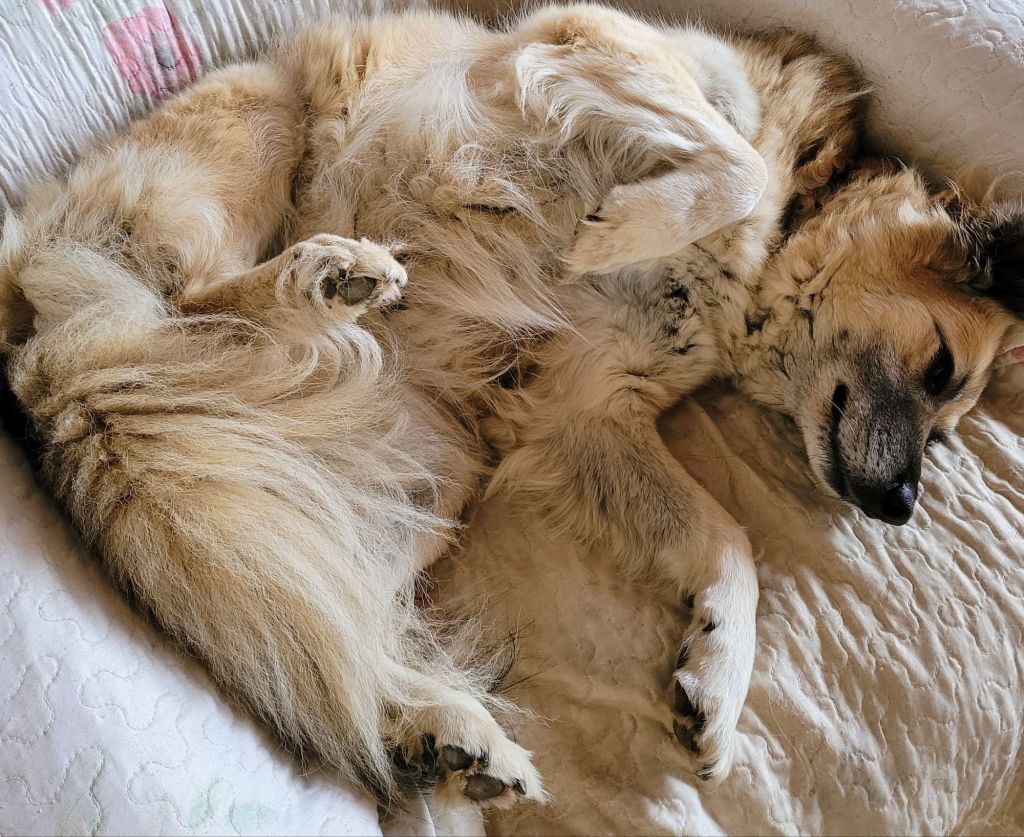
Having just given Lydia a good ‘rub-a-dub-dub’ tummy rub and chest massage, and knowing that she looks out for me and Trev too, in her way, it’s good to know that we have our own friendship group here at home.
Waking up this morning I reflect – as I often do – on how fortunate I am to have access to the Buddhist teachings that I have access to.
We’re on a short break from the mid-week classes that I usually go to, but my mind turns to two of the mantras that I have been learning from most recently. One is in the form of an acronym: RARE.
Recognise
Accept
Reduce
Eliminate
‘Recognise’ is to recognise a negative thought as delusional.
‘Accept’ is to accept the situation in which the thought is arising.
‘Reduce’ is to reduce the impact of the delusional thought.
‘Eliminate’ is to eliminate the delusional thought.
In my experience it can be extremely difficult to identify a thought as delusional because our thought patterns are often so ingrained that we don’t even notice them when they do arise. However, I’ve recently found that if I start to feel anxious, this alerts me to potential negative/delusional thoughts that are giving rise to the anxiety. I can then turn my attention to my breath, engage in a short meditation and find that the anxiety starts to abate.
I’ll continue to do what I can to recognise, accept, reduce and eliminate my delusional thoughts.
Most of us associate ‘www’ with ‘world wide web’ but an alternative presented in a Buddhist teaching recently is: ‘welcome wholeheartedly whatever’.
The nun who gave the teaching presented an example of a monk who lives at the Centre who has significant paralysis, is unable to walk and experiences constant pain. Apparently, he affirms the ‘welcome wholeheartedly whatever’ mantra and I’ve found this immensely humbling and inspirational.
I don’t know how things might unfold in my life – none of us do – but if I keep meditating, keep my focus on positives and aim to eliminate old habits where negative thinking takes hold, then I’ll be better prepared to welcome whatever does lie ahead with an open heart.
These were words spoken to me this morning when I picked Lydia up from the kennels where she’d been staying over the weekend.
I’ve always thought this myself, because she is.
We had a good walk together, before I took her home, and she’s enjoyed much of the day outside in the yard, in what is warm and rather windy weather.
After a two-week break I resumed my usual ‘Mental Health Monday’ activities this afternoon: yoga followed by Qigong.
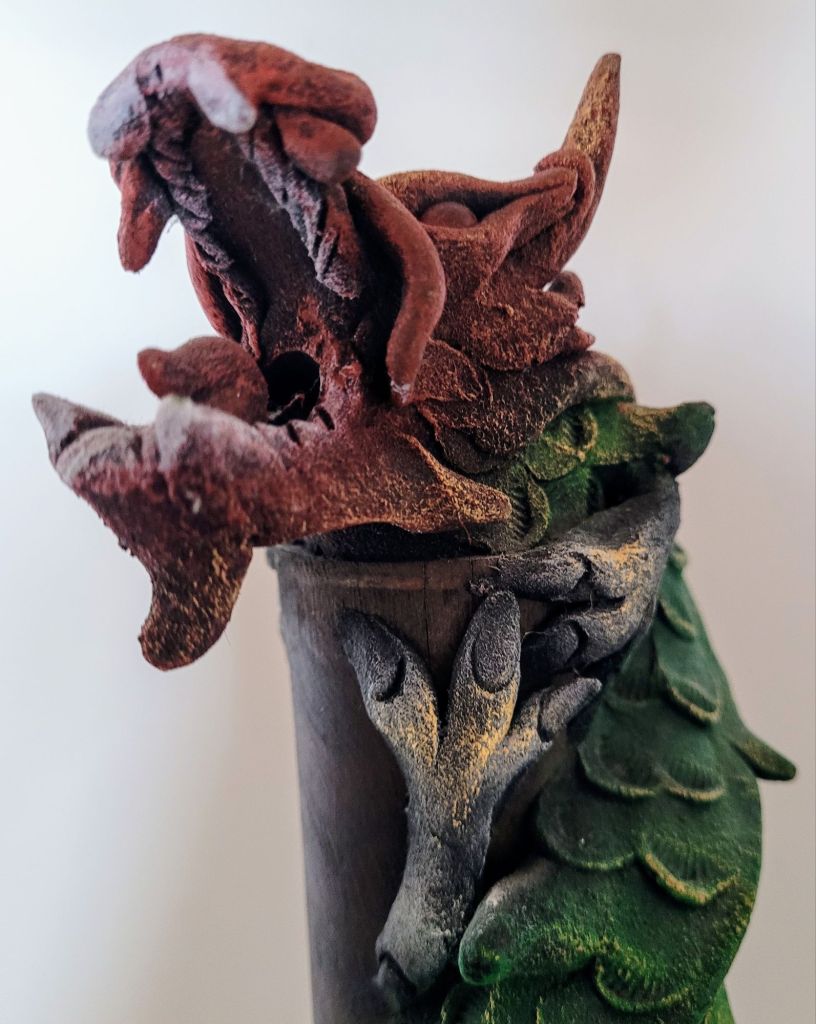
So, I’ve had two-and-a-half hours of concentrated activity for health and wellbeing with the added benefit – for brief periods – of being a tiger, a dog, a cat, a tree, a warrior and a dragon.
I don’t feel a need to compare and say which of these I’ve preferred being, but I did like the dragon movements.
I can now relax into a mellow evening knowing that I have given important attention to my musculoskeletal system as well as my mind and spirit. I think my girl with the beautiful soul is quite relaxed too; still in the back yard; still enjoying the warm and windy weather.
“I choose to be peaceful and calm. Everything is unfolding as it should.”
Affirmations can be hard to take on faith at the best of times. At times like this – and especially with an affirmation like this – it can be even harder.
On my daily walk with my partner, in the beautiful spring sunshine and along the peaceful country lanes around where we are lucky enough to live, I’ve stopped and said this affirmation out loud, and it has helped; helped me to remind myself that I can choose to respond to any given situation in a calm and peaceful way, providing I have control of my emotions and my mind. It might be hard, but not impossible. It is something that I can keep working towards being able to do, even if I can’t do it now.
I first started to use this affirmation a few months ago, when I was struggling with some very difficult work situations and high levels of associated anxiety.
I discovered it in a slightly different form at http://thinkup.me/affirm and my thanks go to the author of that article. (5 Recommended Positive Affirmations for Anxiety by Yvonne Williams Casaus, 26 December 2017)
After struggling with anxiety and depression for many years, I keep thinking that I’ve beaten them, only to be hit again by another wave.
The difference, though, between when I first started my personal battle with depression – in my teens – and now – in my 60s – is that I now have a well-stocked resource bank of strategies to fall back on.
Even so, the nature of the disease- and it is a dis-ease – is such that it can be hard to fall back on what we know works when we are at our lowest ebb. I also find that I no longer have the reserves of fighting energy that I used to have, but if I can at least find an affirmation that resonates with me – even on a leap of faith – then I am doing something positive to pull myself through.
The first time I came across affirmations was when I was going through a breakdown in my late thirties.
Suddenly reaching out – desperately, as I knew I was in danger of drowning and was definitely not waving – I found that there were sources of help and support around that I had never even heard about before or could imagine being available.
Counselling was one of these, meditation another, and I also came across a book called You Can Heal Your Life by Louise Hay (1984).
In that book, as I recall, I identified an affirmation that reflected the exact opposite of how I was feeling:
“I am the love and beauty of life in full expression.”
At the time, I was feeling like the worst wretch that ever crawled the planet. But I knew I had to do something to turn my life around and so I took on board the affirmation and kept saying it to myself again and again and again. And it worked. Not on its own, not without me doing all sort of other things at the same time and ever since, but it helped to cure my warts (literally) and set me on the path to keep working and trying, never giving up.
This brings me to some more poetry, and Poetry Rule No. 28, Stand your ground when you need to; move when you don’t.
Sometimes
Sometimes it isn’t as bad as you think it’s going to be it isn’t even worse as you hesitate with anticipation and brace yourself to curse
Sometimes you’re presently surprised more than you thought you could be when you’re met with some small kindness unexpectedly
At times like these it’s good to be wrong in fact I would go so far as to say it’s a blessing that’s been missing for a long time so, no messing seriously
Sometimes are better than no times never wouldn’t you agree?


 Glad About
You must be logged in to post a comment.