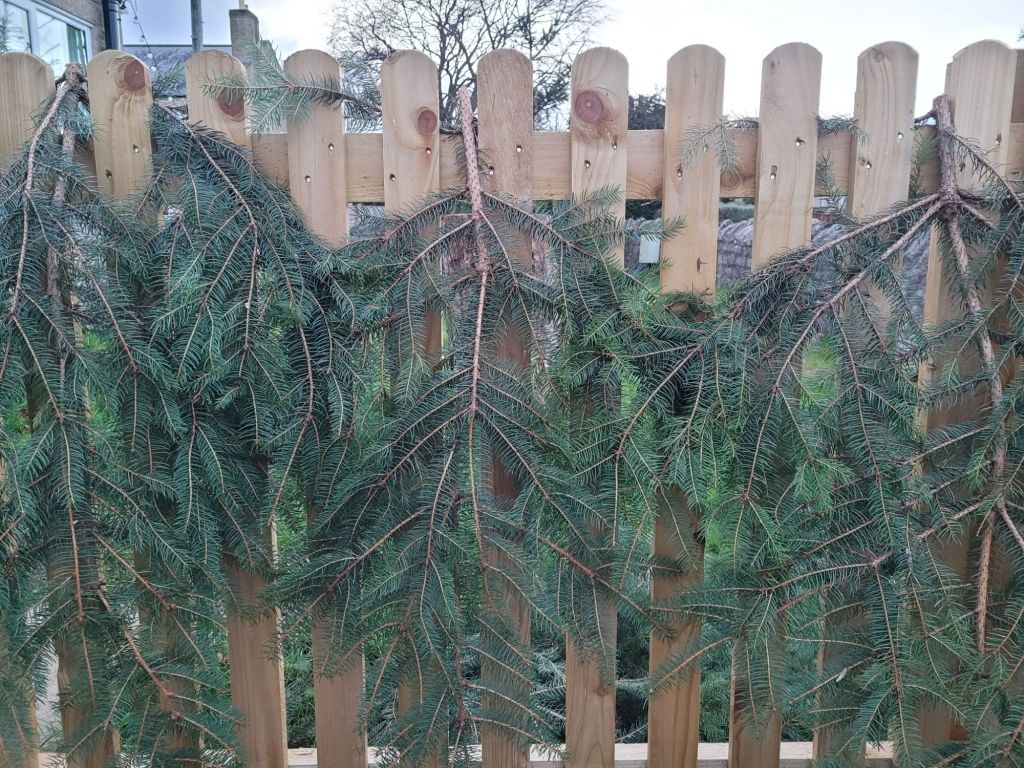
Seasonal branches adorning the fence at our Qigong venue this evening
Lydia is steadily getting used to her new collar. By the end of our woodland walk this morning it felt like she was almost gliding along next to me. The lead that I attach to the collar has a bungee section at the end of it, which helps.
Yoga this afternoon had a strong emphasis on the pose of a tree, and in Qigong we did a lot of work on developing the strength and flexibility of the spine. I felt quite focused in both sessions and enjoyed the poses and movements.
Despite all my health and wellbeing activities, I feel like I may be starting to come down with a cold, so may have to rest up tomorrow if it lingers.
I’m hoping for a good night’s sleep though, tonight. Lydia has already joined me in the bedroom for her ‘sleepy time’ and I’m going to settle down for the night now as well. Sweet dreams.
It seems fitting to start this latest cycle of writing on a Mental Health Monday. So, it was a walk with Lydia this morning, yoga and Qigong this afternoon.
Over the last couple of weeks, I’ve been busy with work on the house, doing some decorating, and I’m now starting on a phase of going round, room by room, clearing, cleaning, sorting.
Just as well then, that I’ve given myself a recharge boost with a weekend at the Buddhist Centre, with teachings and meditation sessions included as part of the course. I’ve also arranged to volunteer at the Centre one afternoon a week, which is an opportunity to put some skills and experience to good use, learn new things and meet new people.
For now, then, I’ve got a good complement of different activities and interests during the week, without being too structured or rigid and with plenty of time to rest or do other things as they arise. I know I’ll want and need to review what I do at some point in the future as I look for new challenges and further growth, but I’ve got what I hope is a reasonable balance for the time being.
I continue to reflect on how fortunate I am to have my health, fitness and circumstances to be able to do what I do.
Thankfully, also, Lydia is fit and healthy too.
We’ll keep walking and working together and I’ll keep writing. They’re all good things to do.
At the turn of the Millennium, I completed a project under the Mind-Millennium Award Scheme.
My project – the Lifelines Project – involved collecting and publishing poems, pictures and self-help strategies from other people who, like me, had suffered from enduring and debilitating depression.
I had not met many of the contributors, and was amazed – honoured – that they trusted me with their personal expressions, all because of the underlying intention of reaching out in the hope of helping others.
If you, yourself, are suffering with depression, I would like to wish you well and tell you that you are not alone.”
Since then, there’s been increased awareness about mental health and how it can be improved. While there remains much to be done in society from the ‘prevent’ and ‘promote’ perspectives, being able to – and even encouraged – to talk about mental health difficulties more openly represents a start.
In my own experience, I eventually got fed up of talking – I’ve never been much good at it anyway. I knew that I needed to take action, to find ways of turning my life around, however difficult or painful that might be. And I knew it would be difficult and painful, to rebuild from a below zero level when I was in my forties.
From somewhere, somehow, I found the resolve to put my head down, prioritise, and push myself through. For a long time, I concentrated on work and on developing my internal resilience. Just before I turned 60, I decided to take the plunge and commit to a relationship. I now have a much fuller and richer life than I have ever had before and I’m thankful for that.
Even so, life continues to be difficult and I still take antidepressants – probably always will. But I have other coping skills and strategies, and have also been able to recently retire, taking away work pressures that I could no longer deal with.
I wasn’t able to keep in touch with all the people who contributed to the Lifelines Project but they’ve always remained in my thoughts and I hope that they too have been able to find a way through; a way that works for each of them:
For my age – pushing 70 – I have very little in the way of bodily aches and pains or physical ailments.
I do exercises for my knees – which keep the Baker’s Cysts at the back of them at bay – and my daily walks with Lydia help me to maintain my overall fitness levels.
The other day, though, I started getting a twinge to one side of my lower back. Nothing drastic, but noticeable.
I couldn’t have asked for more, then, when our Qigong teacher, Sue, in yesterday’s class, talked us through exercises that concentrated on the lower back area.
Qigong movements are very gentle, methodical. It isn’t always easy to see how they can be of immediate benefit – because they aren’t designed necessarily to be of immediate benefit. Effects over time can be difficult to recognise because of the very fact that they are gradual, often almost imperceptible. All I do know, is that I started going to Sue’s classes regularly – weekly – around 15 years ago and I hold them in no small part responsible for some of the health and fitness benefits I now enjoy.
This morning, the twinge in my lower back is less. I didn’t take painkillers and it didn’t just go away on its own. The combination of Qigong, preceded by yoga – which in turn was a gentle, meditative session – has, I believe, helped.
I meditated again this morning, sitting upright in a chair in the way we have been taught. Thankfully, there is no expectation of sitting cross legged on the floor. I used to try that, but it ‘killed’ my knees!
Lydia and I have had a woodland walk today. We also have new neighbours, including another dog. It’s going to be a challenge to train Lydia not to bark at it every time she hears it on the other side of the fence. We’ll get there though, just as we’re ‘getting there’ with other things. Even if we don’t know where we’re going, were doing our best to make the most of our time together, day by day, step by step.
Starting this latest 28-day cycle of writing into life on a Mental Health Monday, I have so far meditated and had a walk with Lydia.
I collected her from the boarding kennels this morning where she has been staying for a couple of nights. I had a night out in town with two friends on Saturday and a duvet day on Sunday.
Cocktails and a Thai curry in good company made a welcome change and Lydia had a change of environment as well. We all need it sometimes.
I’m booked into yoga this afternoon, followed by a Qigong class.
I’m struggling with low mood and low energy levels. For now, I don’t think there is anything I can do other than what I am doing. There are no ‘quick fixes’ so I approach the situation as positively as possible, keeping a focus on health and wellbeing and remembering to be glad that I am so fortunate to have my health and a reasonable level of fitness; not something to be taken for granted.
The day is mild, with blue sky and sunshine, albeit damp from the weekend’s rain.
Lydia has had her second breakfast – they’d fed her before I picked her up from the kennels this morning but she still demanded – and got – her breakfast ball with her usual supply. We all need a bit of a ‘bonus ball’ sometimes. She’s now outside enjoying being back in her domain.
Over the last couple of weeks, while I’ve had a writing ‘holiday’, I’ve been bringing my focus closer to my own domain: my home; our home. Home isn’t something to be taken for granted either. I’ve always been fortunate to have one, one way or another.
Over the next few months – through the winter – I’m going to concentrate on giving care and attention to the edges and corners in our home – the bits that often get missed with a general sweep and ‘hoover’ round. I’ve never been the best at spring cleaning so I’m going to do it over the winter instead. Then, when spring comes, I’ll be free to do other things instead. That’s my plan; that’s what I’ll do. It may not be the most exciting plan on the planet, but it’s mine.
Paperback versions of my two latest books are now available on Amazon:
Rules, Rhymes, Recovery, Recipe, Random: writing into life
I first encountered Qigong when I was exploring anything and everything that I could find that I thought might help to restore my mental health from a point of crisis to some semblance of stability. That was over 25 years ago, and I had a long and arduous journey ahead of me. Along the way I took part occasionally in Qigong classes and workshops. It wasn’t until some years later, however, when I was struggling to push through the challenges of a demanding job – in itself part of my recovery process – that I considered a more regular commitment to the practise of Qigong.
Google searches came up with limited references to Qigong being offered locally. Luckily, one of these few was an evening class at a school just a few miles from where I was living, in Leeds.
An online Medical Dictionary notes:
Qigong (pronounced “chee-gung,” also spelled chi kung) is translated from the Chinese to mean “energy cultivation” or “working with the life energy.” Qigong is an ancient Chinese system of postures, exercises, breathing techniques, and meditations. Its techniques are designed to improve and enhance the body’s qi. According to traditional Chinese philosophy, qi is the fundamental life energy responsible for health and vitality.
The Dictionary goes on to state:
Qigong may be used as a daily routine to increase overall health and well-being, as well as for disease prevention and longevity. It can be used to increase energy and reduce stress. In China, qigong is used in conjunction with other medical therapies for many chronic conditions, including asthma, allergies, AIDS, cancer, headaches, hypertension, depression, mental illness, strokes, heart disease, and obesity.
Qigong is presently being used in Hong Kong to relieve depression and improve the overall psychological and social well-being of elderly people with chronic physical illnesses.
While I can’t claim that I commit to a daily practice – not yet anyway – I have been attending these evening classes – and some day workshops at weekends too – with the same teacher ever since.
When the Covid lockdowns first started, Sue Dunham – the teacher – was quick off the mark with setting up Zoom classes. Just as in the live classes, Sue’s commitment to her own practice and to sharing her knowledge and vast experience has shone through into these Zoom sessions.
Sue doesn’t just demonstrate what to do for us to follow. She talks through and builds up each movement step by step, repeating as necessary; infinitely thorough and always engaging. Her approach is very meditative and mindful, working deep on different themes in each group of three classes. During the height of the pandemic, focusing on the lungs could not have been more appropriate, and we’ve also recently worked on the spine and the digestive system.
Though the movements are slow and steady, I find that I sleep really well after a class session, and wake in the morning with the sense that I’ve had a really good workout, even though it isn’t ‘exercise’ in the conventional sense.
According to Sue:
“Qigong is an extraordinary practice: it can bring you to question fundamental beliefs about mind and your life, bringing you to that in a supported, gentle way. I have found it to be accessible and yet challenging, it’s enigmatic but intriguing!”
One of my favourite Qigong movements is called ‘Healing Form’, and Qigong has certainly become an essential part of my own movement towards health and healing.
When I started to become aware of my body, as a teenager, it was on the basis of how it looked. The negative compulsive obsessions I developed were – I realise now – associated with complex psychological and emotional traumas that have taken me 50 years to unravel.
Fortunately for me, my body was and is healthy and, while I continued well into adulthood to control my life by controlling what I ate, my body served me well. Deep roots hold tight, though, and it was a long time – being ultimately faced with the choice of life or no life – before I was able to find the strength, coping mechanisms, and resolve, to push through and come out the other side.
Qigong has helped me to work at a deeper level with my body – my amazing body.
It hasn’t provided me with a miracle ‘cure’ but it has helped to shift my focus into health and wellbeing, which is where it should be.
I feel a lot ‘lighter’ these days, even though I’m 65 and probably weigh at least 4 stone more than I did when I was 15. At six-and-a-half stone and still feeling the need to lose weight, I was weighed down and locked in as a teenager.
Some of the grief, sadness and regret linger on, but less so day by day. I’m thankful for a lot of things and hope that I can continue to be so for many years to come. Qigong helps me to nurture my body, with all its intricate mechanisms for feeding and flow.
One of the wonderful things about this practice is that it takes me beyond what I ‘know’, what I can measure or evaluate, into that sense of wonder, about what I don’t know, with all the associated mysteries of those realms.
When I’m practising Qigong, under Sue’s infinitely patient and painstaking instruction, I feel as graceful as a dancer, and that – for me – is something of a miracle.
The Covid pandemic has shown us just how vulnerable any of us can be, at any age, but also how those vulnerability factors can increase as we get older. The more we can do ourselves to mitigate those factors, the more likely we are to be able to lead fulfilling, meaningful lives for longer. That’s my plan, anyway, and I’m sticking to it!
The health benefits of exercise are well recognised.
Exercise also keeps the brain and your other vital organs healthy.
Experts believe exercise releases chemicals in your brain that make you feel good. Regular exercise can boost your self-esteem and help you concentrate, sleep and feel better.
“I get a huge buzz from my rock ’n’ roll class. Hours later, my legs ache, but I’m still smiling.”
Exercising doesn’t just mean doing sport or going to the gym. Walks in the park, gardening or housework can also keep you active.
Experts say most people should do about 30 minutes’ exercise at least five days a week.
Try to make physical activity that you enjoy a part of your day.
We all know this and are likely to have had direct experience of these benefits.
Why, then, can it still be so difficult to find the motivation to exercise?
It’s an issue that I’ve struggled with all my life, experiencing barriers associated with body image when I was younger. I knew swimming was good exercise but would only ever go to a swimming pool or wear a swimsuit on a beach if I’d starved myself to be thin enough to feel able to do that. And even then, I felt morbidly self-conscious about how I looked. It took a long time and a lot of working through masses amount of personal ‘stuff’ before I could stop worrying and start enjoying swimming. My partner and I even go wild swimming now, and it feels wonderful.
I tried jogging but always found it so hard to build myself up to a regular routine. Lacking in willpower and discipline some people might say. Struggling with severe depression, anxiety and low self-esteem was the real reason. I’ve continued to struggle ever since, but have also never given up. Now 65, I’ve been doing on-line exercise classes, including yoga and pilates during lockdown. Last summer we did some cycling around our local lanes. We still both find that it’s an effort to go out, sometimes, but give each other a push and/or moral support when we need it. Whatever it takes.
What’s the alternative? An inactive old age with all the complications that brings?
I’ve always found it difficult to go to a gym or to exercise classes after work. Just getting through a day involved such a major effort for me. So, I looked for ways to combine exercise into my daily routine. Cycling to work meant that I often turned up looking like a drowned rat, but it did help.
Even so, I continued to struggle with depression and continued to find it hard to motivate myself to exercise enough to help it lift on anything more than a temporary basis. I felt like the only way I could sustain the ‘lift’ would be to train as if I was an Olympic athlete. I have neither the physique nor the talent to be anything remotely akin to athletic and, like most people, have had to commit a significant amount of my time to earning a living and keeping up with the usual day to day domestic activities.
There were times as well when I felt that the more I exercised, the deeper my depression went, after the initial ‘buzz’ fell away.
I continued to have to do a lot of work to try and shift it, with exercise being one of a number of tools and techniques that I’ve tried and tested over the years. It has been, and continues to be, a lifetime endeavour. I think that this is in part because of the way emotions are stored in the body, a matter which has been increasingly recognised and written about including the following article by Sean Grover (2018):
For years, I’ve made a study of where people tend to store their unwanted emotions. Certainly, not all body aches or illnesses are psychosomatic. However, as I studied people’s bodily reactions to stress, recurring patterns emerged.
Healthy vs. Unhealthy Repression
Fear is the driving force behind repression, and is frequently rooted in your past. Repression is often necessary, particularly when you feel overwhelmed or experience trauma. But an overdependence on repression fuels psychosomatic symptoms and self-destructive patterns.
In his article in Psychology Today, Sean Grover goes on to identify the ‘Top 10 Tension Areas for Unwanted Feelings’ as:
1.Lower Back: Anger 2. Stomach & Intestines: Fear 3. Heart & Chest: Hurt 4. Headache: Loss of control 5. Neck/Shoulder Tension: Burdens 6. Fatigue: Resentments 7. Numbness: Trauma 8. Breathing Difficulties: Anxiety 9. Voice & Throat Problems: Oppression 10. Insomnia: Loss of self
I find this interesting and helpful, relating these areas to recent and past experiences.
I did a lot of work on repressed anger at one point, including going to a workshop where I was encouraged to take a lot of it out on a punch bag. The physicality of the release at the time was phenomenal (although I did go into a kind of ‘toxic shock’ afterwards, so I would not recommend anyone trying this approach without a very strong support network around them).
Some years later, experiencing stress at work, I searched out volunteering opportunities, finding an outlet by doing trail maintenance work where I could break big rocks into smaller rocks to make hardcore with a sledgehammer. I came back refreshed and invigorated. Although the effects did wear off after a while, I have so far – touch wood – not suffered from lower back problems.
Fatigue and resentments strike a chord with me – I’m so good at hanging on to them, no wonder I feel tired all the time!
So, while I’ve done a lot of work on myself to get to this point, and to feel largely positive about the position I’m in, there’s still a lot to do.
It’s often the enormity – or perceived enormity of the challenge – that puts us off dealing with it, which leads to repression, which leads to depression….
There are no easy answers or quick fix solutions, especially when difficulties are deep-rooted. I just keep reminding myself that it’s all about the next step. And the one after that. And the one after that. It does get easier. Miraculously – it feels to me – my steps feel a lot lighter, at the age I’m at now, than they did when I was young, all those years ago! Something must be working, somehow. Barriers can be overcome. It’s not easy, but it’s worth working at it, bit by bit.
These were words spoken to me this morning when I picked Lydia up from the kennels where she’d been staying over the weekend.
I’ve always thought this myself, because she is.
We had a good walk together, before I took her home, and she’s enjoyed much of the day outside in the yard, in what is warm and rather windy weather.
After a two-week break I resumed my usual ‘Mental Health Monday’ activities this afternoon: yoga followed by Qigong.
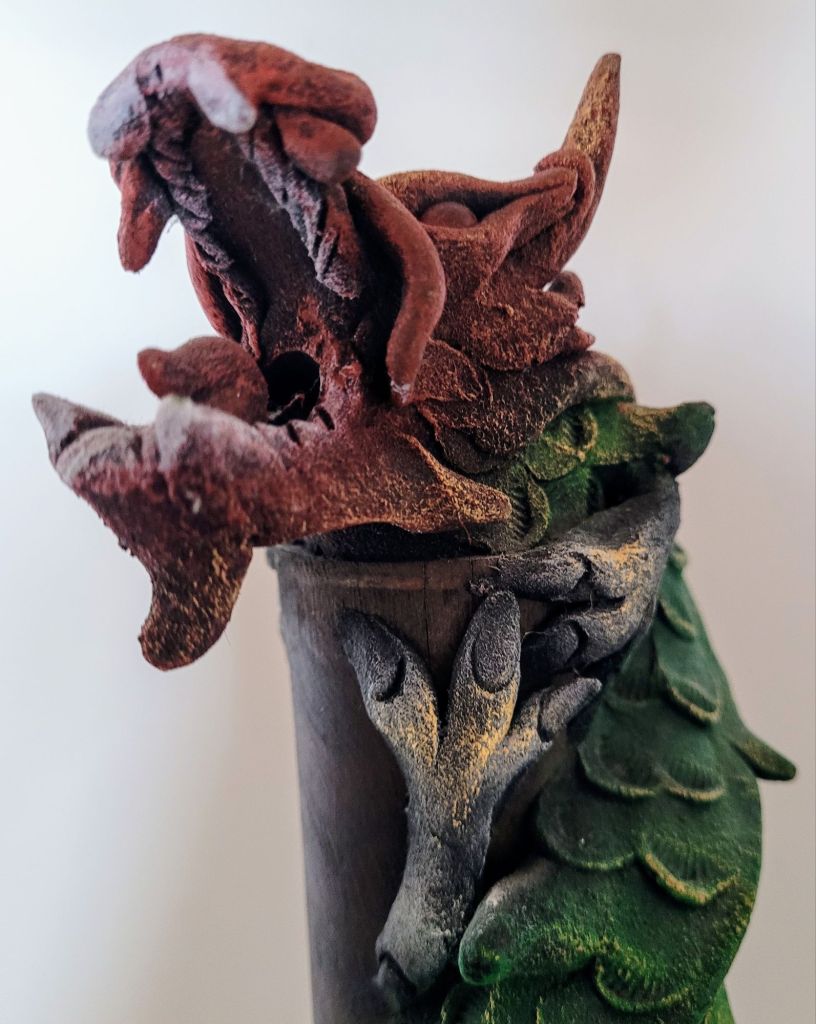
So, I’ve had two-and-a-half hours of concentrated activity for health and wellbeing with the added benefit – for brief periods – of being a tiger, a dog, a cat, a tree, a warrior and a dragon.
I don’t feel a need to compare and say which of these I’ve preferred being, but I did like the dragon movements.
I can now relax into a mellow evening knowing that I have given important attention to my musculoskeletal system as well as my mind and spirit. I think my girl with the beautiful soul is quite relaxed too; still in the back yard; still enjoying the warm and windy weather.
Grey island you spin and swirl around me (or is it the sea?) as I sit and wait for my thick-headed brain to clear which it does almost, but elusively and all too briefly teasingly still tense tension immense
Four seagulls soar one sits probably shits (or is that on the wing?)
Thrift, rock, heather purple, black, yellow, mauve green, grey, white weather wild mild quite
Walking, talking, inwardly I sit (still) and wait for my thick-headed brain to clear and allow me to feel the joy of the sea and the splendour of the trees and everything around me
So, I sit (on a rock) and wait for my thick-headed brain to clear and know that someday soon it will be free hopefully
1998
A quarter of a century after I started my self-directed journey of recovery from a complete personal breakdown, it would be easy to think at this stage that I never will get that sense of mental clarity that I have been seeking.
I hoped by now that I could have been sailing instead of struggling to find the energy to get through each day in a remotely positive way.
There are significant differences though, between then – when I started out – and now – when I’ve arrived at a particularly low-down point, wondering how on earth I’m going to summon up the motivation and momentum to start going ‘up’ or ‘forward’ again.
The most significant difference for me is that now I’m in a loving relationship. My partner and I care for and about each other in ways that make us both feel good. He suffers from depression too, so we often alternate in terms of who most needs support from the other at any one time. We’ve both had almost catastrophic life experiences to contend with in the past, both just come through by the skin of our teeth, both had to learn to trust again – often the most difficult thing of all, including trusting ourselves as well as each other. And we’re both now thankful that we’ve found each other. ‘Together Forever’ is our motto. We want to make the most of the time that we have – both now in our 60s – and that, in itself, is a motivator. At the same time, I’m still feeling profoundly exhausted and know that I need to do some more work on myself to pull out of this and finally put the traumas of the past behind me.
I know that it’s important to sometimes push myself and at other times do nothing. Doing nothing is hard as it brings with it the fear that it will become a permanent state and that I will vegetate from doing nothing to being nothing. At my age, fear of dementia also comes in to the mix. But in the depths of depression, doing anything at all feels like just too much, so where do I start?
I keep coming back to affirmations. Affirmations, some gentle regular exercise, healthy eating, not too much alcohol. All sensible things.
The affirmations I’ve identified for myself at this time are for depression and hearing problems. While I don’t really have hearing problems as such – other than age-related deterioration – I do have problems with ‘itchy ears’ and I have also had problems in the past with being heard.
I set about learning and practising active listening skills when I trained as a volunteer bereavement counsellor – it must have been about 20 years ago now. I’ve found those skills invaluable in different jobs and roles that I’ve held, although more latterly I’ve found it increasingly hard to concentrate. Active listening, by definition, means giving another person full attention. I think my body and brain have been telling me to give myself full attention for a change; had I ‘listened’ to what they were telling me earlier, I might not have arrived at the state I’m at now, although by the nature of cycles, they do have to go full turn.
Anyway, the affirmations that I’ve found, to say to myself when I can and when I need to, are:
“I move beyond other people’s fear and limitations. I create my own life.”
When I say each of these, at the very low ebb that I’m at now, I get a sense of uplift in my spirit, even if my body and brain are running well behind. I hold on to the belief that they will catch up though. Eventually.
Oh, and of course writing – something, anything – can be therapeutic as well. I’m going to keep writing, and affirming. And washing up, and doing a bit of gardening …
Keeping things simple is key for me just now. I can’t cope with complicated nor do I want to.
What better way, then, than to enjoy the company of friends, as I have done this weekend.
Yesterday I visited a friend – a fellow Ceramic Artist – at the Dovecot Gallery, near Doncaster, where she was exhibiting. It was a summer show in a garden setting, full of colour and creativity.
Today a friend and I visited a friend of hers. We sat together for about four hours, talking. Just talking. It was lovely to have a three-way conversation, each of us bringing in thoughts and ideas from our lives and experience.
My Ceramic Artist friend is a year or two older than me, so in her early 70’s. She started out in her career with clay just a few years ago. Rarely have I come across anyone more passionate about what they do.
My friend’s friend is about 10 years younger than us. Unlike me, she doesn’t enjoy good physical health, but she doesn’t let that stop her expressing herself through her art. She is a talented Textile Artist as well as a dog lover and owner of four canine companions.
While I aim in this blog to be positive about pushing through into a position of mental health recovery that I’ve been working towards most of my life, at the moment I’m struggling to get my brain to function.
Despite enjoying the company of friends, despite the wonderful weather, despite the woodland walk I had with Lydia this morning, I’ve hit a wall.
At least though, now, I know it won’t last, that I just need to rest – which I will – and tomorrow will be another day.
Looking across at Lydia, as I write, she is looking back at me. I’ll give her some more “rub-a-dub-dub” massages later, to help soothe her vagus nerve and I’ll keep doing what I need to do to help soothe mine too.
Train your dog; train your mind – positive reinforcement for humans and canines – now available in paperback: https://amzn.eu/d/eQ2sWjU.
The Kindle version is currently for sale at £0.99 on a Kindle Countdown deal https://amzn.eu/d/99yW3Qk.




 Glad About
You must be logged in to post a comment.