Yesterday I ate cake and nothing but cake. But I didn’t eat the whole cake. I had some more for brunch today and there’s still plenty left. It’s just as well, then, that I like cake.
It’s quickly come back round to ‘Mental Health Monday’, with yoga and Qigong each concentrating on areas that I’m glad to have some help with, including joints, back and legs. All good for mind, body and spirit.
Lydia is learning not to bark at the sheep in a field close to where we start our woodland walk. The field that the path to the wood cuts through is planted with a combination of brassicas and legumes that are still in the early stages of growing. I haven’t seen this combination of planting before, and wonder if it will be a crop that matures before winter, or in the spring. We shall see.
Although it is a signed public footpath through the field, I’m careful where I tread, to minimise impact on the crop. At the moment it doesn’t look like it’s getting much traffic other than from Lydia and me, but over the last few years it has been well trod throughout the year.
Lydia spots a squirrel in a tree, but doesn’t seem too inclined to try and chase it. She does sniff and pull a lot through the wood. On the way back, though, she’s more settled. With a bit of encouragement from me, we walk past the sheep and get back to the car. It’s a grey dampish day but thanks to Lydia I’ve had a chance to get some fresh air and exercise, and smell the smells of the earth and the autumn leaves.
It was an early start for Lydia and me this morning.
I’d set the alarm for 6.15 but was awake and got up before then.
After a quick cup of tea I took Lydia out for a walk.
She is very amenable and adaptable to changes in routine. We normally have a slow start to the day and I take her out mid- to late morning. However, she took it in her stride – literally – as we walked together for about an hour before heading back for breakfast.
Leaving Lydia at home with Trev, I set off to go to a half-day course at the Buddhist Centre, about a 50-minute drive away.
It’s an easy drive and I arrived in good time for the start of the session: Finding the Hero Within.
I was relieved to find that it didn’t mean I had to be able to quickly don a cape and a vest with a big ‘S’ on it and whizz about in the sky.
The ‘hero’ or ‘heroine’ was defined as anyone who made the decision to train their mind to identify, reduce and eventually eliminate delusional thoughts. Delusional thoughts are those such as ignorance, desirous attachment and anger. These delusional thoughts lead us to believe that our happiness is dependant on external factors or other people rather than ourselves.
For me, an important aspect of the teaching this morning was the emphasis on meditation as the primary means for training the mind, and the acknowledgement that it was all about building things up, bit by bit. Making the commitment, and taking small steps towards achieving it, are the key, with the ultimate aim of building our capacity to be of benefit to others.
This brings me to self-management rule no. 26:Your brief case is an important tool. Use it well. Use it wisely. I’ve struggled with using my brief case – my life – well and wisely, largely because of the mental health complications that I developed as a child and young adult.
I’ve had to do a lot of unravelling, and that in itself has been debilitating and exhausting. Having said that, perhaps what I’ve done is the best that I could do in the circumstances that I was presented with, and now I can start to do things differently, in the circumstances I’m now in?
There is really only one answer to my question, so I’ll continue to meditate, read the dharma (teaching) books, go to classes and retreats and find whatever way that I can to be the best person I can be, for the benefit of others.
I have to confess I find it daunting – terrifying – but bit by bit, step by step, is the way.
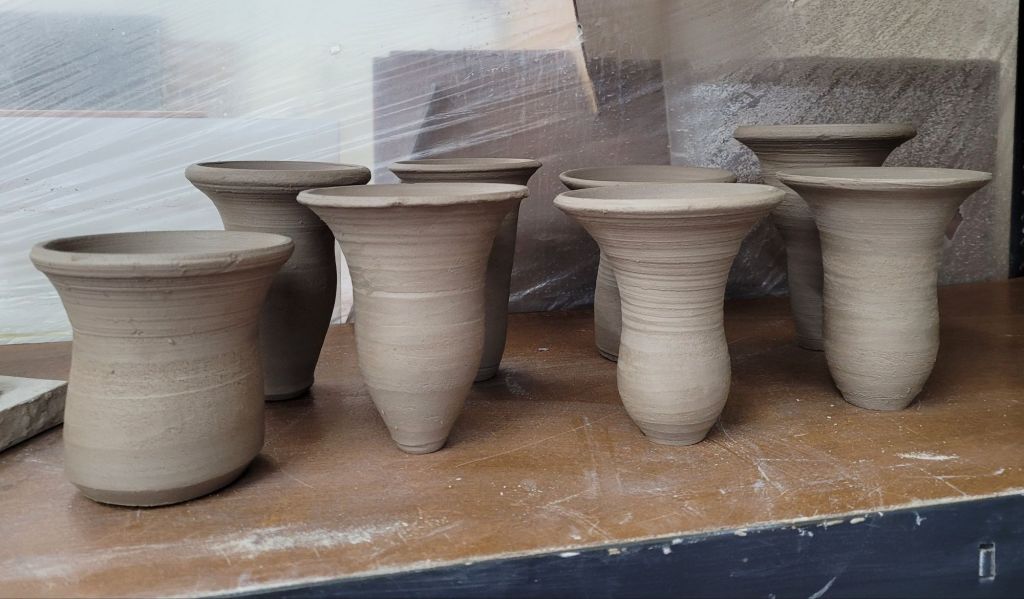
Eight more pots in the making; it’s a slow process but a good one
I took Lydia for an appointment at the grooming studio this morning. She continues to be more relaxed each time we go. As always, Vicky the groomer gives her lots of reassurance, encouragement and treats. Lydia is quite rightly proud of herself at the end of the session. She is doing so well, and I’m proud of her too.
Later I collected the 28 small pots that I made back in May. These have now been through their first firing which means they are at the ‘bisque’ or ‘biscuit’ stage.
My plan is to give them a second firing in a sawdust kiln.
A sawdust kiln is basically a heatproof container into which pots are placed, with lots of fine sawdust packed around them.
My sawdust kiln is made out of old bricks that I acquired from a neighbour.
I don’t have the space or scope for any other type of kiln at home but I do like to experiment with a sawdust firing now and then.
I’ll be doing the firing soon as these pots will be part of my display at the Aldborough & Boroughbridge Show, on 27 July.
After collecting my bisque-fired pots I had an afternoon at the pottery studio, finishing some work I threw a few weeks ago on the potter’s wheel. I love the process of turning the pots when they are leather hard, trimming away excess clay until I’m satisfied with the shapes.
This evening I am tired and more than a little despondent. I’m sure the latter low mood is at least in part influenced by the former state. Bringing myself back into wellness has been and still is a long haul. I have better support and good things going on in my life than I’ve ever had, but tonight I just feel ‘washed out’.
Lydia helps to lift me though. Just seeing her lovely face looking at me as I feed her, and hearing her make soft gutteral sounds of pleasure and anticipated pleasure is all I need to reboot.
Lydia had a chance to run about without harness or lead this morning, in a secure dog field.
I love to see her using what I call her ‘happy legs’, as she trots around, rolls about, sniffs, sniffs and sniffs some more.
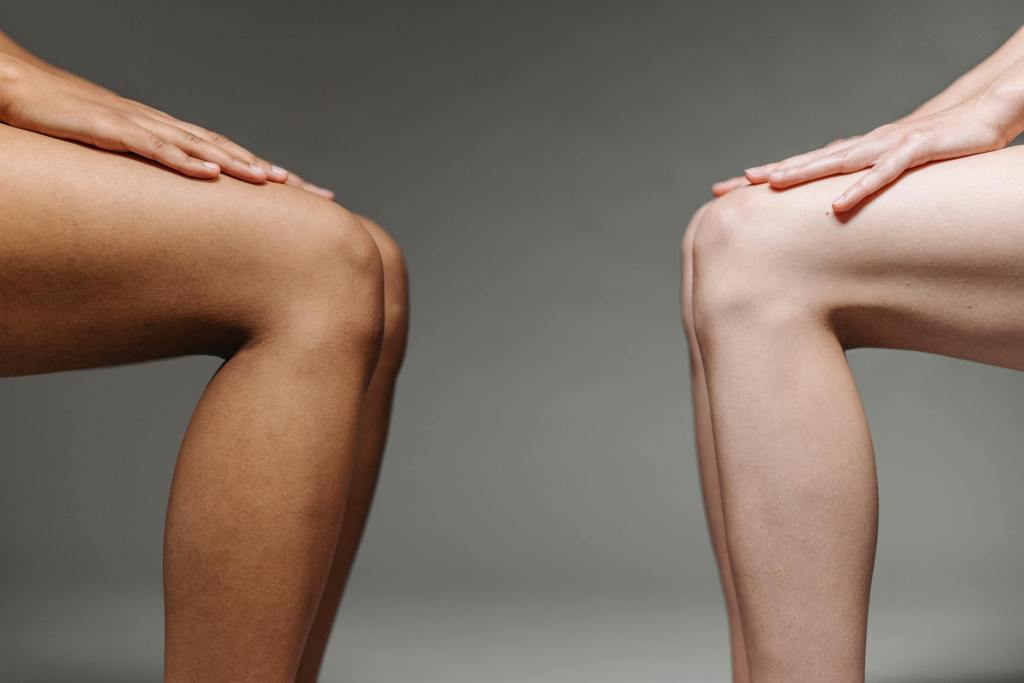
While she is doing what she wants to do, I do some exercises for my knees. I’m still applying the ‘wear and tear’ gel to the backs of my knees, taking a joint care supplement, and saying the affirmation: “My knee is healing and getting stronger each passing day”. This combination of attention to my knees seems to be working. My right knee – the one that I was having some problems with a few weeks ago – is much improved. Again, I reflect on how lucky I am, at the age of 69, to have the level of fitness and health in my body that I have.
During difficult times mentally and emotionally it can be hard to look after ourselves physically. Well, that’s my experience anyway and earlier blogs refer to evidence that supports this.
And, of course, it is in those times that we most need to look after ourselves in all aspects, so that we can have the chance to recover into a good place.
If it wasn’t for Lydia, I would have nowhere near the level of physical fitness that I have at the present time. Taking her for a walk every day – even if it isn’t a particularly long or strenuous one – has helped me both physically and mentally. The training and learning we’re doing together helps to keep us both mentally stimulated and strengthens the bond between us.
I gave her some good neck and leg rubs this morning while we were out in the dog field. She settled down into the massage, then shortly afterwards went for another run and a roll.
I’ve read a little bit about the vagus nerve and the part it plays in regulating a dog’s nervous system.
I’m doing some of the things that are recommended to help support her nervous system. She is generally quite calm in most situations these days, including now as she is lying outside in the back yard, enjoying some sunshine and not even barking at the birds. Progress!
As for me, well I think my vagus nerve may be over-stimulated and not well-regulated, but I will keep working on it, doing my best to remain as calm as possible, even under difficult circumstances.
Coming back to knees, I came across an online article, published recently by the Knee Pain Centers of America (The Psychological Impact of Knee Pain and How to Cope) which identifies a link between stress and knee pain:
Stress plays a crucial role in the experience and management of chronic knee pain, affecting both physical and emotional health. When an individual encounters stress, the body activates the hypothalamic–pituitary–adrenal (HPA) axis, leading to increased secretion of cortisol, the primary stress hormone. Elevated cortisol levels over time can contribute to tissue degeneration, muscle wasting, and persistent inflammation, all of which can exacerbate knee pain.
Psychologically, stress is closely linked with emotional disturbances like anxiety and depression. These mental health issues can alter pain perception, often intensifying the sensation of pain through neurochemical pathways. Depression, in particular, involves cytokine imbalance and neurotransmitter dysregulation, which can make pain feel more severe and reduce motivation for physical activity.
Moreover, chronic knee pain can itself influence mental health adversely. Limitations in movement and daily activities may lead to social withdrawal, loneliness, and feelings of helplessness. This emotional distress feeds back into the physical aspect, worsening inflammation and pain, and setting up a vicious cycle.
However, research indicates that managing stress through lifestyle modifications, engaging in regular, low-impact physical activity, and psychosocial strategies can break this cycle. Techniques such as mindfulness, relaxation exercises, and support groups have shown to alleviate stress, reduce inflammation, and improve both mental well-being and joint health.
Referring to strategies to reduce stress and its impact on knee health, the article notes:
Effective strategies include engaging in mindfulness-based exercises such as yoga and tai chi, which promote joint flexibility and mental calmness. Maintaining a healthy lifestyle with weight management, smoking cessation, and regular exercise helps lower stress levels and protect joint integrity.
Supportive therapies like cognitive-behavioral therapy (CBT) help reframe negative thought patterns about pain, reducing catastrophizing and emotional distress. Additionally, social support networks and participation in support groups can provide emotional resilience, helping individuals cope better.
Incorporating these approaches into comprehensive treatment plans addressing both physical and mental health aspects yields better outcomes, reducing pain severity, improving mood, and fostering overall well-being.
Therefore I seem to be doing quite a few things right to help maintain healthy knees. I’ve still got a lot to work on but I am doing what I can, when I can.
The identified strategy also brings to mind and – to my mind – supports the principle of affirmations. Affirmations help to reframe negative thought patterns and I am committed to continuing to do that, for myself, for my knees and for my dog.
My knee is healing and getting stronger each passing day.
As I write, my beautiful girl is crunching her way through a dental chew.
The chew is bone shaped. I did quite a lot of internet searching to find out about different brands, and this is one of the brands that got the best reviews. She has good teeth, and I want to help her to look after them.
I’ve struggled a bit with looking after my own teeth in the past.
I previously wrote a blog post about this, and about other aspects of self-care within the context of mental distress:
At that time, there was a mental health update strategy in progress with a claim that mental health would be included in an overall ‘major conditions’ strategy that will focus on ‘whole-person care’.
There is now a Policy paper ‘Major conditions strategy: case for change and our strategic framework’ (Updated 21 August 2023) that includes common mental health conditions and severe mental illness (SMI).
There is some reassurance in the reference to reducing risks earlier in life, and it is also noted that:
“… access to physical healthcare is particularly important for people with SMI. The NHS LTP sets out a transformation programme to develop integrated models of care and holistic support closer to home. The major conditions strategy will outline how to do more to implement physical health support across mental health pathways.”
So, there’s a long way to go but at least there does seem to be some movement in the right direction, hopefully for future generations and hopefully for some people sooner than that.
In the here and now, I continue with my own strategy to manage my health and wellbeing, relying on only minimal, but still welcome, support from the system in the form of anti-depressant medication.
However, I do have access to other forms of support, that make all the difference to me in the context of my life. These take human and canine form. They are, of course, my friends, including Lydia.
With her, I am out every day, walking, enjoying fresh air and steady exercise. I have, with her, companionship and company. Good company.
My friends are amazing – they are rallying for me at a time when I am struggling emotionally.
I am still struggling with anger; have just come back from a Buddhist prayer session; have just spoken to a friend on the phone; am writing this. It all helps; having positive outlets for energy and emotions helps. I didn’t have this when I was younger, but I do now.
“I choose to be peaceful and calm. Everything is unfolding as it should.”

 Glad About
You must be logged in to post a comment.