When I first started writing this blog I had just retired and it was something that I wanted to do.
I thought it would help me to complete a cycle of mental health recovery that I’d started many years previously, and that in writing about my experiences it might help others too.
I had no idea then just how far away I was from the summit of my recovery mountain, or just how many sheer cliff faces I was going to have to climb to be able to finally enjoy the view.
That was over five years ago.
I found no easy answers but knew that I had to keep going, and I did.
At 69 I have no wish or need now to climb any more mountains, either in my head or with my feet. However, my journey does continue, day by day, step by step, and I will continue to write about it and share it with anyone who is interested.
My new e-book, publishing on Amazon for Kindle 5th June, gives insights into how Lydia, Me & our Family of Three have recently made our final ascent:
‘Train your dog; train your mind – positive reinforcement for humans and canines’
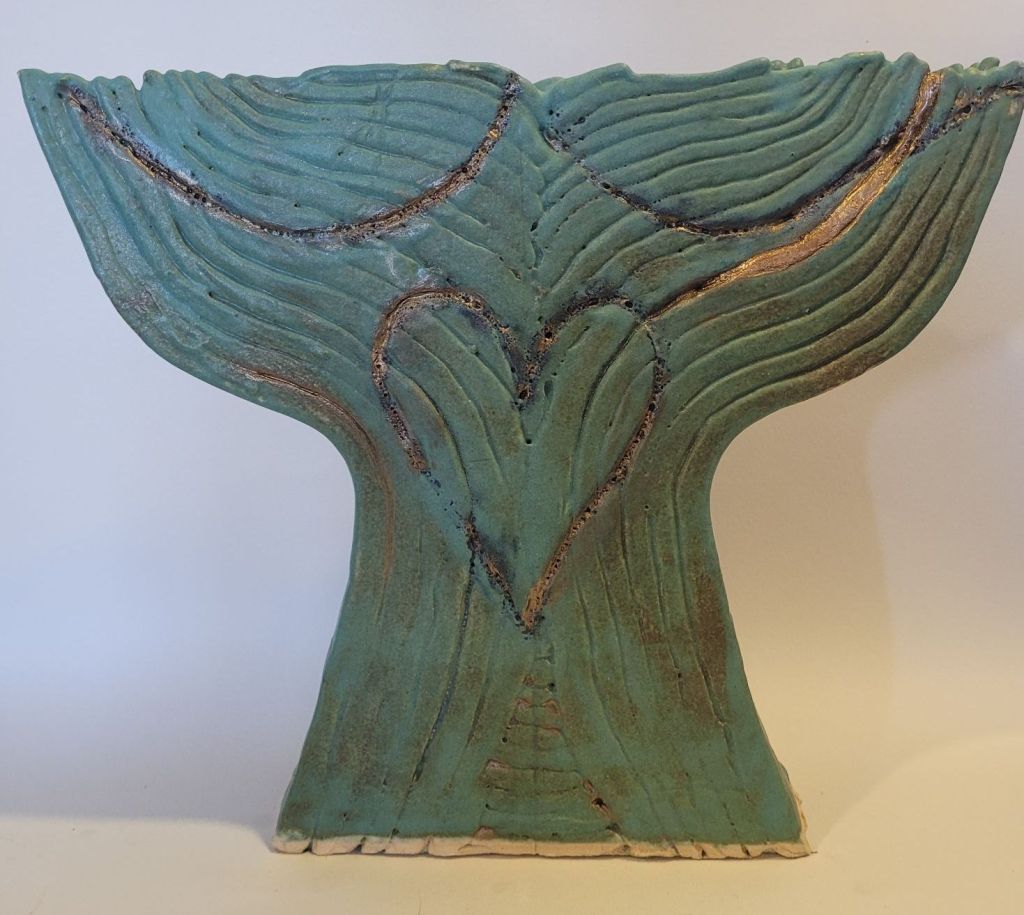
My latest piece of ceramic art, made out of stoneware clay. This and other works by me and 70 other artists and makers will be on show and for sale at the Saltaire Maker’s Fair, Victoria Hall, Saltaire, near Bradford from 24-26 May 2025:
“Tree of Love”, my latest piece, ready for the Saltaire Makers Fair at the end of May #saltaireinspired #saltairemakersfair
I’m struggling a lot with fear at the moment. Fear of the future; fear of uncertainty; fear of not being able to cope with whatever life challenges lie ahead.
I’ve coped with a lot of life challenges in the past but I was younger then! I used to put my head down, put my back into it, prioritise and push through. Now, in my 69th year, I know I can no longer do what I used to do. I have to do things differently; see things differently; find an approach to working through my fear that is in tune with my more mature status and circumstances.
I know that I have to believe that everything will be – is – OK. I also know that a lot of what I fear is in my head. I don’t live in a war zone or on the streets.
But when you’ve had to pick yourself up by the bootstraps and start again, and again, and again, it’s hard to believe that the pattern isn’t on repeat.
I’ve been working hard to learn my lessons, to change how I see and do things and to live in the here and now. The important thing is not to let the fear take over. This can be easier said than done, but I’m working on it!
The featured ceramic piece includes some Kintsugi repair work. This is a Japanese method for making a feature of a repair instead of trying to hide it. The idea is that the piece is even more beautiful than it was before.
Although I’ve previously described myself as a poetic potter and a potting poet, I don’t think that is really the case. They are two separate outlets for expression.
There’s nothing wrong with that, and the two may never combine or get closer. But there’s a part of me that wishes I could find a way of integrating the two, to some extent at least.
At a potter’s fair recently, where I had set up a stand, I sold a small piece – a box that I had made out of solid clay and put through the raku-firing process – to a lady called Lynne.
Lynne was really encouraging about my work, and she also invited me to join a poetry group.
I had some inner resistance as I’ve been struggling with my mental health and know that I need to have time to rest and not over-commit. However, Lynne’s enthusiasm was inspiring and it turned out that the group met only a few miles away from where I live. So I went along to a meeting.
I’m so glad that I did.
There were just five of us there and each of us read poems that we’d written. We were able to give feedback to each other if we wanted, but there was no pressure. It was relaxed, informal and supportive.
The theme for the meeting was ‘Highlight’ and I’d written a poem – my first in ages – which I read out:
Highlight
The highlight of the holiday was your choosing of the story; one that I'd read to you before
It's a story that opens the door to a memory of what hasn't been; days unseen; and brings to life the clue about what to do in days to come - more highlights - and maybe after all nothing left undone.
Sometimes it can be hard to open ourselves up to new possibilities when we’re still coming to terms with grief about the past and/or dealing with prevailing difficulties in the present.
I don’t yet know how my work with words and my work with clay are going to come together directly, if at all, but it’s good to work creatively with words again, as well as with clay.
I’ve somehow arrived at the point in retirement where I have ‘Wellbeing Wednesdays’ in my non-working week.
After taking Lydia – our dog – for a walk – which I do every day, usually twice a day – I go to a yoga class. Then, at 1pm, I have a therapy session. In the evening, providing I’m not too tired (or relaxed) I go to a Buddhist class which includes two meditations as well as the teachings.
I usually sleep well on a Wednesday evening; another factor which contributes to wellbeing.
I do other things on other days, including a Qigong class on a Monday, and pottery/making things with clay when I feel like it. But Wednesday stands out as the day when three focused activities combine to contribute to a strong sense of wellbeing emerging.
It amazes me that the Buddhist religion, rooted in the East, is so accessible to me here in the West, in the UK.
“Dharma” is the teaching and “sangha” is the community. I’ve taken refuge in Buddha, dharma and sangha recently and will continue to do so, as it helps me to see things differently, train my mind, start to feel calmer about things that have been profoundly distressing.
Sometimes in life it can feel like we’re faced with an impossible situation. ‘Fight’ or ‘flight’ – the reflex responses – seem like the only options and neither of these provides a way forward. But if we can start to see a problem as an opportunity – something that we can grow with rather than get angry about or run away from, there is potential for a way forward to open up after all.
This isn’t something that I’ve found easy, not now and certainly not when I was younger.
I’ve gone into flight mode at critical times in my life because I just didn’t have the skills or insights, confidence or support to help me do it differently.
I used to struggle to assert myself in any way and used to get it horribly wrong, with disastrous consequences in terms of life choices and relationships.
I was in my late thirties when I discovered Buddhism at around the same time as I found out that I could turn to a counsellor for therapeutic support.
I haven’t always found that Buddhism and personal therapy are comfortably aligned. In some ways they have seemed to me to work from opposite polarities – Buddhism teaches that I give up ‘self-cherishing’ and therapy helps me to learn to love myself (with great difficulty). However, my approach has been to not over-think, take from each what they offer and do my best to move forward in more positive ways. It’s an ongoing journey, still fraught with trials and traumas.
I’ve worked through – cried, ached and screamed through – a lot of emotions over the last 30 or so years. There were some, though, that I put to the back of my mind, locked away because they were too difficult to deal with and I had to find a way of building a life for myself rather than staying stuck. Those locked away emotions do, however, have a way of finding their way out, demanding to be addressed because they be need to be resolved. That happened when I retired.
So I’m now at the point where I’m engaging with both therapy and Buddhism again. Except now they don’t feel so polarised. I just feel very lucky to have access to all the wisdom and wonder of Buddhist teachings from the East here in the West, as well as skilled therapy, that will help me to heal, and to make the most of the life that I have.
I make the distinction between a minor breakdown and a major breakdown on the basis of the level of functionality that I lost, and the time it has taken to return to a semblance of normal functionality (whatever that means).
When I had a major breakdown over thirty years ago, it took years to recover to the point where I could do paid work again (although I did a lot of voluntary work as part of the recovery process).
In the years leading to my major breakdown, which was effectively from my teens until my late thirties, I developed unhealthy coping strategies.
With no idea how to deal with things differently, I worked out ways of getting through that worked – to a degree – but they weren’t sustainable, and I came crashing down.
“The wound is the place where the Light enters you.” – Rumi
The main thing was – in the trauma of the breakdown experience – I didn’t give up; the survivor in me kicked in. Reaching out for and finding sources of support helped me to rebuild. I started to retrain my brain through meditation and affirmations, did hard physical work and exercise when I could, pushed myself when I felt I needed to; tried to rest and relax into feelings that had previously been buried and then surfaced like a volcano. They were so difficult to deal with.
What do I do with all these feelings? Do I chew them up and spit them out and start again? And if I do what then?
I’m now retired, so in a sense the pressure is off, in that I don’t have to recover enough to fulfil the demands of a job. However, in retirement it is all the more important – and can be difficult – to find reasons to be motivated; to get up in the morning; to have a sense of purpose.
After my recent breakdown, and with support from my partner, good friends, and effective medication, I was able to start drawing on these healthier coping strategies fairly quickly, because I had already built them in to my life over many years; they had become part of my ‘muscle memory’, in brain and in body.
The Chinese exercise for health and well-being – Qigong – works on the whole person; walking our dog takes me into fresh air and the opportunity to appreciate the morning or evening light; making things with clay helps to take my mind away from unwelcome thoughts; Buddhist mind training helps me to just accept these thoughts as thoughts; meditation and affirmations provide the opportunity to let go of negative and introduce positive, even if it’s just for a few moments.
I haven’t yet achieved that all elusive peace of mind – my mind is still a work in progress – but I can at times feel a sense of peacefulness in the moment, and that is very welcome.
“Flowing Form”, stoneware glazed with Teracolor ‘Tourmaline’
Forty five years ago I completed a degree in Ceramics. It wasn’t until a couple of years ago, though, that I started working with clay again.
The intervening years have been challenging, to say the least.
As a teenager with undiagnosed mental health difficulties including an eating disorder and depression, I struggled to get a foot hold on life and eventually came crashing down.
For the last thirty years I’ve largely been focused on getting back going again, pushing through, surviving.
A sense of well-being isn’t easy to establish or maintain when your mind and mood are volatile, like mine can be, always trying to pull me back to a pivotal point of trauma and grief that have been so hard to leave behind.
I do try to make the most of each day, and be thankful for what I’ve got – which is a lot – but when tiredness takes over from positive thinking, it can feel almost overwhelmingly bleak.
Sometimes it’s best to do nothing, rest into it and let it pass. I also find that, if I can get absorbed in making something with clay, I can start to come through the low mood to a brighter sense of self and life.
I have a table at home that I have set up with basic tools and materials, but I find it most uplifting when I go to a studio where I can spend a morning or an afternoon with others. We are all focused and industrious but there together, and it has a special kind of effect, which always leaves me feeling so much better at the end of a session than I felt when I got there.
It isn’t easy to pick up the pieces of your life and start again, but picking up a piece of clay is now a part of my ongoing journey of recovery and reclamation.
One of the fellow potters that I meet up with occasionally at the #pottermanstudio used to be an art therapist.
She told me that she no longer works as an art therapist because there is no basis of evidence that art is therapeutic.
I’d come to the same conclusion myself, although am also now going to contradict myself because I do believe that art can be therapeutic. It just depends on a lot of other factors such as context, timing and the weight of influences going on in a person’s life and head at any one time.
When I was an inpatient in a psychiatric hospital back in the 90s, I went along to art classes in the hope of finding them helpful, but they made me feel much worse.
I had a degree in art and design, but in those classes I was only able to produce work that most 6-year-olds would be embarrassed about. At least, that was how I felt at the time.
Subsequently and periodically I’ve gained some benefit from drawing – particularly life drawing – but I found more therapeutic benefit from smashing rocks with a sledge hammer when I worked as a volunteer on the Appalachian Trail #ATC. I’ve also found typing and other repetitive tasks – addressing and stuffing envelopes, for example – therapeutic, in different ways.
When I worked at a small publishing unit – part of the #Longman publishing group – we used to send marketing mailshot work to the same psychiatric hospital that I stayed in myself a few years later. The stuffing of envelopes with marketing materials was deemed to be therapeutic for some of the patients, and, based on my own experience, I believe it probably was.
It isn’t just the stuffing of the envelopes – or whatever simple repetitive task it is that you are doing – it’s also the experience that you have while doing it. Stuffing envelopes alone is highly unlikely to be particularly therapeutic – although it may pay bills if you’re doing it to earn money – but in a supportive group environment it can be very calming.
I set something similar up in a Buddhist community that I stayed at for a while, after my breakdown, helping to raise funds for the community. We sat around a table in the Temple and it was very meditative, for a while at least.
When you’ve got a lot of inner turbulence going on, it’s hard to find something – anything – to settle on for any length of time. It’s important to keep looking for and finding whatever it is that gets you through, until the next time you have to start looking for and finding whatever it is that gets you through.
This brings me to one of my ‘Rules for Self Management’ that I haven’t referred to for a while:
Rule No. 5: Don’t underestimate the therapeutic value of envelope stuffing (but don’t overestimate it either).
I’m glad I’m no longer envelope stuffing – either therapeutically or for a living – and am happy to be steadily working with clay in a creative way. This is therapeutic for me now, but it wasn’t before. A lot of other work needed to be done before it could be.
You must be logged in to post a comment.