After grinding to a halt last year (when I was 64), I’ve had 12 months of resting and recuperating. It’s been great to have no time pressures, be able to catch up on household jobs and generally just ‘chill’. However, I still don’t feel like giving up on my working life altogether and have just started a new job. It’s part-time and temporary – just for a few weeks – and has tested my ability to keep calm in the face of new technology (use of a smart phone is an intrinsic part of the job). With some effort I’ve been able to keep my anxiety levels within manageable parameters – breathing through the stress and repeating my ever-faithful affirmation of ‘I choose to be peaceful and calm; everything is unfolding as it should’. There have been times when I have felt anything other than peaceful and calm but I seem to be settling in. It’s tiring, but I’m doing it.
When I was going through the worst of my breakdown, one of things I hung on to, to haul myself through, was the knowledge of how hard I’d worked when I was younger – dealing with anxiety without any coping mechanisms for a long time – to develop work skills and experience. I was determined that all that hard work would not go to waste.
I do believe that if more people had more help with anxiety and associated difficulties when they were younger, it would help to avoid the devastation that having a breakdown can bring. As a society we still have a long way to go before we can consider ‘inclusion’ a reality rather than a pretend game.
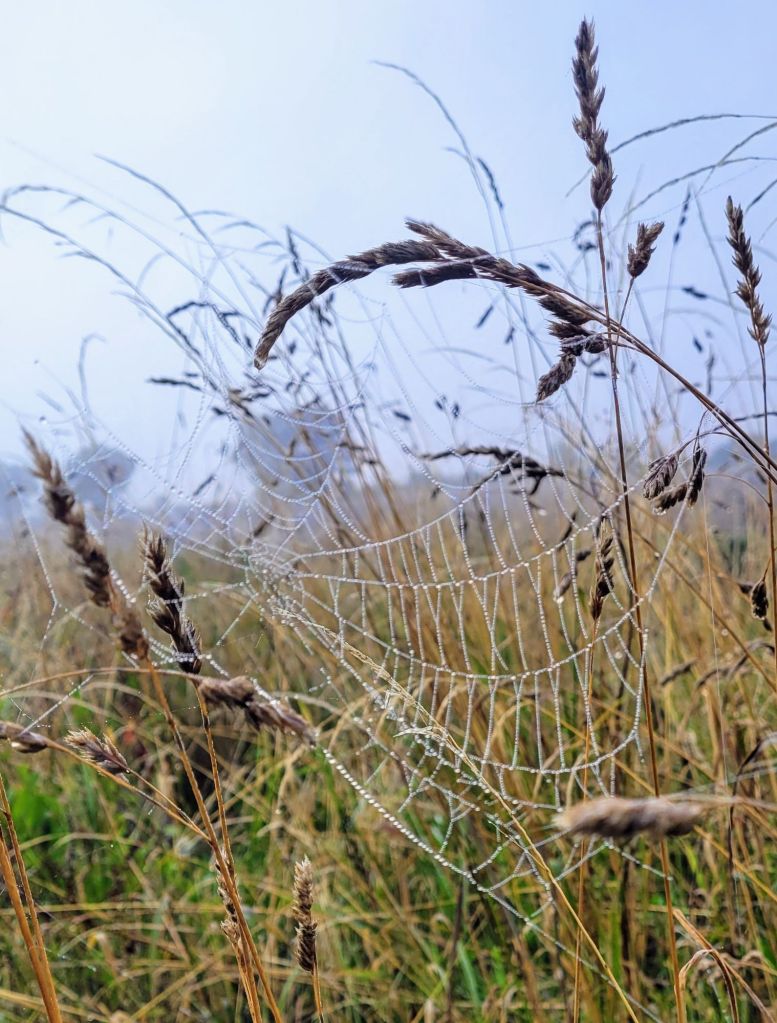
It was misty when we stepped out, and the spiders had been busy all night by the look of it. There were webs everywhere, finely woven and sparkling when the sun started to shine.
After our walk, I gave Lydia her breakfast and headed off to meet up with a friend.
We don’t meet often, this friend and I, but we settled into each other’s company quickly and easily, as only good friends can do.
Like me, she has recently suffered from anxiety, so we were able to ‘compare notes’. She’s found hypnotherapy a great help; I’ve found meditation works for me, along with affirmations.
“I choose to be peaceful and calm. Everything is unfolding as it should.”
I did a quick Google search and it seems that hypnotherapy is not usually available on the NHS, which means that it sometimes is.
I’ll stick with meditation for now, but hypnotherapy is something that I had little awareness of before and know a bit more about now.
We talked about a lot of other things too, of course, and I so enjoyed catching up with my friend. Then I had another good friend to go home to: Lydia of course!
Good friends come in all shapes, sizes and species. I don’t know where I’d be without them.
Grey island you spin and swirl around me (or is it the sea?) as I sit and wait for my thick-headed brain to clear which it does almost, but elusively and all too briefly teasingly still tense tension immense
Four seagulls soar one sits probably shits (or is that on the wing?)
Thrift, rock, heather purple, black, yellow, mauve green, grey, white weather wild mild quite
Walking, talking, inwardly I sit (still) and wait for my thick-headed brain to clear and allow me to feel the joy of the sea and the splendour of the trees and everything around me
So, I sit (on a rock) and wait for my thick-headed brain to clear and know that someday soon it will be free hopefully
1998
A quarter of a century after I started my self-directed journey of recovery from a complete personal breakdown, it would be easy to think at this stage that I never will get that sense of mental clarity that I have been seeking.
I hoped by now that I could have been sailing instead of struggling to find the energy to get through each day in a remotely positive way.
There are significant differences though, between then – when I started out – and now – when I’ve arrived at a particularly low-down point, wondering how on earth I’m going to summon up the motivation and momentum to start going ‘up’ or ‘forward’ again.
The most significant difference for me is that now I’m in a loving relationship. My partner and I care for and about each other in ways that make us both feel good. He suffers from depression too, so we often alternate in terms of who most needs support from the other at any one time. We’ve both had almost catastrophic life experiences to contend with in the past, both just come through by the skin of our teeth, both had to learn to trust again – often the most difficult thing of all, including trusting ourselves as well as each other. And we’re both now thankful that we’ve found each other. ‘Together Forever’ is our motto. We want to make the most of the time that we have – both now in our 60s – and that, in itself, is a motivator. At the same time, I’m still feeling profoundly exhausted and know that I need to do some more work on myself to pull out of this and finally put the traumas of the past behind me.
I know that it’s important to sometimes push myself and at other times do nothing. Doing nothing is hard as it brings with it the fear that it will become a permanent state and that I will vegetate from doing nothing to being nothing. At my age, fear of dementia also comes in to the mix. But in the depths of depression, doing anything at all feels like just too much, so where do I start?
I keep coming back to affirmations. Affirmations, some gentle regular exercise, healthy eating, not too much alcohol. All sensible things.
The affirmations I’ve identified for myself at this time are for depression and hearing problems. While I don’t really have hearing problems as such – other than age-related deterioration – I do have problems with ‘itchy ears’ and I have also had problems in the past with being heard.
I set about learning and practising active listening skills when I trained as a volunteer bereavement counsellor – it must have been about 20 years ago now. I’ve found those skills invaluable in different jobs and roles that I’ve held, although more latterly I’ve found it increasingly hard to concentrate. Active listening, by definition, means giving another person full attention. I think my body and brain have been telling me to give myself full attention for a change; had I ‘listened’ to what they were telling me earlier, I might not have arrived at the state I’m at now, although by the nature of cycles, they do have to go full turn.
Anyway, the affirmations that I’ve found, to say to myself when I can and when I need to, are:
“I move beyond other people’s fear and limitations. I create my own life.”
When I say each of these, at the very low ebb that I’m at now, I get a sense of uplift in my spirit, even if my body and brain are running well behind. I hold on to the belief that they will catch up though. Eventually.
Oh, and of course writing – something, anything – can be therapeutic as well. I’m going to keep writing, and affirming. And washing up, and doing a bit of gardening …
“I choose to be peaceful and calm. Everything is unfolding as it should.”
Affirmations can be hard to take on faith at the best of times. At times like this – and especially with an affirmation like this – it can be even harder.
On my daily walk with my partner, in the beautiful spring sunshine and along the peaceful country lanes around where we are lucky enough to live, I’ve stopped and said this affirmation out loud, and it has helped; helped me to remind myself that I can choose to respond to any given situation in a calm and peaceful way, providing I have control of my emotions and my mind. It might be hard, but not impossible. It is something that I can keep working towards being able to do, even if I can’t do it now.
I first started to use this affirmation a few months ago, when I was struggling with some very difficult work situations and high levels of associated anxiety.
I discovered it in a slightly different form at http://thinkup.me/affirm and my thanks go to the author of that article. (5 Recommended Positive Affirmations for Anxiety by Yvonne Williams Casaus, 26 December 2017)
After struggling with anxiety and depression for many years, I keep thinking that I’ve beaten them, only to be hit again by another wave.
The difference, though, between when I first started my personal battle with depression – in my teens – and now – in my 60s – is that I now have a well-stocked resource bank of strategies to fall back on.
Even so, the nature of the disease- and it is a dis-ease – is such that it can be hard to fall back on what we know works when we are at our lowest ebb. I also find that I no longer have the reserves of fighting energy that I used to have, but if I can at least find an affirmation that resonates with me – even on a leap of faith – then I am doing something positive to pull myself through.
The first time I came across affirmations was when I was going through a breakdown in my late thirties.
Suddenly reaching out – desperately, as I knew I was in danger of drowning and was definitely not waving – I found that there were sources of help and support around that I had never even heard about before or could imagine being available.
Counselling was one of these, meditation another, and I also came across a book called You Can Heal Your Life by Louise Hay (1984).
In that book, as I recall, I identified an affirmation that reflected the exact opposite of how I was feeling:
“I am the love and beauty of life in full expression.”
At the time, I was feeling like the worst wretch that ever crawled the planet. But I knew I had to do something to turn my life around and so I took on board the affirmation and kept saying it to myself again and again and again. And it worked. Not on its own, not without me doing all sort of other things at the same time and ever since, but it helped to cure my warts (literally) and set me on the path to keep working and trying, never giving up.
This brings me to some more poetry, and Poetry Rule No. 28, Stand your ground when you need to; move when you don’t.
Sometimes
Sometimes it isn’t as bad as you think it’s going to be it isn’t even worse as you hesitate with anticipation and brace yourself to curse
Sometimes you’re presently surprised more than you thought you could be when you’re met with some small kindness unexpectedly
At times like these it’s good to be wrong in fact I would go so far as to say it’s a blessing that’s been missing for a long time so, no messing seriously
Sometimes are better than no times never wouldn’t you agree?
After dropping my pots off yesterday with Imogen, who runs the firing service that I use, I went to the pottery studio. There I had a quiet afternoon making more pots. I didn’t count how many I made. I discarded one and there was another that I could have discarded but I chose to keep it. It has a quirky shape, not quite what I was aiming for at the time – my throwing skills are still very much in development:) – but it may turn out to be a pot that somebody chooses to buy, and loves.
This morning, I lie in until about 9.30, although get up a few times to let Lydia out into the back yard and then go out to her when she starts barking. I give her a good “rub-a-dub-dub” massage to help calm her down and she settles again, for a while.
It’s another hot day so we only have a short walk but it’s a relaxed one. Lydia is walking by my side, to heel, most of the time. She does start to lunge and bark at a passing car but I do what the behaviourist taught me to do and then give her plenty of verbal reassurance, combined with some more “rub-a-dub-dub”. I think she’s started to associate the phrase with the massage now, so we’ll keep working on it.
I notice that my knee is a lot better; the right one that I tend to have problems with. I also notice that I’m spending more time rubbing in the ‘wear and tear’ lubricating gel that I bought, to help with it. The combination of gel, affirmation, physio exercises and joint care vitamin and mineral supplement is working. Slowing down the pace, focusing on priorities, is working too, for Lydia and for me. The stress that I had been feeling a few days ago is dissolving, for now at least. How wonderful this weather is; long may it last.
As I wake this morning, Lydia is lying at the foot of the bed. She is looking neither sleepy nor restless. I get up to go to the bathroom and, on the way, give her a “rub-a-dub-dub” around her ears, neck, chest and upper arms. I go downstairs, open the back door, make tea and take it back to bed with me. I need some more “sleepy time” and I encourage Lydia to have some more too.
Lydia comes from Romania. So, she’s not only had to learn about a different culture and adjust to a different climate, she’s also had to learn a new language.
I have found Lydia to be very quick to learn on a lot of things. She soon got used to me saying “stay” when we had to leave her alone in the house, and has never had separation anxiety, like a lot of dogs do.
Other words/phrases I’ve introduced to help us to communicate with each other are “peepie time” and “poopie time”. “Peepie time” was important for house training, although we never really had any problems with that, except in the very early days when she was inclined to occasionally have a wee on a carpet.
“Poopie time” was important as for a long time she was very reluctant to have a poo in the back yard. While she mostly did her poos when we were out walking, there were occasions in the early hours of the morning when she had a tummy upset but just would not relieve herself in the back yard. So I ended up driving her out to a quiet country road – one of our usual walking spots – where we would walk up and down until she eventually felt able to do what she needed to do, and then we could go home. There was a time when my partner’s grandsons were staying with us and I had to take Lydia out in the car in the early hours; then when I eventually got back into bed, a cry came up from the boys’ room: “Maggie, I’ve had an accident!”. Quite what was going on in our household that night I don’t know but we did eventually all settle down for a bit more sleep.
I have now managed to train Lydia to occasionally have a “poopie” in the back yard, so that we don’t have to have any more early morning drives out into the country. I’ve still got a long way to go in learning her language, but I do think the “rub-a-dub-dub” is a good development for both of us. I stop and give her quite a few of these on our walk this morning, hopefully helping to regulate her vagus nerve.
As I write there is a window cleaner cleaning next door’s windows. Lydia starts to bark and I say, “No!” firmly and call her to me. Eventually she does come to me and I give her another “rub-a-dub-dub”. I’m hoping this might start to become her cue to feel more settled and calmer when we encounter whatever triggers her fears when we’re out walking. We shall see.
I certainly feel more settled and calmer today after yesterday’s breath and body work, stretching and strengthening. To consolidate this, I’m going to now do some meditation, before visiting a friend this afternoon. Oh, but I think I’ll have another cup of coffee first, because I’m retired, and I fancy another cup of coffee.
My knee is healing, and growing stronger, each passing day”
My knee is healing, and getting stronger, each passing day”
This affirmation has been coming into my head this morning and I kept saying it to myself, over and over again, as I drove to the walking spot for Lydia and me.
I also kept saying it over and over to myself as I was walking with her. And as she was walking with me, she was walking easily to heel most of the time.
I reinforced this with occasional reminders: “heel – yes – good girl”/treat. But she seemed happy to fall in easily by my side with a loose lead, and we had a lovely walk together in the sunshine, with a light breeze.
I’m looking into how I can do more work with Lydia’s vagus nerve, and more work with my own nervous system, dysregulated after years of doing my best to address compounded complex sets of difficult circumstances.
The website, stuffofsuccess.com, identifies a number of ways that a dog’s vagus nerve can be re-set or stimulated:
1. Learn to read their body language. Anxious dogs tend to drool, pant heavily, pace back and forth, or whine when they’re feeling anxious. Some dogs may tuck their tail between their legs or pin down their ears. Pay close attention to your dog’s body language so you can react quickly to help settle them down.
2. Show them some physical affection. Few things get a dog to calm down faster than the owner’s touch. Pet parents can help alleviate their dogs’ stress by holding them or petting them during stressful events.
3. Put on some classical music. Music therapy has been shown to work for some anxious dogs. Dogs with mild separation anxiety may benefit from music therapy when they’re left at home alone.
4. Try aromatherapy. Use an essential oil diffuser to fill the air with calming aromas such as chamomile or lavender. You can also try diffusing synthetic pheromones that can help calm dogs.
5. Provide a calm, safe place. If your dog’s anxiety is triggered by thunderstorms or loud noises like fireworks, it’s important that your dog feels safe when these triggers occur. Dogs’ ears are much more sensitive than human ears, so consider placing a white noise machine in a cozy spot in the house to drown out the noises that are scaring them. Keep stimuli to a minimum.
6. Dress your dog in a calming vest. Calming vests wrap around your dog, offering a consistent level of pressure that can make them feel calm during stressful situations.
7. Provide proper socialization. Exposing puppies to a wide array of social situations can help stave off anxiety at a young age, but you may want to skip the dog park. Provide socialization in a more controlled environment first. Older dogs who may have pre-existing traumas or phobias may need the help of a trained behaviorist.
8. Make sure hyper dogs get enough exercise. Sometimes the best thing for a hyperactive dog is to let them get their energy out through exercise. If your dog is exhibiting destructive behaviors at home—chewing, jumping, biting—they likely have pent-up energy that needs to be exhausted. Take them for a walk or give them some extra playtime to help bring down their stress level.
9. Avoid eye contact with hyper dogs. Dogs love attention, but sometimes this can be counterproductive. Hyper dogs who are exhibiting anxious behaviors may feel validated when they receive attention while acting out. Instead, try to ignore a hyper dog until they calm down. Then reward them for calming down with lots of eye contact and dog treats.
10. Give them calming supplements. Chamomile, pet-friendly CBD oils, and melatonin are all good options for helping lower your dog’s heart rate. Check with your veterinarian before giving your dog any over-the-counter supplements to ensure you’re giving your dog the correct dose.
11. Consider anxiety medication. If most calming techniques are not working to calm your dog down, talk to a veterinarian about getting your dog a prescription anxiety medication.
Of these, I haven’t done any work with her so far on 4, 6 and 11. I do occasionally burn a scented candle or some joss sticks in the house, but generally the house is a calming environment for Lydia.
If she was demonstrating anxiety all the time, at home and during walks outside generally, I would consider anxiety medication. But she’s so much calmer than she used to be when we’re outside, that I would be reluctant to go down that route because of potential side effects. We’ve recently consulted a behaviourist regarding her reactivity to other dogs, and we continue to put into practice the techniques identified. Therefore I’m going to do more work with her on ‘massage and gentle pressure’ as my identified priority for the time being.
Ear massage, neck and throat massage and acupressure & TTouch are identified on stuffofsucess.com as techniques that focus on nerve stimulation, for example using “light circular motions along the spine and near the ears”.
I don’t know what TTouch is so will do some more research to find out. In the meantime, I can do more of what I’ve been doing on ear, neck and throat massage.
Having done that bit of research, and identified a priority to help Lydia feel more relaxed, I can now look forward to a bit of relaxation for myself for the rest of the day.
We have a neighbour coming round to enjoy the sunshine with us. Warm sausage rolls, cold beer, potato salad and coleslaw. It’s going to be a good afternoon.
Lydia had a chance to run about without harness or lead this morning, in a secure dog field.
I love to see her using what I call her ‘happy legs’, as she trots around, rolls about, sniffs, sniffs and sniffs some more.
While she is doing what she wants to do, I do some exercises for my knees. I’m still applying the ‘wear and tear’ gel to the backs of my knees, taking a joint care supplement, and saying the affirmation: “My knee is healing and getting stronger each passing day”. This combination of attention to my knees seems to be working. My right knee – the one that I was having some problems with a few weeks ago – is much improved. Again, I reflect on how lucky I am, at the age of 69, to have the level of fitness and health in my body that I have.
During difficult times mentally and emotionally it can be hard to look after ourselves physically. Well, that’s my experience anyway and earlier blogs refer to evidence that supports this.
And, of course, it is in those times that we most need to look after ourselves in all aspects, so that we can have the chance to recover into a good place.
If it wasn’t for Lydia, I would have nowhere near the level of physical fitness that I have at the present time. Taking her for a walk every day – even if it isn’t a particularly long or strenuous one – has helped me both physically and mentally. The training and learning we’re doing together helps to keep us both mentally stimulated and strengthens the bond between us.
I gave her some good neck and leg rubs this morning while we were out in the dog field. She settled down into the massage, then shortly afterwards went for another run and a roll.
I’ve read a little bit about the vagus nerve and the part it plays in regulating a dog’s nervous system.
I’m doing some of the things that are recommended to help support her nervous system. She is generally quite calm in most situations these days, including now as she is lying outside in the back yard, enjoying some sunshine and not even barking at the birds. Progress!
As for me, well I think my vagus nerve may be over-stimulated and not well-regulated, but I will keep working on it, doing my best to remain as calm as possible, even under difficult circumstances.
Coming back to knees, I came across an online article, published recently by the Knee Pain Centers of America (The Psychological Impact of Knee Pain and How to Cope) which identifies a link between stress and knee pain:
Stress plays a crucial role in the experience and management of chronic knee pain, affecting both physical and emotional health. When an individual encounters stress, the body activates the hypothalamic–pituitary–adrenal (HPA) axis, leading to increased secretion of cortisol, the primary stress hormone. Elevated cortisol levels over time can contribute to tissue degeneration, muscle wasting, and persistent inflammation, all of which can exacerbate knee pain.
Psychologically, stress is closely linked with emotional disturbances like anxiety and depression. These mental health issues can alter pain perception, often intensifying the sensation of pain through neurochemical pathways. Depression, in particular, involves cytokine imbalance and neurotransmitter dysregulation, which can make pain feel more severe and reduce motivation for physical activity.
Moreover, chronic knee pain can itself influence mental health adversely. Limitations in movement and daily activities may lead to social withdrawal, loneliness, and feelings of helplessness. This emotional distress feeds back into the physical aspect, worsening inflammation and pain, and setting up a vicious cycle.
However, research indicates that managing stress through lifestyle modifications, engaging in regular, low-impact physical activity, and psychosocial strategies can break this cycle. Techniques such as mindfulness, relaxation exercises, and support groups have shown to alleviate stress, reduce inflammation, and improve both mental well-being and joint health.
Referring to strategies to reduce stress and its impact on knee health, the article notes:
Effective strategies include engaging in mindfulness-based exercises such as yoga and tai chi, which promote joint flexibility and mental calmness. Maintaining a healthy lifestyle with weight management, smoking cessation, and regular exercise helps lower stress levels and protect joint integrity.
Supportive therapies like cognitive-behavioral therapy (CBT) help reframe negative thought patterns about pain, reducing catastrophizing and emotional distress. Additionally, social support networks and participation in support groups can provide emotional resilience, helping individuals cope better.
Incorporating these approaches into comprehensive treatment plans addressing both physical and mental health aspects yields better outcomes, reducing pain severity, improving mood, and fostering overall well-being.
Therefore I seem to be doing quite a few things right to help maintain healthy knees. I’ve still got a lot to work on but I am doing what I can, when I can.
The identified strategy also brings to mind and – to my mind – supports the principle of affirmations. Affirmations help to reframe negative thought patterns and I am committed to continuing to do that, for myself, for my knees and for my dog.
My knee is healing and getting stronger each passing day.
As I write, my beautiful girl is crunching her way through a dental chew.
The chew is bone shaped. I did quite a lot of internet searching to find out about different brands, and this is one of the brands that got the best reviews. She has good teeth, and I want to help her to look after them.
I’ve struggled a bit with looking after my own teeth in the past.
I previously wrote a blog post about this, and about other aspects of self-care within the context of mental distress:
At that time, there was a mental health update strategy in progress with a claim that mental health would be included in an overall ‘major conditions’ strategy that will focus on ‘whole-person care’.
There is now a Policy paper ‘Major conditions strategy: case for change and our strategic framework’ (Updated 21 August 2023) that includes common mental health conditions and severe mental illness (SMI).
There is some reassurance in the reference to reducing risks earlier in life, and it is also noted that:
“… access to physical healthcare is particularly important for people with SMI. The NHS LTP sets out a transformation programme to develop integrated models of care and holistic support closer to home. The major conditions strategy will outline how to do more to implement physical health support across mental health pathways.”
So, there’s a long way to go but at least there does seem to be some movement in the right direction, hopefully for future generations and hopefully for some people sooner than that.
In the here and now, I continue with my own strategy to manage my health and wellbeing, relying on only minimal, but still welcome, support from the system in the form of anti-depressant medication.
However, I do have access to other forms of support, that make all the difference to me in the context of my life. These take human and canine form. They are, of course, my friends, including Lydia.
With her, I am out every day, walking, enjoying fresh air and steady exercise. I have, with her, companionship and company. Good company.
My friends are amazing – they are rallying for me at a time when I am struggling emotionally.
I am still struggling with anger; have just come back from a Buddhist prayer session; have just spoken to a friend on the phone; am writing this. It all helps; having positive outlets for energy and emotions helps. I didn’t have this when I was younger, but I do now.
“I choose to be peaceful and calm. Everything is unfolding as it should.”
I had a lovely visit with friends yesterday. They lifted me.
I was late arriving at their house. There had been a road accident and I struggled to find an alternative route. When I phoned them to let them know about my delay, they made sure that I realised it didn’t matter – they just wanted to see me. This meant such a lot to me.
I rested into most of the rest of the evening on my return home, after giving Lydia her tea.
I’m continuing to feed her all her food by hand, as training rewards, either when we’re out on a walk, or at home for her evening meal.
The big treat for Lydia, as part of her evening meal, is a raw bone. Today it’s a chicken drumstick. She waits for 90 seconds on “stay” and then bounds towards me when I say “here”. Lydia loves her raw bone[1]. It’s a high value treat that provides a really good opportunity to reinforce the training and learning we’re doing together.
Trev went out to buy our tea – fish and chips. We have some great chippies round here. I like mine with curry sauce. He has mushy peas. This is a high value treat for us.
A phone call from another good friend also meant the world to me and I slept with a much easier mind that I’d had the other day.
This morning, I wake around 8am.
At some point during the night Lydia went downstairs to continue her sleep in her favourite armchair. She has a bed in the bedroom which she loves but also loves that chair.
When I go down in the morning to make a cup of tea, she turns from her sleeping position onto her back, with floppy paws.
This is my invitation to tickle her tummy, although these days it’s more of a massage.
I concentrate on her neck, upper arms and chest, rather than her tummy. I’m not a trained masseuse, either human or canine, but I focus on muscles and areas where she might be holding a bit of tension. She makes some soft gurgling noises so I think I must be doing OK. To finish, I take hold of each of her paws in turn and give them a bit of a rub. This will, in turn, help her to feel more comfortable when her paws are being held for claw clipping.
Lydia and I have our woodland walk today.
I do some heel reinforcement work on our walk across the field towards the wood, and the walk itself is easy. I only have to do an occasional turnabout if Lydia starts to tug, but she’s not doing much tugging at all. After a full circuit, I decide to go back and do the walk again, from the other direction.
My right knee, that I’ve had a few problems with recently, is much better.
I’m lucky. At 69 I have no serious physical ailments or infirmities to contend with.
To improve the condition and flexibility of my knees, I’ve been doing some physio exercises that I was taught. I also rub in ‘wear and tear’ lubricating gel, morning and evening, take a good quality multi-vitamin and mineral supplement for joint care, and repeat an affirmation:
“My knee is healing, and getting stronger, each passing day.”
It’s easy to forget, when things are going well, what it’s taken to get to that point.
So, I’ll continue with my maintenance regime, and hopefully continue to enjoy the benefits of healthy knees.
[1] Dogs should never be given cooked bones. Raw bones may not be suitable for all dogs. Consultation should always be made with a qualified canine nutritionist and/or vet.






 Glad About
You must be logged in to post a comment.