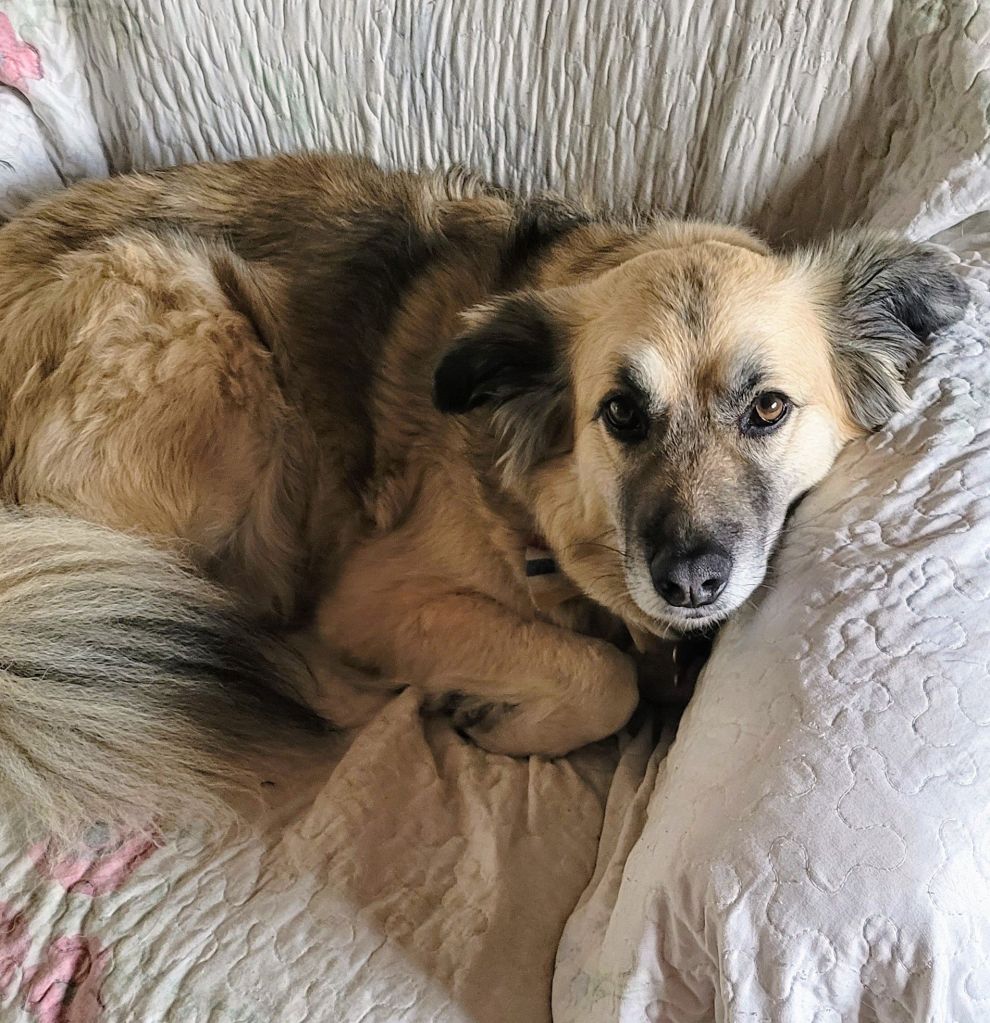
Lydia emerging from the tunnel at the dog field this morning.
How do we find solutions to problems if we don’t know the root cause?
The answer, of course, is “with great difficulty”.
In fact, if we don’t identify the root cause of a problem, we are only ever going to be treating the surrounding tissue, which may alleviate symptoms for a while, but does nothing for the longer term.
As I’ve continued my journey of recovery from mental health and emotional difficulties that got buried deep inside when I was a child, I’ve come to realise that I’ve still got a long way to go.
I’ll turn 70 at my next birthday. I am, in all aspects, in a better place than I’ve ever been in my life, but the process of healing continues, probably because it’s only just begun.
There are times now when I can physically feel the emotional and psychological pain – pain that was compacted down into the mould that was made for me when I was young – finally pushing out from the core of my bones and the pores of my body.
It’s only because I’ve finally been able to acknowledge the source and reach a point of acceptance, that I can sit with this pain, experience it, let it go.
It’s taken a lot of work, a lot of searching, a lot of learning, a lot of losing, a lot of loving, to arrive at this point.
And I do feel sadness, regret, an ache for what I haven’t had, that a lot of people take for granted or even don’t appreciate at all: family. My own family.
But I also know that I have been so, so lucky to have met the people that I’ve met, learned what I’ve learned, found what I’ve found.
As I write there is gentle music playing, the back door is open and Lydia is lying in one of her favourite places, just outside.
It’s a spot that is fairly cool in this summer weather and from which she has a good vantage point of her domain: our back yard.
She barks occasionally at potential invaders – mainly pigeons – but mostly just enjoys being there, as I am enjoying, being here.
I realise that somebody, or circumstances, could take that away from me. But for now, I’m just glad for what I have. It’s a lot.
It was wrapped up in special packaging: a teaching and meditation morning at a Buddhist centre.
The teaching carried in it a message that helped me to put to rest something that I’d been struggling with for decades.
I’d thought, for a long time, that I would never be able to put right mistakes that I’d made in the past because they were too big; too major. I thought that I’d fallen and failed early on in my life and all my efforts to rebuild had failed too. Despite doing my best to push through on positives for a long time, it had never been enough.
Then, suddenly, there it was, in the teaching that morning. It was possible for me to put the past behind me and be happy in the present. All I had to do was develop a calm and peaceful mind.
That teaching gave me hope, when I needed hope, and I’ve been building on it ever since.
That doesn’t mean that I am suddenly happy and joyful all the time. You don’t go through a lifetime of struggling with complex mental health and emotional difficulties without that struggle alone taking its toll. But I now allow myself to feel lighter, have stopped berating myself, stopped feeling responsible for everything that goes ‘wrong’ or has gone ‘wrong’ in the past.
For a long time, friends have told me that I deserved to be happy, but there was something so badly hurt, and at such a deep level, that it’s taken a long, long time for that place of hurt to be finally exposed to a point of healing, and for that healing to start taking place.
Tonight is a meeting of the Buddhist group that I go to, which is an outreach from the Centre that I went to last year[i].
I’ve already had a good day today, and I have that to look forward to this evening.
Ironically, I’ve recently been feeling too tired to write about what I have wanted to write about: sleep. Until today.
Breaking the cycle of inactivity is massively difficult during a period of depression. It feels impossible to know what to do or where to start that will make any difference in any meaningful and lasting way. And then sleeplessness takes hold and so it goes on.
I still have variable experiences of being able to get to sleep, and sleep long and deep enough to feel rested. However, any current difficulties I have are nothing compared to what it was like for me, years ago, when I became addicted to sleeping pills (Triazepam).
In the end, to detox, I took myself to Turkey in the hot season, walked and sweated for miles and eventually screamed myself off them.
The process of detox itself, especially in unsupported circumstances, is very dangerous, and, to anyone contemplating taking tranquilizers of any kind, I would say, “Don’t!”.
It might be easy for me to say that now, as I did take them then and felt that I needed to – desperately – at the time. Maybe I did. But that was before I had explored all the other options and possibilities, mainly because I didn’t know about them.
There is much more awareness and access to mental health coping strategies than there used to be over twenty years ago when I was going through some extreme experiences. Meditation courses and apps, Cognitive Behaviour Therapy, affirmations (I use these a lot), talking therapies, the benefits of exercise and so on. Even so, despite drawing on these approaches and applying them in my day-to-day life as best as I can, I don’t always sleep well.
Now, though, I’m much more able to sit or lie with the lack of sleep and rest into it, be patient with it, rather than going for a quick fix with all the associated draw backs. If I’m really struggling to settle, I might get up, watch a bit of telly (reading is usually out of the question at these times, such is the impact of depression on my capacity to concentrate), make a cup of tea or – even better – hot chocolate. I also occasionally indulge in a glass or two of wine or a gin and tonic. (I’m conscious of the drawbacks and addictive aspects of alcohol reliance but it does sometimes do the trick; a couple of paracetamols – again as a very occasional alternative and never at the same time as alcohol – also eventually send me off.)
I’m gradually working towards having a kinder and more balanced relationship with myself, doing what I can to be good to my body and my brain. I work on being thankful, get my brain into ‘glad’ mode and accept that I am getting “there”, which is “here”, with every day a blessing.
It is much easier for the me that I am now, than the me that I was twenty years ago, to not fall back on the quick fixes, partly because I have worked hard to find out about and put self-management strategies into practice and partly because I am in a much better place on a personal level. It is much easier to get to sleep on an evening, knowing that in the morning I will wake up in my partner’s loving arms.
Maybe there was a time when I did shoot the Albatross, and paid the price. But sleep is a very gentle thing, and doing my best to let sleep slide into my soul is part of an essential process of healing.
Grey island you spin and swirl around me (or is it the sea?) as I sit and wait for my thick-headed brain to clear which it does almost, but elusively and all too briefly teasingly still tense tension immense
Four seagulls soar one sits probably shits (or is that on the wing?)
Thrift, rock, heather purple, black, yellow, mauve green, grey, white weather wild mild quite
Walking, talking, inwardly I sit (still) and wait for my thick-headed brain to clear and allow me to feel the joy of the sea and the splendour of the trees and everything around me
So, I sit (on a rock) and wait for my thick-headed brain to clear and know that someday soon it will be free hopefully
1998
A quarter of a century after I started my self-directed journey of recovery from a complete personal breakdown, it would be easy to think at this stage that I never will get that sense of mental clarity that I have been seeking.
I hoped by now that I could have been sailing instead of struggling to find the energy to get through each day in a remotely positive way.
There are significant differences though, between then – when I started out – and now – when I’ve arrived at a particularly low-down point, wondering how on earth I’m going to summon up the motivation and momentum to start going ‘up’ or ‘forward’ again.
The most significant difference for me is that now I’m in a loving relationship. My partner and I care for and about each other in ways that make us both feel good. He suffers from depression too, so we often alternate in terms of who most needs support from the other at any one time. We’ve both had almost catastrophic life experiences to contend with in the past, both just come through by the skin of our teeth, both had to learn to trust again – often the most difficult thing of all, including trusting ourselves as well as each other. And we’re both now thankful that we’ve found each other. ‘Together Forever’ is our motto. We want to make the most of the time that we have – both now in our 60s – and that, in itself, is a motivator. At the same time, I’m still feeling profoundly exhausted and know that I need to do some more work on myself to pull out of this and finally put the traumas of the past behind me.
I know that it’s important to sometimes push myself and at other times do nothing. Doing nothing is hard as it brings with it the fear that it will become a permanent state and that I will vegetate from doing nothing to being nothing. At my age, fear of dementia also comes in to the mix. But in the depths of depression, doing anything at all feels like just too much, so where do I start?
I keep coming back to affirmations. Affirmations, some gentle regular exercise, healthy eating, not too much alcohol. All sensible things.
The affirmations I’ve identified for myself at this time are for depression and hearing problems. While I don’t really have hearing problems as such – other than age-related deterioration – I do have problems with ‘itchy ears’ and I have also had problems in the past with being heard.
I set about learning and practising active listening skills when I trained as a volunteer bereavement counsellor – it must have been about 20 years ago now. I’ve found those skills invaluable in different jobs and roles that I’ve held, although more latterly I’ve found it increasingly hard to concentrate. Active listening, by definition, means giving another person full attention. I think my body and brain have been telling me to give myself full attention for a change; had I ‘listened’ to what they were telling me earlier, I might not have arrived at the state I’m at now, although by the nature of cycles, they do have to go full turn.
Anyway, the affirmations that I’ve found, to say to myself when I can and when I need to, are:
“I move beyond other people’s fear and limitations. I create my own life.”
When I say each of these, at the very low ebb that I’m at now, I get a sense of uplift in my spirit, even if my body and brain are running well behind. I hold on to the belief that they will catch up though. Eventually.
Oh, and of course writing – something, anything – can be therapeutic as well. I’m going to keep writing, and affirming. And washing up, and doing a bit of gardening …
Turning the corner, the familiar fields andshelters come into view.
Open outlook, clear and calm; this is the place where past harms are healed.
Friends, old and new, graze on at steady pace. It’s never too late for needs to be met just a turn of fate.
The familiar fields and shelters will come into view again next year. The way ahead may not always be calm and clear, but we can always come back to this place, this sanctuary, and marvel at the donkeys, stroke the pony’s mane. It’s always different every year and every year, just wonderfully the same.
It’s around a year ago today that my friend, Rosemary, passed away. She was 49.
I wrote the above piece after we had been to visit an animal sanctuary in Norfolk. Rosemary had introduced me to the animal sanctuary because she had adopted a Shetland pony who lives there, Sampson.
I suggested we go and visit which we did, and revisited a few times more, before it got to the point where it was too much for Rosemary. She found it too tiring, she said, which it was. It was too tiring because she smoked heavily and was an alcoholic.
Rosemary had been diagnosed with schizophrenia in her early 20s. While she never opened up much about her past or about anything emotional at all really – I was told in no uncertain terms to ‘leave it’ if I prompted her in any way – she did tell me once that the psychiatrist who diagnosed her told her that she would never work again.
That may well have been the case in the conventional sense of what constitutes ‘work’ in our society, but if it was unlikely that she would ever do regular paid work again, that prognosis could have been presented differently, to give Rosemary a sense of hope of having a fulfilling life, even if not the life that she would have been hoping for as a young woman in her 20s at that time.
In recent times there has been a lot of talk about mental health and a lot of awareness raising in the media, but when it fundamentally comes down to it, has anything significantly changed to ensure that people who have diagnoses of extreme forms of mental illness can find some way of identifying themselves with a meaningful role, a sense of positive purpose, in the world? I’m not convinced that it has.
Some people are fortunate to be partners, wives, husbands, mothers, fathers, which can help to offset the stigma and isolation that accompanies their condition, but many – like Rosemary – do not.
Rosemary was not an easy person to get on with. She pushed people away, more often than not, and did make lifestyle choices – however hard and judgmental that sounds – that led to her limiting her own life in many ways. But I have often wondered how different it would have been if, when given that diagnosis of schizophrenia all those years ago, she had been told about all the things that she could keep doing – and all the support that she would get in the process – to help her feel good about herself and her life, whatever form or path that took.
Having extra support at a critical time can make all the difference between us, on the one hand finding our own strength and resolve to come through with a sense of purpose and, on the other hand, wavering and floundering and – at best – just not drowning.
At times Rosemary pushed my patience to the limits and then some (and she knew it!), but I could only try and imagine what difficulties she went through every day. Somehow, through that diagnosis, and prognosis, and the position it placed her in, in the world, all her intelligence, her good memory, her dark sense of humour, her creativity, her kindness to animals and sense of fair play got devalued, not least by her.
Thank you for the friendship that we shared Rosemary. For the times we spent at nature reserves and animal sanctuaries, the concerts we went to and the smile that you used to greet me with.
I’ve recently been fortunate to have taken part in a group poetry project.
Group experiences have been central to my mental health recovery for many years.
Some group experiences have an uplifting, energising and inspiring effect; others lead to alienation, isolation and degradation.
The poetry group experience that I’ve recently had was a good one, thanks largely to the enthusiasm and encouragement of the group leader https://mariafrankland.co.uk/.
In case you don’t want to buy the book, or perhaps as a taster (I’m one of 12 poets in the completed work), here are my poems from the collection:
Now
Now at the Pinnacle 14-and-a-half per cent proof point of my existence I’ve reached the Nottage Hill sub-station of my life I haven’t got a Sauvignon Blanc’s clue about what to do next other than to ‘méthode-champenoise’ my way through and hope that if the cork crumbles the bottle won’t be blue and the sieve will be fine so that just for now I can at least drink the wine
I can dance
I can dance without moving my feet at all I don’t have to do the foxtrot or quickstep my way to any ball I can cry without moving my lips I can laugh without making a sound all I have to do is know that the earth is flat, it isn’t round The dance is mine to make up from the music of the wind a sense of something swirling in and around my mind I don’t need a choreographer an audience or loud applause I just need to dance in my own way and then I’ll dance some more I can dance without moving my feet at all on and on and on and on it is my dance my life my call
Here’s to Wealth!
Cheers my dear to the love that you bring into my life and though I never want to be your wife I want to share with you all the good things that life brings
I love it when you sing as I know it comes from within your soul and as we learn together to love each other something magical unfolds
The trees without leaves that you hung around my neck and from my ears help to take away all my fears of things undone of words unsaid the sadness of never nurturing a child upon my breast
Where once was hope and then despair becomes a sense of stillness in the air and from that place of breathing and of wings comes freedom to wonder and wander into the rich realms of being together feeding the birds with the wealth of our love
Instant Coffee
Heading for instant gratification no time to waste or spare I take my mug into the kitchen only to find a queue of people there
Halted, suddenly, empty cup in hand my thoughts spill over into the needs of others heads bowed or lifted as we together stand
I only needed coffee and soon the queue was gone my waiting time was over but for someone else it had only just begun
***
I’m also proud of the back cover copy that I wrote for the book:
A relationship break-up can be a difficult experience at any age. It isn’t always easy to see the opportunity beyond the heartache, and even less easy to find ways of putting the experience into words.
The triumphs of Maria Stephenson’s emergence into a new life as a writer and teacher are embodied in her collection of ‘Poetry for the Newly Single Forty Something’ (2017). Maria didn’t just stop at publishing her own collection though. She inspired others to explore their creative approaches to the theme, leading to this exciting anthology, which is more than the sum of its poems.
The words of each poet paint a picture of part of their own unique life story. Demonstrating diverse responses to life and writing challenges, threads of commonality emerge and unite.
What are you waiting for? Dive in, explore, share in the joy of words and wonders of life that these writers have explored and shared. These poems aren’t just about being newly single, or about being forty something, they are about being – essentially – human.
The reason for my pride is partly because I think it stands well as a piece of writing in its own right (and even being able to credit myself with that is a remarkable* achievement in its own right), and partly because of what it represents for me in terms of having come through what I’ve come through, still fighting, still writing, still reaching out.
* https://iamremarkable.withgoogle.com/ (#IamRemarkable is a Google initiative empowering women and underrepresented groups to celebrate their achievements in the workplace and beyond.)
As this 28-day cycle of journaling/blogging comes to a close, I reflect on how far I’ve come in being able to make the most of every day as I do, after the journey of mental health breakdown and recovery that I’ve had, for most of my so far 69 years.
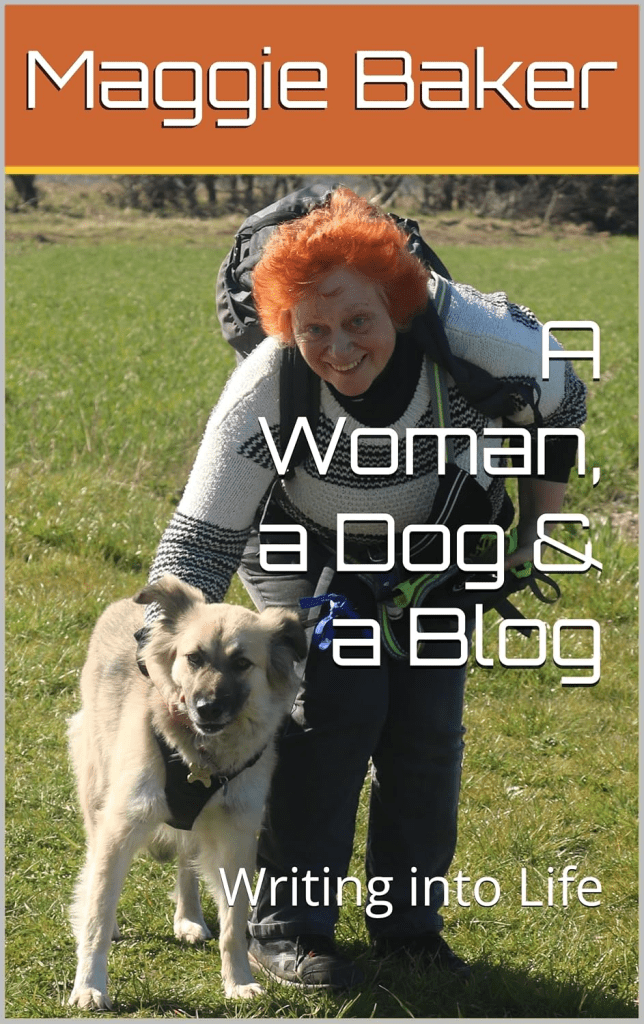
I’m now going to have a short break from writing while I put together a two-volume book of the story of Lydia and me so far. While I’m doing this, I will re-post a blog from the past every day.
A full collection of my earlier blogs, from March 2020 to September 2024, is now available on Amazon for Kindle:
‘Rules’ came originally from a set of ‘self-management rules’ that I devised, largely to reflect on some of the very negative experiences I’d had of being managed by others. I later developed these Rules into ‘Poetry Rules’, relating them to poems that I wrote or had previously written.
‘Rhymes’ are my poems, even though not all my poems rhyme. I just like writing them, expressing myself through words in whatever way I choose.
‘Recovery’ pieces reflect on different approaches and factors that influence mental health and wellbeing, including barriers to recovery.
‘Recipe’ is largely focused on one dish, but it’s an important one: Leftovers Soup.
‘Random’ – well, anything that didn’t quite fit in to the other categories but wanted to include anyway.
Step by step, day by day, the story of Lydia and me continues, and I’ll continue to record it at https://gladabout.life/.
As I wake this morning, Lydia is lying at the foot of the bed. She is looking neither sleepy nor restless. I get up to go to the bathroom and, on the way, give her a “rub-a-dub-dub” around her ears, neck, chest and upper arms. I go downstairs, open the back door, make tea and take it back to bed with me. I need some more “sleepy time” and I encourage Lydia to have some more too.
Lydia comes from Romania. So, she’s not only had to learn about a different culture and adjust to a different climate, she’s also had to learn a new language.
I have found Lydia to be very quick to learn on a lot of things. She soon got used to me saying “stay” when we had to leave her alone in the house, and has never had separation anxiety, like a lot of dogs do.
Other words/phrases I’ve introduced to help us to communicate with each other are “peepie time” and “poopie time”. “Peepie time” was important for house training, although we never really had any problems with that, except in the very early days when she was inclined to occasionally have a wee on a carpet.
“Poopie time” was important as for a long time she was very reluctant to have a poo in the back yard. While she mostly did her poos when we were out walking, there were occasions in the early hours of the morning when she had a tummy upset but just would not relieve herself in the back yard. So I ended up driving her out to a quiet country road – one of our usual walking spots – where we would walk up and down until she eventually felt able to do what she needed to do, and then we could go home. There was a time when my partner’s grandsons were staying with us and I had to take Lydia out in the car in the early hours; then when I eventually got back into bed, a cry came up from the boys’ room: “Maggie, I’ve had an accident!”. Quite what was going on in our household that night I don’t know but we did eventually all settle down for a bit more sleep.
I have now managed to train Lydia to occasionally have a “poopie” in the back yard, so that we don’t have to have any more early morning drives out into the country. I’ve still got a long way to go in learning her language, but I do think the “rub-a-dub-dub” is a good development for both of us. I stop and give her quite a few of these on our walk this morning, hopefully helping to regulate her vagus nerve.
As I write there is a window cleaner cleaning next door’s windows. Lydia starts to bark and I say, “No!” firmly and call her to me. Eventually she does come to me and I give her another “rub-a-dub-dub”. I’m hoping this might start to become her cue to feel more settled and calmer when we encounter whatever triggers her fears when we’re out walking. We shall see.
I certainly feel more settled and calmer today after yesterday’s breath and body work, stretching and strengthening. To consolidate this, I’m going to now do some meditation, before visiting a friend this afternoon. Oh, but I think I’ll have another cup of coffee first, because I’m retired, and I fancy another cup of coffee.
My knee is healing, and growing stronger, each passing day”
I had a lovely visit with friends yesterday. They lifted me.
I was late arriving at their house. There had been a road accident and I struggled to find an alternative route. When I phoned them to let them know about my delay, they made sure that I realised it didn’t matter – they just wanted to see me. This meant such a lot to me.
I rested into most of the rest of the evening on my return home, after giving Lydia her tea.
I’m continuing to feed her all her food by hand, as training rewards, either when we’re out on a walk, or at home for her evening meal.
The big treat for Lydia, as part of her evening meal, is a raw bone. Today it’s a chicken drumstick. She waits for 90 seconds on “stay” and then bounds towards me when I say “here”. Lydia loves her raw bone[1]. It’s a high value treat that provides a really good opportunity to reinforce the training and learning we’re doing together.
Trev went out to buy our tea – fish and chips. We have some great chippies round here. I like mine with curry sauce. He has mushy peas. This is a high value treat for us.
A phone call from another good friend also meant the world to me and I slept with a much easier mind that I’d had the other day.
This morning, I wake around 8am.
At some point during the night Lydia went downstairs to continue her sleep in her favourite armchair. She has a bed in the bedroom which she loves but also loves that chair.
When I go down in the morning to make a cup of tea, she turns from her sleeping position onto her back, with floppy paws.
This is my invitation to tickle her tummy, although these days it’s more of a massage.
I concentrate on her neck, upper arms and chest, rather than her tummy. I’m not a trained masseuse, either human or canine, but I focus on muscles and areas where she might be holding a bit of tension. She makes some soft gurgling noises so I think I must be doing OK. To finish, I take hold of each of her paws in turn and give them a bit of a rub. This will, in turn, help her to feel more comfortable when her paws are being held for claw clipping.
Lydia and I have our woodland walk today.
I do some heel reinforcement work on our walk across the field towards the wood, and the walk itself is easy. I only have to do an occasional turnabout if Lydia starts to tug, but she’s not doing much tugging at all. After a full circuit, I decide to go back and do the walk again, from the other direction.
My right knee, that I’ve had a few problems with recently, is much better.
I’m lucky. At 69 I have no serious physical ailments or infirmities to contend with.
To improve the condition and flexibility of my knees, I’ve been doing some physio exercises that I was taught. I also rub in ‘wear and tear’ lubricating gel, morning and evening, take a good quality multi-vitamin and mineral supplement for joint care, and repeat an affirmation:
“My knee is healing, and getting stronger, each passing day.”
It’s easy to forget, when things are going well, what it’s taken to get to that point.
So, I’ll continue with my maintenance regime, and hopefully continue to enjoy the benefits of healthy knees.
[1] Dogs should never be given cooked bones. Raw bones may not be suitable for all dogs. Consultation should always be made with a qualified canine nutritionist and/or vet.
I first heard about affirmations over 30 years ago, when I came across the Louise Hay book, ‘You Can Heal Your Life’. (Hay House, 1984)
Affirmations have helped me in my healing process, although I’ve had to do a lot of other things as well.
The affirmation that I connected with at that time was: “I am the love and beauty of life in all its manifestations.”
I didn’t feel like I was the love and beauty of life in any of its manifestations, but I kept saying it to myself, over and over again.
I’d had some persistent warts on my thumb for years and found no lotions or potions that did anything to get rid of them. They disappeared though, shortly after I started using this affirmation.
Coincidence? Maybe, but I don’t think so. The power of positive thinking is not to be underestimated, in my view. And my view does tend to be aligned with a lot of other views, including those embedded in Buddhist teachings.
During the Covid crisis, my affirmation of choice was, “I choose to be peaceful and calm; everything is unfolding as it should”. Some people laughed at me when I told them about this at the time, but it did help me to stay calm during Covid, even if I did go through some very ‘not so calm’ periods later.
Today, I am saying the Louise Hay affirmation, and also another that I came across online:
“My knee is healing and getting stronger, each passing day.”
I don’t have too much of a problem with my knees, at the moment, but they are a weak point for me, so I do exercises that a physio taught me, take a one-a-day vitamin and mineral supplement for joints, apply some ‘wear & tear’ lubricating fluid that I bought from the chemist, and say the affirmation.
I need my knees to be functioning and flexible so that I can keep walking and working with Lydia.
We go on our woodland walk this morning.
On the narrow path across the field, between growing crops, Lydia’s nose nudges the backs of my knees, but the lead is looser than it was the last time we did this walk. She seems much more relaxed, and this continues as we emerge from the field and start along the grassy path beside the wood. I do a few ‘about turns’ as I need to but she pulls very little. We make our way through the wood, which has a warm dampness about it from yesterday’s rain, heating up now with today’s sun.
At one point during our walk, Lydia looks up at me, mouth open as if she is smiling, and I think that she is telling me that she isn’t as afraid as she used to be. She is still alert to sights, sounds, smells, but she isn’t pulling away from me. I feel like we are more ‘together’ on this walk, today. Every so often I reinforce the “heel” command, using some dried food from her daily allowance, mixed with some treats to give extra value to her reward for being a “good girl”. I haven’t brought cooked chicken with me this morning; I’ll use that tonight when we have our evening training time.
Home and, after giving Lydia the rest of her breakfast allowance in her favourite food ball – which she pushes around with her nose to get access to the dried food pellets that I put inside – I get my own breakfast. It’s a late one and I have a busy afternoon planned.
For much of last year I had what I referred to as ‘Wellbeing Wednesdays’ because I used to take Lydia for a walk first thing, then go to a yoga class, then go for a psychotherapy session at 1pm, then, after taking Lydia out for another walk in the afternoon, go to a Buddhist teaching and meditation session in the evening.
Now I have ‘Mental Health Mondays’, with yoga and Qigong in the afternoon.
Qigong isn’t as well known as yoga, and I find both beneficial for both my physical and mental health. I wrote a blog post about Qigong a while back:
It’s good to be on the receiving end of congratulations, and to feel good about the publication of my book. I used to think that I could never feel good about anything to do with myself again. Now I can, and I do.








 Glad About
You must be logged in to post a comment.