Day 3

Wild roses blooming on our walk today

Continuing the story of Lydia, Me and our Family of Three https://amzn.eu/d/99yW3Qk

This morning, I wake with a sense of unease. I try saying affirmations but can’t settle, and decide to just rest into the feeling. It will pass.

Not so long ago, I felt an almost overwhelming sense of fear; almost but not quite. I drew on all the self-management methods I could muster, and it abated.

I let Lydia out into the back yard earlier.

We’re lucky to have a courtyard-cum-garden which is approximately square in shape, has a seating area, a paved area and some flower beds.

It is low maintenance and has become even lower maintenance since we got Lydia.

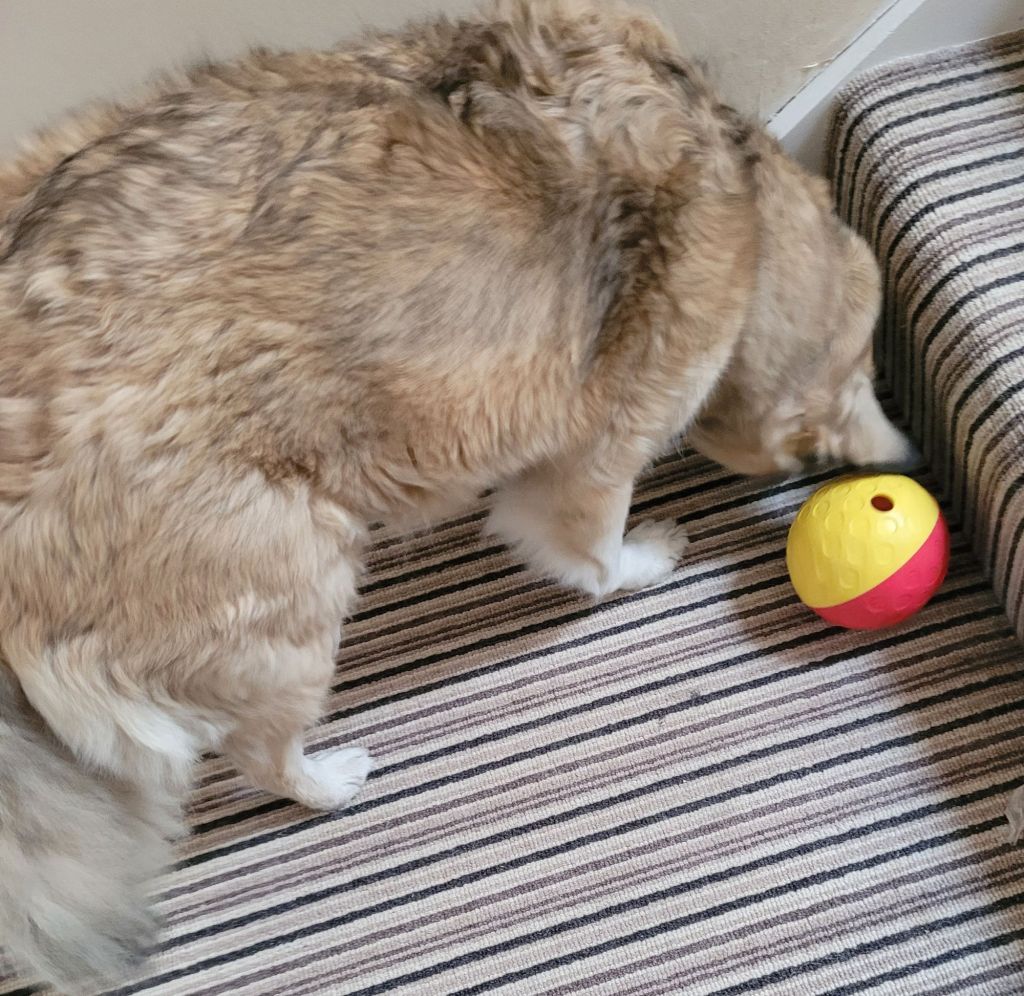
Lydia likes to dig. 

I decided to not try to stop her digging which means we have big holes in the flower beds.

Even so, or maybe even because of this, we have some self-seeded flowers blossoming – purple foxgloves and yellow Icelandic poppies.

She’s been quiet so far this morning.  When I checked on her earlier, she was lying down, looking up at the sky, following the pigeons in flight but not barking at them – not much anyway.

I’m encouraging Lydia to be “quiet”.  In doing this I’m following some guidelines from an on-line training resource I bought, that follows the principles of service dog training.

Lydia is approximately 9 or 10 years old.  She would have made an amazing service or working dog if she’d been trained from when she was a puppy.  She’s responding positively to the training I’m doing with her now, although it’s a slow process.  This is just as well, because I’m 69 heading towards 70, and slow suits me, especially as I’m learning too.

Trev heads out to yoga. He’s only just started going to yoga classes, tending to favour the gym, and a swim. It isn’t always easy to learn to do new things with your body and your brain as you get older, but that doesn’t mean it can’t be done.

When I do eventually get out of bed I do a few physio exercises for my knees, then head downstairs.

I talk to Lydia, to let her know that we’re not going out for “w-a-l-k-i-e-s” yet. I’m going to meditate first.

It’s the Buddhist group meeting tonight, but I feel I need to meditate now, so I do.

I don’t have a formal routine for meditating at home.

I sit down in my comfy chair with a cushion supporting my back and my feet on the floor.

I put my hands in the position on my lap as we are taught in the class, and partly close my eyes, letting just a little bit of light in.

Surprisingly – to me – I don’t find it too difficult to concentrate on my breath this morning. I don’t have too many distracting thoughts creeping in.  I don’t time my meditation, just do it as long as I want to and can, and then feel ready to go out for our walk.

As is usual now, Lydia waits patiently while I put on her harness and leads. I reward her with a treat, get myself sorted with bag, phone and keys, and then we head for the door.

I ask Lydia to “sit” and “wait” while I open the door. This is all part of our process of learning not to rush, taking things step by step, being calm and not worrying about what may lie ahead.

I take her in the car to the walking place that we’re both most familiar with. We go to this spot at least three times a week, usually mid-week. It provides plenty of opportunity for stress-free walking and stress-free training with occasional but manageable encounters with other dogs.

This morning, we have one such encounter and I apply the techniques that I have been taught by the behaviourist that I recently consulted with.

The distance between us and the other dog and owner are less than they’ve been before, although we still have a couple of grassy banks and a drainage ditch between us.

Lydia does react but she also settles down quite quickly, and we continue on our way.  It is progress. We still have a lot of work to do between us, but it is progress.

I’ve brought some pieces of cooked chicken with me today, and we do some “heel” reinforcement work, as well as some repeats of “watch”.  We are building up muscle memory, hers and mine. I didn’t learn to respond positively to a lot of frightening and difficult to process situations when I was younger and neither did she.  We are on this journey together.

Lydia, Me & our Family of Three

Lydia, 2025

When I first started writing this blog I had just retired and it was something that I wanted to do.

I thought it would help me to complete a cycle of mental health recovery that I’d started many years previously, and that in writing about my experiences it might help others too.

I had no idea then just how far away I was from the summit of my recovery mountain, or just how many sheer cliff faces I was going to have to climb to be able to finally enjoy the view.

That was over five years ago.

I found no easy answers but knew that I had to keep going, and I did.

At 69 I have no wish or need now to climb any more mountains, either in my head or with my feet. However, my journey does continue, day by day, step by step, and I will continue to write about it and share it with anyone who is interested.

My new e-book, publishing on Amazon for Kindle 5th June, gives insights into how Lydia, Me & our Family of Three have recently  made our final ascent:

‘Train your dog; train your mind – positive reinforcement for humans and canines’

https://amzn.eu/d/iAQbck8

Wellbeing Wednesdays

I’ve somehow arrived at the point in retirement where I have ‘Wellbeing Wednesdays’ in my non-working week.

After taking Lydia – our dog – for a walk – which I do every day, usually twice a day – I go to a yoga class. Then, at 1pm, I have a therapy session. In the evening, providing I’m not too tired (or relaxed) I go to a Buddhist class which includes two meditations as well as the teachings.

I usually sleep well on a Wednesday evening; another factor which contributes to wellbeing.

I do other things on other days, including a Qigong class on a Monday, and pottery/making things with clay when I feel like it. But Wednesday stands out as the day when three focused activities combine to contribute to a strong sense of wellbeing emerging.

From major to minor

Photo by Kristina Paukshtite on Pexels.com

I’ve recently come through a minor breakdown.

I make the distinction between a minor breakdown and a major breakdown on the basis of the level of functionality that I lost, and the time it has taken to return to a semblance of normal functionality (whatever that means).

When I had a major breakdown over thirty years ago, it took years to recover to the point where I could do paid work again (although I did a lot of voluntary work as part of the recovery process).

In the years leading to my major breakdown, which was effectively from my teens until my late thirties, I developed unhealthy coping strategies.

With no idea how to deal with things differently, I worked out ways of getting through that worked – to a degree – but they weren’t sustainable, and I came crashing down.

“The wound is the place where the Light enters you.” – Rumi

The main thing was – in the trauma of the breakdown experience – I didn’t give up; the survivor in me kicked in. Reaching out for and finding sources of support helped me to rebuild. I started to retrain my brain through meditation and affirmations, did hard physical work and exercise when I could, pushed myself when I felt I needed to; tried to rest and relax into feelings that had previously been buried and then surfaced like a volcano. They were so difficult to deal with.

What do I do
with all these feelings?
Do I chew them up

and spit them out
and start again?
And if I do
what then?

I’m now retired, so in a sense the pressure is off, in that I don’t have to recover enough to fulfil the demands of a job. However, in retirement it is all the more important – and can be difficult – to find reasons to be motivated; to get up in the morning; to have a sense of purpose.

After my recent breakdown, and with support from my partner, good friends, and effective medication, I was able to start drawing on these healthier coping strategies fairly quickly, because I had already built them in to my life over many years; they had become part of my ‘muscle memory’, in brain and in body.

The Chinese exercise for health and well-being – Qigong – works on the whole person; walking our dog takes me into fresh air and the opportunity to appreciate the morning or evening light; making things with clay helps to take my mind away from unwelcome thoughts; Buddhist mind training helps me to just accept these thoughts as thoughts; meditation and affirmations provide the opportunity to let go of negative and introduce positive, even if it’s just for a few moments.

I haven’t yet achieved that all elusive peace of mind – my mind is still a work in progress – but I can at times feel a sense of peacefulness in the moment, and that is very welcome.