Fear

“Tree of Love”, my latest piece, ready for the Saltaire Makers Fair at the end of May #saltaireinspired #saltairemakersfair


I’m struggling a lot with fear at the moment. Fear of the future; fear of uncertainty; fear of not being able to cope with whatever life challenges lie ahead.

I’ve coped with a lot of life challenges in the past but I was younger then! I used to put my head down, put my back into it, prioritise and push through. Now, in my 69th year, I know I can no longer do what I used to do. I have to do things differently; see things differently; find an approach to working through my fear that is in tune with my more mature status and circumstances.

I know that I have to believe that everything will be – is – OK. I also know that a lot of what I fear is in my head. I don’t live in a war zone or on the streets.

But when you’ve had to pick yourself up by the bootstraps and start again, and again, and again, it’s hard to believe that the pattern isn’t on repeat.

I’ve been working hard to learn my lessons, to change how I see and do things and to live in the here and now. The important thing is not to let the fear take over. This can be easier said than done, but I’m working on it!

The featured ceramic piece includes some Kintsugi repair work. This is a Japanese method for making a feature of a repair instead of trying to hide it.  The idea is that the piece is even more beautiful than it was before.

Publishing 05 June 2025:
https://amzn.eu/d/2UyHVFQ

Wellbeing Wednesdays

I’ve somehow arrived at the point in retirement where I have ‘Wellbeing Wednesdays’ in my non-working week.

After taking Lydia – our dog – for a walk – which I do every day, usually twice a day – I go to a yoga class. Then, at 1pm, I have a therapy session. In the evening, providing I’m not too tired (or relaxed) I go to a Buddhist class which includes two meditations as well as the teachings.

I usually sleep well on a Wednesday evening; another factor which contributes to wellbeing.

I do other things on other days, including a Qigong class on a Monday, and pottery/making things with clay when I feel like it. But Wednesday stands out as the day when three focused activities combine to contribute to a strong sense of wellbeing emerging.

Making things with clay

“Flowing Form”, stoneware glazed with Teracolor ‘Tourmaline’

Forty five years ago I completed a degree in Ceramics. It wasn’t until a couple of years ago, though, that I started working with clay again.

The intervening years have been challenging, to say the least.

As a teenager with undiagnosed mental health difficulties including an eating disorder and depression, I struggled to get a foot hold on life and eventually came crashing down.

For the last thirty years I’ve largely been focused on getting back going again, pushing through, surviving.

A sense of well-being isn’t easy to establish or maintain when your mind and mood are volatile, like mine can be, always trying to pull me back to a pivotal point of trauma and grief that have been so hard to leave behind.

I do try to make the most of each day, and be thankful for what I’ve got – which is a lot – but when tiredness takes over from positive thinking, it can feel almost overwhelmingly bleak.

Sometimes it’s best to do nothing, rest into it and let it pass. I also find that, if I can get absorbed in making something with clay, I can start to come through the low mood to a brighter sense of self and life.

I have a table at home that I have set up with basic tools and materials, but I find it most uplifting when I go to a studio where I can spend a morning or an afternoon with others. We are all focused and industrious but there together, and it has a special kind of effect, which always leaves me feeling so much better at the end of a session than I felt when I got there.

It isn’t easy to pick up the pieces of your life and start again, but picking up a piece of clay is now a part of my ongoing journey of recovery and reclamation.

#thepottermanstudio

Art isn’t therapeutic but – then again – it is, or can be. . .

Photo by Vlad Cheu021ban on Pexels.com

One of the fellow potters that I meet up with occasionally at the #pottermanstudio used to be an art therapist.

She told me that she no longer works as an art therapist because there is no basis of evidence that art is therapeutic.

I’d come to the same conclusion myself, although am also now going to contradict myself because I do believe that art can be therapeutic. It just depends on a lot of other factors such as context, timing and the weight of influences going on in a person’s life and head at any one time.

When I was an inpatient in a psychiatric hospital back in the 90s, I went along to art classes in the hope of finding them helpful, but they made me feel much worse.

I had a degree in art and design, but in those classes I was only able to produce work that most 6-year-olds would be embarrassed about. At least, that was how I felt at the time.

Subsequently and periodically I’ve gained some benefit from drawing – particularly life drawing – but I found more therapeutic benefit from smashing rocks with a sledge hammer when I worked as a volunteer on the Appalachian Trail #ATC. I’ve also found typing and other repetitive tasks – addressing and stuffing envelopes, for example – therapeutic, in different ways.

When I worked at a small publishing unit – part of the #Longman publishing group – we used to send marketing mailshot work to the same psychiatric hospital that I stayed in myself a few years later. The stuffing of envelopes with marketing materials was deemed to be therapeutic for some of the patients, and, based on my own experience, I believe it probably was.

It isn’t just the stuffing of the envelopes – or whatever simple repetitive task it is that you are doing – it’s also the experience that you have while doing it. Stuffing envelopes alone is highly unlikely to be particularly therapeutic – although it may pay bills if you’re doing it to earn money – but in a supportive group environment it can be very calming.

I set something similar up in a Buddhist community that I stayed at for a while, after my breakdown, helping to raise funds for the community. We sat around a table in the Temple and it was very meditative, for a while at least.

When you’ve got a lot of inner turbulence going on, it’s hard to find something – anything – to settle on for any length of time. It’s important to keep looking for and finding whatever it is that gets you through, until the next time you have to start looking for and finding whatever it is that gets you through.

This brings me to one of my ‘Rules for Self Management’ that I haven’t referred to for a while:

Rule No. 5: Don’t underestimate the therapeutic value of envelope stuffing (but don’t overestimate it either).

I’m glad I’m no longer envelope stuffing – either therapeutically or for a living – and am happy to be steadily working with clay in a creative way. This is therapeutic for me now, but it wasn’t before. A lot of other work needed to be done before it could be.

A piece that I’m pleased with

One aspect of depression that is a constant struggle is finding something – anything – to build up my self-esteem. To a certain extent I’ve learnt to live with it, knowing that the worst moments pass if I rest up and tune in to parts of my brain that I’ve trained, using positive processes such as meditation, and affirmations: “I choose to be peaceful and calm; everything is unfolding as it should.”

I’ve identified my own truths and ‘root causes’ of past problems, and arrived at a point – in a very long and arduous journey – where I felt I didn’t need to have any aspects of these verified or vindicated by any one or any thing. However, I have found it helpful recently to have discovered the work of Imi Lo. I went through her book – Emotional Sensitivity and Intensity: how to manage intense emotions as a highly sensitive person (John Murray Learning, 2018) – highlighting many passages that I felt applied directly to me. I urge anyone who has been deemed ‘over-sensitive’ and felt alienated one way or another as a result, to read and take hope from this book.

The author states in a key point (p.45):

We are not here to dismiss the validity of all mental health diagnoses, or the importance of appropriate treatment in the case of severe psychological trauma. But it is important to examine the root of your suffering: often, it may be a reflection of your natural tendencies, and a result of being misunderstood, rather than as a sign of defectiveness. We must be extra cautious to not reinforce any restrictive categories, diagnoses and stigma around emotional intensity.

In the final chapter of her book, Imi Lo identifies possibilities for tapping in to our creative potential.

It’s possible to be creative in many ways – not just through the arts. I’ve been as creative as I could be at different stages in my life and through many different types of work. However, having arrived at the point when I’m now retired, giving me a new-found freedom that I relish, I’m loving being able to re-immerse myself in solving problems associated with art and design, construction and concepts.

A significant difference that I’ve noticed between how I feel about work that I produce now, compared with work that I produced when I was younger, is that now I can feel a sense of satisfaction about having produced it. I can ‘own it’, take pride in it, see it for what it is in the context of my life; a life that I’m glad to have.

My self-esteem still falls by the wayside sometimes, but – generally speaking – I’m in a much better place than I’ve ever been. It takes a bit of getting used to, but I’m determined to make the most of it, knowing that I am – after all ‘gifted’ rather than the waste of space I often felt myself to be.

Two small pieces

The outcome of my first day of making things from clay at home:
small, imperfectly formed, and mine

43 years ago, when I graduated with a degree in Ceramics, I knew that there was something wrong with me – mentally, emotionally – but I didn’t know what or how to deal with it. Since then I’ve been close to the edge more than once and in more ways than one. I nearly lost my life during a psychotic experience in Iceland, felt broken to the point where I didn’t think I could possibly mend, and ultimately pushed myself through such extreme, painful experiences that many times I wondered why.

Thankfully, I also thought ‘why not?’ and bit by bit I found a way through.

Being in survival mode doesn’t leave any energy for forward planning, including consideration of what I would do when I retired. The idea of doing some work with clay again suddenly came out of ‘nowhere’ and I’ve been enjoying going to workshop sessions at a studio not too far from where I live. However, I also thought it would be good to be able to do some work from home, especially during the winter months when I can’t work outside in the garden.

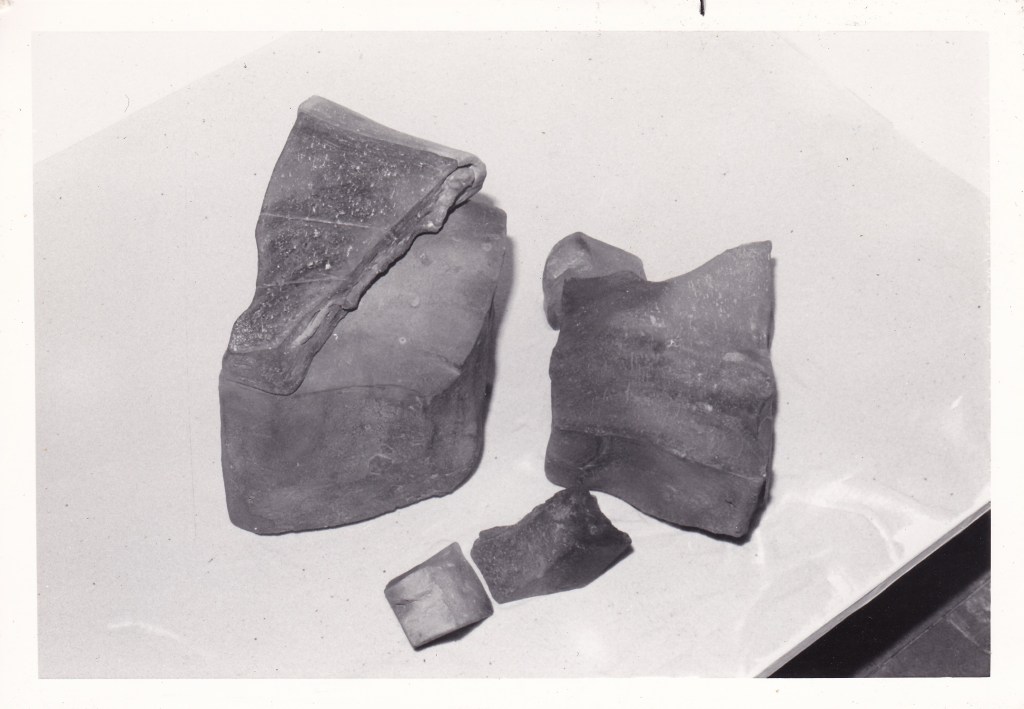
Pieces of a puzzle; sawdust fired 1978

The work I produced at college for my degree show was fired initially to bisque level and then finished in a sawdust kiln. We have no space here for a proper kiln but I’ve been exploring possibilities for sawdust firing; even firing ‘greenware’, that is without having put the pieces through the initial bisque firing. This will produce porous pots that are not ‘vitrified’ as they are when fired to higher temperatures, but some beautiful subtle effects can be obtained.

So with a few basic tools and a dining table, I’m off to a good start. I’m still going to continue to attend the studio sessions – apart from anything else it’s a lovely encouraging atmosphere and I enjoy the companionship and sense of shared experience. But it’s also great to be able to ‘sit and do’ at home – to make whatever I want to make – without time constraints or consideration of anything other than what I’m working on.

This brings me to Poetry/Pottery Rule No. 20: Enjoy the process.

Now that does sound like a plan – the housework may not get done, but these are pots that won’t need washing up!

A Bag of Clay

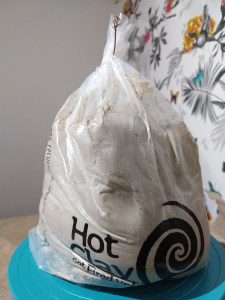
A bag of clay bought from ‘Hot Clay’ of Warrington

A bag of clay
some simple tools
it’s time to play
by my own rules

The place to start
is here and now
I’ll make some art
then take a bow

The bag of clay
is mine to mould
to use my way
until I’m old

Pinch, coil and fire
it will become
a bag of clay
in different form

Maggie ‘Glad the Poet/Potter’ Baker 2021

Clay

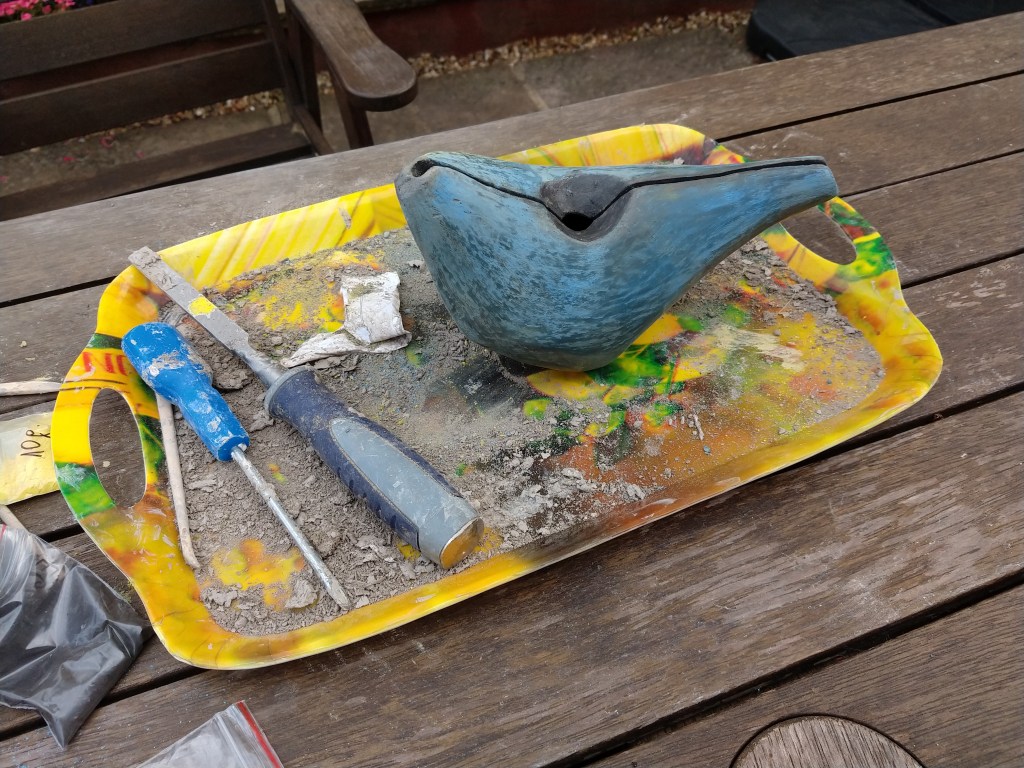
Today I sat outside turning a piece of clay from one form into another. It’s called ‘art’ and I love it.

I have limited tools and equipment at the moment, so improvised, and just became profoundly absorbed in the process of ‘doing’.

The end result may not be classed as a ‘masterpiece’, but it’s my ‘mixed up piece’, and that’s what counts.

I’m looking forward to spending many more happy hours making things out of clay. It’s a wonderful medium to work with, providing all sorts of possibilities to explore.

Poetry & Pottery: The Perfect Partnership

1978

1978 was not a good year, for me
even though I hold it dear

Try as I might I could not find the key
to unlock my brain
work out its mystery

Lurching this way and that
never finding a hold
I fell so many times
but got ever more bold

Crashing right down
I broke back to the core
then inched my way through
to daylight once more

The clay in my hand
is the life that I’ve led
I’ve cried, ached and screamed
and wished I was dead

But I never gave up
and I never gave in
I just kept on going
and drank lots of gin

Joking aside –
though I do like a drop –
I feel like I’ve won
I’ve come out on top

For I have love in my life
a treasure most true
I’m here and I’m now
simply human, through and through

© Maggie ‘Glad the Poet’ Baker 2021

1978 was the year I graduated with a degree in Ceramics from Bristol Polytechnic. 

I’d reached out to art in my teens as a way of asserting a direction, without knowing where that direction might take me. It was driven by some deep-rooted instinct; an instinct which for a long time I thought had failed me. But it hadn’t.

As it’s turned out, my life has taken many “twists and turns, and loops and leaps”, most of which have left me struggling to find a foothold. Finally, however, I feel I am on firm ground, and astonished to find myself turning back to working with clay, after a break of over 40 years.

What’s even more astonishing is that I’m not only loving working with the medium, I’ve got ideas coming into my head from goodness knows where. I’m not having to push myself just to produce something, anything, as I did when I was at college (although I was proud of what I did produce in the end; it was no easy feat, considering the complexity of mental health problems I was dealing with).

Art didn’t work as a therapy for me when I was younger; the damage went too deep and I had to find ways to dig it out – just like clay has to be dug out.  What I’ve got now is malleable and mouldable in whatever way I choose. I can be creative in any way or ways that suit me; working with clay or words; working with my life.

I hope my pots can be poetic; and that my poetry will continue to be potty.

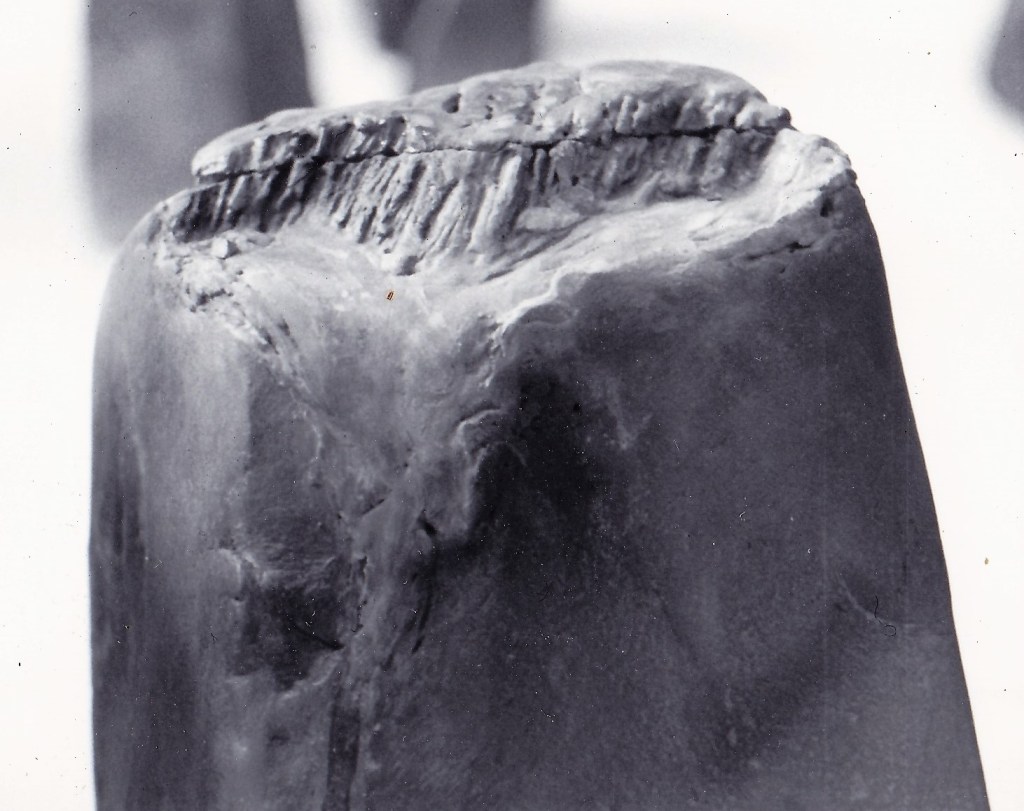
Solid and fluid at the same time. This one’s long gone; I’m making others now.