Day 15

Continuing the story of Lydia and Me

“She’s a beautiful soul.”

These were words spoken to me this morning when I picked Lydia up from the kennels where she’d been staying over the weekend.

I’ve always thought this myself, because she is.

We had a good walk together, before I took her home, and she’s enjoyed much of the day outside in the yard, in what is warm and rather windy weather.

After a two-week break I resumed my usual ‘Mental Health Monday’ activities this afternoon: yoga followed by Qigong.

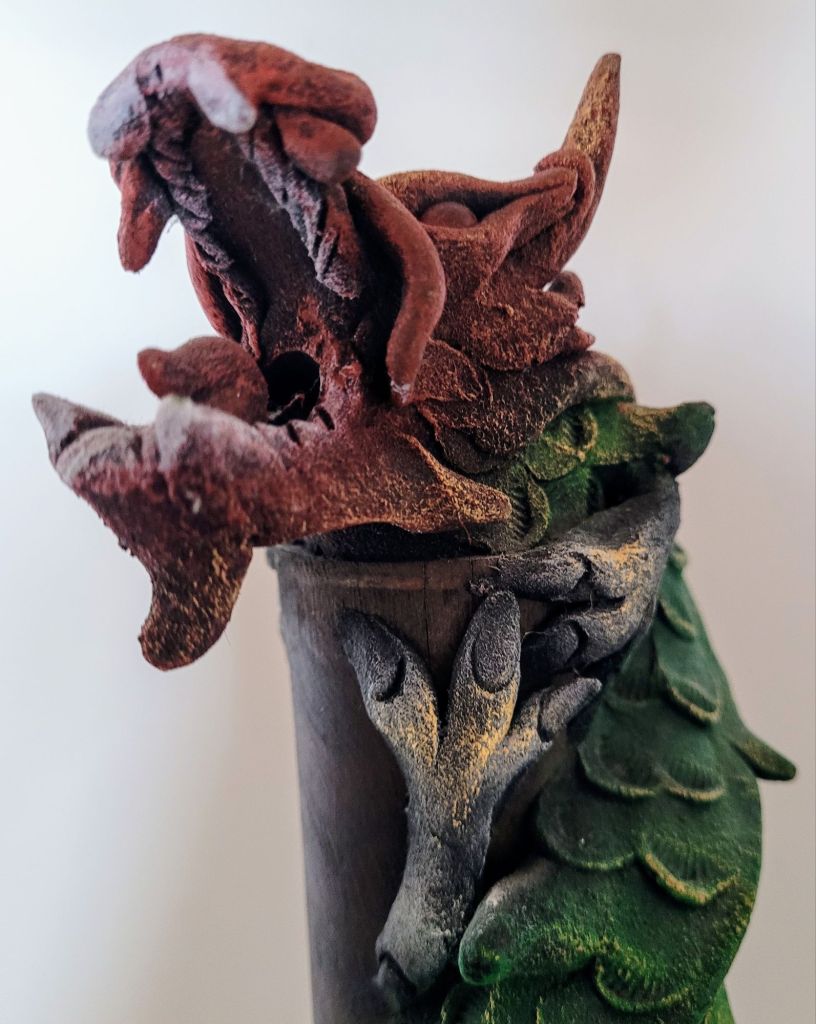
So, I’ve had two-and-a-half hours of concentrated activity for health and wellbeing with the added benefit – for brief periods – of being a tiger, a dog, a cat, a tree, a warrior and a dragon.

I don’t feel a need to compare and say which of these I’ve preferred being, but I did like the dragon movements.

I can now relax into a mellow evening knowing that I have given important attention to my musculoskeletal system as well as my mind and spirit. I think my girl with the beautiful soul is quite relaxed too; still in the back yard; still enjoying the warm and windy weather.

Day 5

Continuing the story of Lydia and Me

Lydia emerging from the tunnel at the dog field this morning.

How do we find solutions to problems if we don’t know the root cause?

The answer, of course, is “with great difficulty”.

In fact, if we don’t identify the root cause of a problem, we are only ever going to be treating the surrounding tissue, which may alleviate symptoms for a while, but does nothing for the longer term.

As I’ve continued my journey of recovery from mental health and emotional difficulties that got buried deep inside when I was a child, I’ve come to realise that I’ve still got a long way to go.

I’ll turn 70 at my next birthday. I am, in all aspects, in a better place than I’ve ever been in my life, but the process of healing continues, probably because it’s only just begun.

There are times now when I can physically feel the emotional and psychological pain – pain that was compacted down into the mould that was made for me when I was young – finally pushing out from the core of my bones and the pores of my body.

It’s only because I’ve finally been able to acknowledge the source and reach a point of acceptance, that I can sit with this pain, experience it, let it go.

It’s taken a lot of work, a lot of searching, a lot of learning, a lot of losing, a lot of loving, to arrive at this point.

And I do feel sadness, regret, an ache for what I haven’t had, that a lot of people take for granted or even don’t appreciate at all: family. My own family.

But I also know that I have been so, so lucky to have met the people that I’ve met, learned what I’ve learned, found what I’ve found.

As I write there is gentle music playing, the back door is open and Lydia is lying in one of her favourite places, just outside.

It’s a spot that is fairly cool in this summer weather and from which she has a good vantage point of her domain: our back yard.

She barks occasionally at potential invaders – mainly pigeons – but mostly just enjoys being there, as I am enjoying, being here.

I realise that somebody, or circumstances, could take that away from me. But for now, I’m just glad for what I have. It’s a lot.

Familiar Fields

First published 13 April 2020

Turning the corner, the familiar fields and shelters come into view.

Open outlook, clear and calm; this is the place where past harms are healed.

Friends, old and new, graze on at steady pace. It’s never too late for needs to be met
just a turn of fate.

The familiar fields and shelters will come into view again next year. The way ahead may not always be calm and clear, but we can always come back to this place, this sanctuary, and marvel at the donkeys, stroke the pony’s mane. It’s always different every year and every year, just wonderfully the same.

It’s around a year ago today that my friend, Rosemary, passed away. She was 49.

I wrote the above piece after we had been to visit an animal sanctuary in Norfolk. Rosemary had introduced me to the animal sanctuary because she had adopted a Shetland pony who lives there, Sampson.

I suggested we go and visit which we did, and revisited a few times more, before it got to the point where it was too much for Rosemary. She found it too tiring, she said, which it was. It was too tiring because she smoked heavily and was an alcoholic.

Rosemary had been diagnosed with schizophrenia in her early 20s.  While she never opened up much about her past or about anything emotional at all really – I was told in no uncertain terms to ‘leave it’ if I prompted her in any way – she did tell me once that the psychiatrist who diagnosed her told her that she would never work again.

That may well have been the case in the conventional sense of what constitutes ‘work’ in our society, but if it was unlikely that she would ever do regular paid work again, that prognosis could have been presented differently, to give Rosemary a sense of hope of having a fulfilling life, even if not the life that she would have been hoping for as a young woman in her 20s at that time.

In recent times there has been a lot of talk about mental health and a lot of awareness raising in the media, but when it fundamentally comes down to it, has anything significantly changed to ensure that people who have diagnoses of extreme forms of mental illness can find some way of identifying themselves with a meaningful role, a sense of positive purpose, in the world? I’m not convinced that it has. 

Some people are fortunate to be partners, wives, husbands, mothers, fathers, which can help to offset the stigma and isolation that accompanies their condition, but many – like Rosemary – do not.

Rosemary was not an easy person to get on with. She pushed people away, more often than not, and did make lifestyle choices – however hard and judgmental that sounds – that led to her limiting her own life in many ways.  But I have often wondered how different it would have been if, when given that diagnosis of schizophrenia all those years ago, she had been told about all the things that she could keep doing – and all the support that she would get in the process – to help her feel good about herself and her life, whatever form or path that took.

Having extra support at a critical time can make all the difference between us, on the one hand finding our own strength and resolve to come through with a sense of purpose and, on the other hand, wavering and floundering and – at best – just not drowning.

At times Rosemary pushed my patience to the limits and then some (and she knew it!), but I could only try and imagine what difficulties she went through every day. Somehow, through that diagnosis, and prognosis, and the position it placed her in, in the world, all her intelligence, her good memory, her dark sense of humour, her creativity, her kindness to animals and sense of fair play got devalued, not least by her.

Thank you for the friendship that we shared Rosemary.  For the times we spent at nature reserves and animal sanctuaries, the concerts we went to and the smile that you used to greet me with. 

I hope you are now flying high, with the birds.

Rules, Rhymes, Recovery, Recipe, Random – Glad About Life:
https://amzn.eu/d/6Ptwe4S

A Woman, a Dog & a Blog – Writing into Life:
https://amzn.eu/d/6Ho21L8


Teeth

Struggling as I have been with my own mental health for most of my life, I haven’t always been able to prioritise dental health.

In voluntary and paid roles supporting others with mental health difficulties, I’ve noticed that poor dental health care is a common problem. Published research supports this observation, for example ‘Oral health interventions for people living with mental disorders: protocol for a realist systemic review’, Kenny Dickson-Swift, Gussy et al, International Journal of Mental Health Systems 14, Article number: 24 (2020) https://doi.org/10.1186/s13033-020-00357-8.

After a major breakdown in my late thirties, I was able to regain and maintain sufficient mental health stability to work and function within society (with various blips and crises along the way) and have since retired. As part of the process of recovery that I went through, I managed to reconnect with regular dental check-ups and treatment.

Recently, though, I struck a stumbling block while going through a really tough patch mentally.

I hadn’t been able to get a check-up at the surgery I’m registered with for over 18 months. While many dentists are still struggling to catch up after Covid, the dentist that I’ve been going to have had an additional burden of backlog due to a fire on their premises. Though they’ve been able to set up satellite surgeries around the city I was advised that, if I wanted a check-up on the NHS, I should seek it elsewhere.

As I have moved out of the city to a neighbouring village, this made sense anyway, so I started ringing around. It was only then that I discovered there was little or no chance of being able to see an NHS dentist as a new patient within the next 2-3 years.

Apparently this is due to government funding, although I don’t know the details of how it works.

What I do know is that government mental health strategy is due to be updated (https://www.bacp.co.uk/news/news-from-bacp/2023/24-january-government-mental-health-strategy-update-announced/) with a claim that mental health will be included in an overall ‘major conditions’ strategy that will focus on ‘whole-person care’.

If that strategy is to be worth more than words on paper then it would do well to ensure prioritisation of funding that enables people who have recognised mental health disabilities to access NHS dental care. It would be one less enormous obstacle to climb for those who deserve a medal just for getting out of bed on a morning. And let’s face it, if you can’t even look forward to a cup of tea because it’s too painful to eat or drink anything, then what’s the point?

It’s taken me several months to be able to concentrate enough to work out how to tackle the presenting problem and then follow up and get myself booked in for an appointment. I’m fortunate in that I’ve been able to pay privately for a check-up (£59.00) and have been presented with a range of options to address my dental treatment needs that I can prioritise on – for me – an affordable basis (approximately £250.00). Basically I’m going to book in for a hygienist appointment to address some gum issues and also get an old crown taken off so that the dentist can explore what’s going on underneath and put a semi-permanent top dressing on. This should keep me going for another year or so at least and I’ve got myself down on a 3-year waiting list at a surgery closer to home.

Others who are less fortunate than me financially shouldn’t have to suffer and wait, compounding mental agony with dental agony.

For my part, when I do eventually emerge from my current ‘downer’, I’d like to be able to smile without worrying about the fact that I have gaps in my teeth.

Hard Core

Breaking big rocks into smaller rocks: the hard core approach to mental health recovery was the title of an article I wrote in 2013. It was published in a journal by the Royal College of Psychiatrists:

I was surprised, though, that there was no follow up from that. Nobody from the world of psychiatry or related fields sought to make further enquiry about the approach I was taking to rehabilitate myself back into a relatively healthy state of mind.

I think maybe it was because what I was doing seemed quite bizarre: undertaking hard physical labour involving a large sledge hammer and a lot of rocks. And yet the improvements I found in my mental well-being were significant, and lasted for several weeks after I returned to my day job, based in an office.

While I don’t believe that all aspects of my complex mental health needs would have been resolved by continuing to do rigorous physical endeavour all day, every day, the experience certainly had a part to play in my overall recovery.

And the principle of breaking things down into smaller chunks is one that I work with every day.

How else do you create hard core?

Poetry & Pottery: The Perfect Partnership

1978

1978 was not a good year, for me
even though I hold it dear

Try as I might I could not find the key
to unlock my brain
work out its mystery

Lurching this way and that
never finding a hold
I fell so many times
but got ever more bold

Crashing right down
I broke back to the core
then inched my way through
to daylight once more

The clay in my hand
is the life that I’ve led
I’ve cried, ached and screamed
and wished I was dead

But I never gave up
and I never gave in
I just kept on going
and drank lots of gin

Joking aside –
though I do like a drop –
I feel like I’ve won
I’ve come out on top

For I have love in my life
a treasure most true
I’m here and I’m now
simply human, through and through

© Maggie ‘Glad the Poet’ Baker 2021

1978 was the year I graduated with a degree in Ceramics from Bristol Polytechnic. 

I’d reached out to art in my teens as a way of asserting a direction, without knowing where that direction might take me. It was driven by some deep-rooted instinct; an instinct which for a long time I thought had failed me. But it hadn’t.

As it’s turned out, my life has taken many “twists and turns, and loops and leaps”, most of which have left me struggling to find a foothold. Finally, however, I feel I am on firm ground, and astonished to find myself turning back to working with clay, after a break of over 40 years.

What’s even more astonishing is that I’m not only loving working with the medium, I’ve got ideas coming into my head from goodness knows where. I’m not having to push myself just to produce something, anything, as I did when I was at college (although I was proud of what I did produce in the end; it was no easy feat, considering the complexity of mental health problems I was dealing with).

Art didn’t work as a therapy for me when I was younger; the damage went too deep and I had to find ways to dig it out – just like clay has to be dug out.  What I’ve got now is malleable and mouldable in whatever way I choose. I can be creative in any way or ways that suit me; working with clay or words; working with my life.

I hope my pots can be poetic; and that my poetry will continue to be potty.

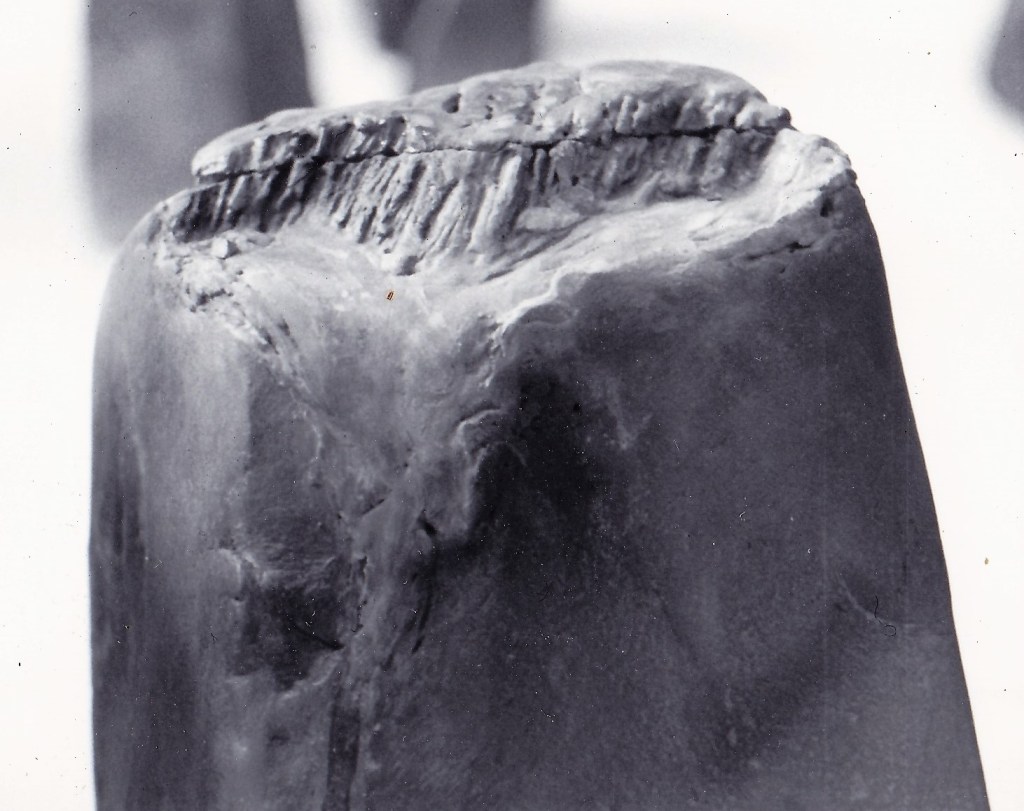
Solid and fluid at the same time. This one’s long gone; I’m making others now.