I’ve somehow arrived at the point in retirement where I have ‘Wellbeing Wednesdays’ in my non-working week.
After taking Lydia – our dog – for a walk – which I do every day, usually twice a day – I go to a yoga class. Then, at 1pm, I have a therapy session. In the evening, providing I’m not too tired (or relaxed) I go to a Buddhist class which includes two meditations as well as the teachings.
I usually sleep well on a Wednesday evening; another factor which contributes to wellbeing.
I do other things on other days, including a Qigong class on a Monday, and pottery/making things with clay when I feel like it. But Wednesday stands out as the day when three focused activities combine to contribute to a strong sense of wellbeing emerging.
“Flowing Form”, stoneware glazed with Teracolor ‘Tourmaline’
Forty five years ago I completed a degree in Ceramics. It wasn’t until a couple of years ago, though, that I started working with clay again.
The intervening years have been challenging, to say the least.
As a teenager with undiagnosed mental health difficulties including an eating disorder and depression, I struggled to get a foot hold on life and eventually came crashing down.
For the last thirty years I’ve largely been focused on getting back going again, pushing through, surviving.
A sense of well-being isn’t easy to establish or maintain when your mind and mood are volatile, like mine can be, always trying to pull me back to a pivotal point of trauma and grief that have been so hard to leave behind.
I do try to make the most of each day, and be thankful for what I’ve got – which is a lot – but when tiredness takes over from positive thinking, it can feel almost overwhelmingly bleak.
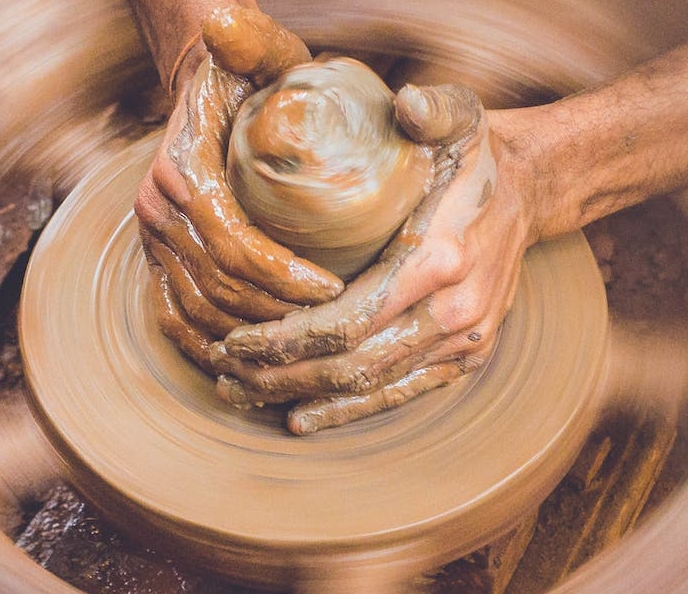
Sometimes it’s best to do nothing, rest into it and let it pass. I also find that, if I can get absorbed in making something with clay, I can start to come through the low mood to a brighter sense of self and life.
I have a table at home that I have set up with basic tools and materials, but I find it most uplifting when I go to a studio where I can spend a morning or an afternoon with others. We are all focused and industrious but there together, and it has a special kind of effect, which always leaves me feeling so much better at the end of a session than I felt when I got there.
It isn’t easy to pick up the pieces of your life and start again, but picking up a piece of clay is now a part of my ongoing journey of recovery and reclamation.
One of the fellow potters that I meet up with occasionally at the #pottermanstudio used to be an art therapist.
She told me that she no longer works as an art therapist because there is no basis of evidence that art is therapeutic.
I’d come to the same conclusion myself, although am also now going to contradict myself because I do believe that art can be therapeutic. It just depends on a lot of other factors such as context, timing and the weight of influences going on in a person’s life and head at any one time.
When I was an inpatient in a psychiatric hospital back in the 90s, I went along to art classes in the hope of finding them helpful, but they made me feel much worse.
I had a degree in art and design, but in those classes I was only able to produce work that most 6-year-olds would be embarrassed about. At least, that was how I felt at the time.
Subsequently and periodically I’ve gained some benefit from drawing – particularly life drawing – but I found more therapeutic benefit from smashing rocks with a sledge hammer when I worked as a volunteer on the Appalachian Trail #ATC. I’ve also found typing and other repetitive tasks – addressing and stuffing envelopes, for example – therapeutic, in different ways.
When I worked at a small publishing unit – part of the #Longman publishing group – we used to send marketing mailshot work to the same psychiatric hospital that I stayed in myself a few years later. The stuffing of envelopes with marketing materials was deemed to be therapeutic for some of the patients, and, based on my own experience, I believe it probably was.
It isn’t just the stuffing of the envelopes – or whatever simple repetitive task it is that you are doing – it’s also the experience that you have while doing it. Stuffing envelopes alone is highly unlikely to be particularly therapeutic – although it may pay bills if you’re doing it to earn money – but in a supportive group environment it can be very calming.
I set something similar up in a Buddhist community that I stayed at for a while, after my breakdown, helping to raise funds for the community. We sat around a table in the Temple and it was very meditative, for a while at least.
When you’ve got a lot of inner turbulence going on, it’s hard to find something – anything – to settle on for any length of time. It’s important to keep looking for and finding whatever it is that gets you through, until the next time you have to start looking for and finding whatever it is that gets you through.
This brings me to one of my ‘Rules for Self Management’ that I haven’t referred to for a while:
Rule No. 5: Don’t underestimate the therapeutic value of envelope stuffing (but don’t overestimate it either).
I’m glad I’m no longer envelope stuffing – either therapeutically or for a living – and am happy to be steadily working with clay in a creative way. This is therapeutic for me now, but it wasn’t before. A lot of other work needed to be done before it could be.
1978 was the year I graduated with a degree in Ceramics from Bristol Polytechnic.
I’d reached out to art in my teens as a way of asserting a direction, without knowing where that direction might take me. It was driven by some deep-rooted instinct; an instinct which for a long time I thought had failed me. But it hadn’t.
As it’s turned out, my life has taken many “twists and turns, and loops and leaps”, most of which have left me struggling to find a foothold. Finally, however, I feel I am on firm ground, and astonished to find myself turning back to working with clay, after a break of over 40 years.
What’s even more astonishing is that I’m not only loving working with the medium, I’ve got ideas coming into my head from goodness knows where. I’m not having to push myself just to produce something, anything, as I did when I was at college (although I was proud of what I did produce in the end; it was no easy feat, considering the complexity of mental health problems I was dealing with).
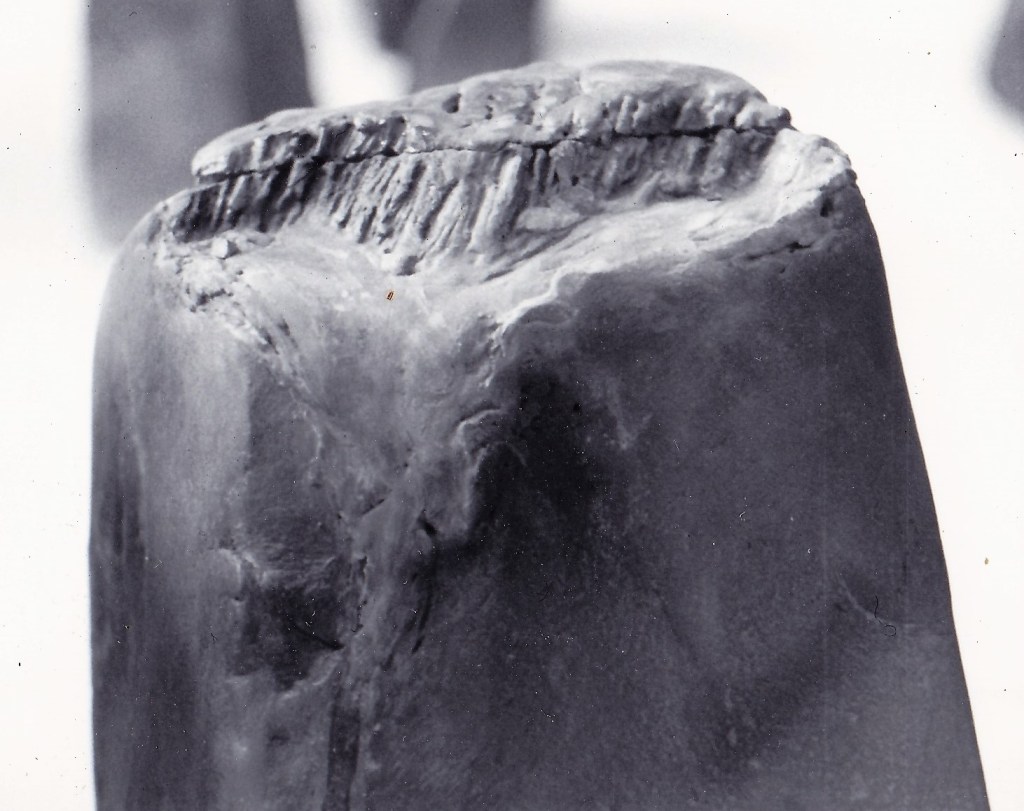
Art didn’t work as a therapy for me when I was younger; the damage went too deep and I had to find ways to dig it out – just like clay has to be dug out. What I’ve got now is malleable and mouldable in whatever way I choose. I can be creative in any way or ways that suit me; working with clay or words; working with my life.
I hope my pots can be poetic; and that my poetry will continue to be potty.
Solid and fluid at the same time. This one’s long gone; I’m making others now.


 Glad About
You must be logged in to post a comment.